Berthellina edwardsii
A soft-bodied orange sea slug logged across the Bay of Biscay and Cantabrian Coast, in water from 15.7 to 21.7 C, most sites report it as uncommon.
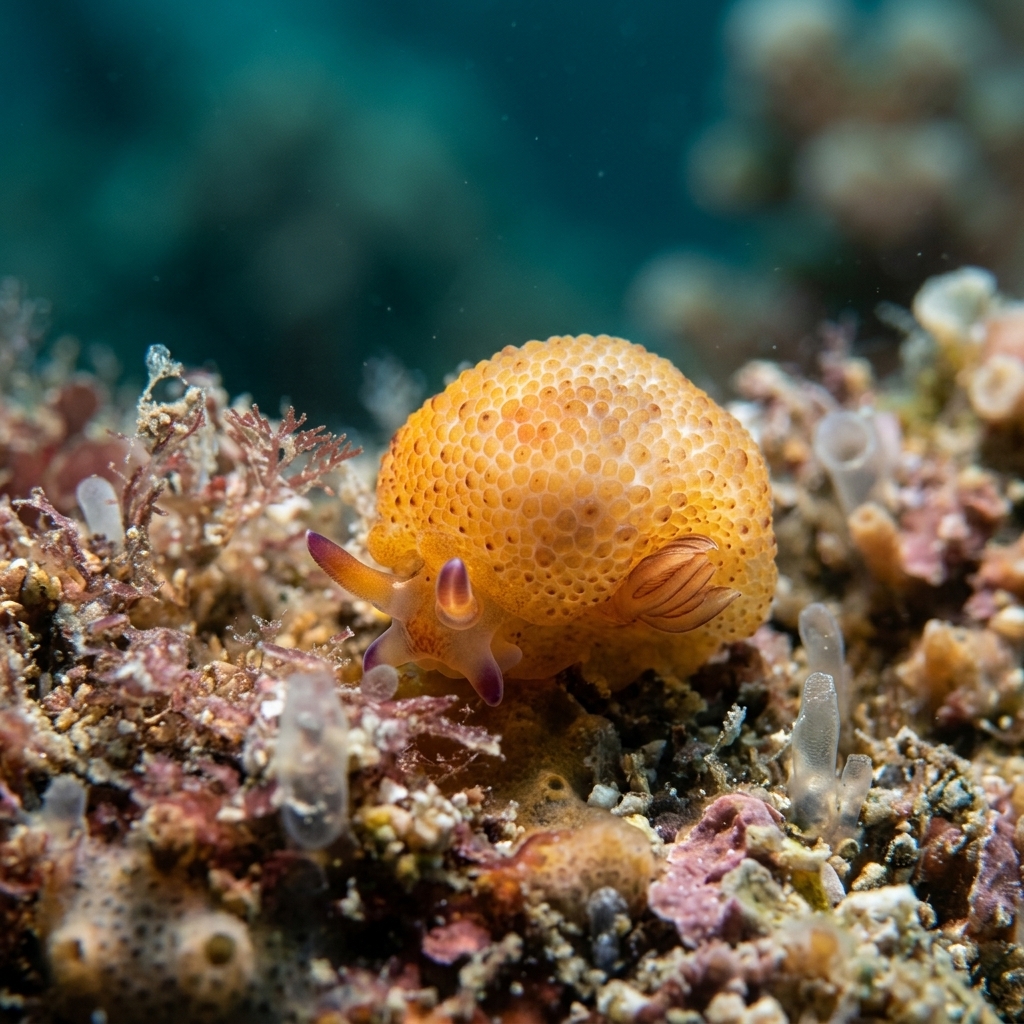
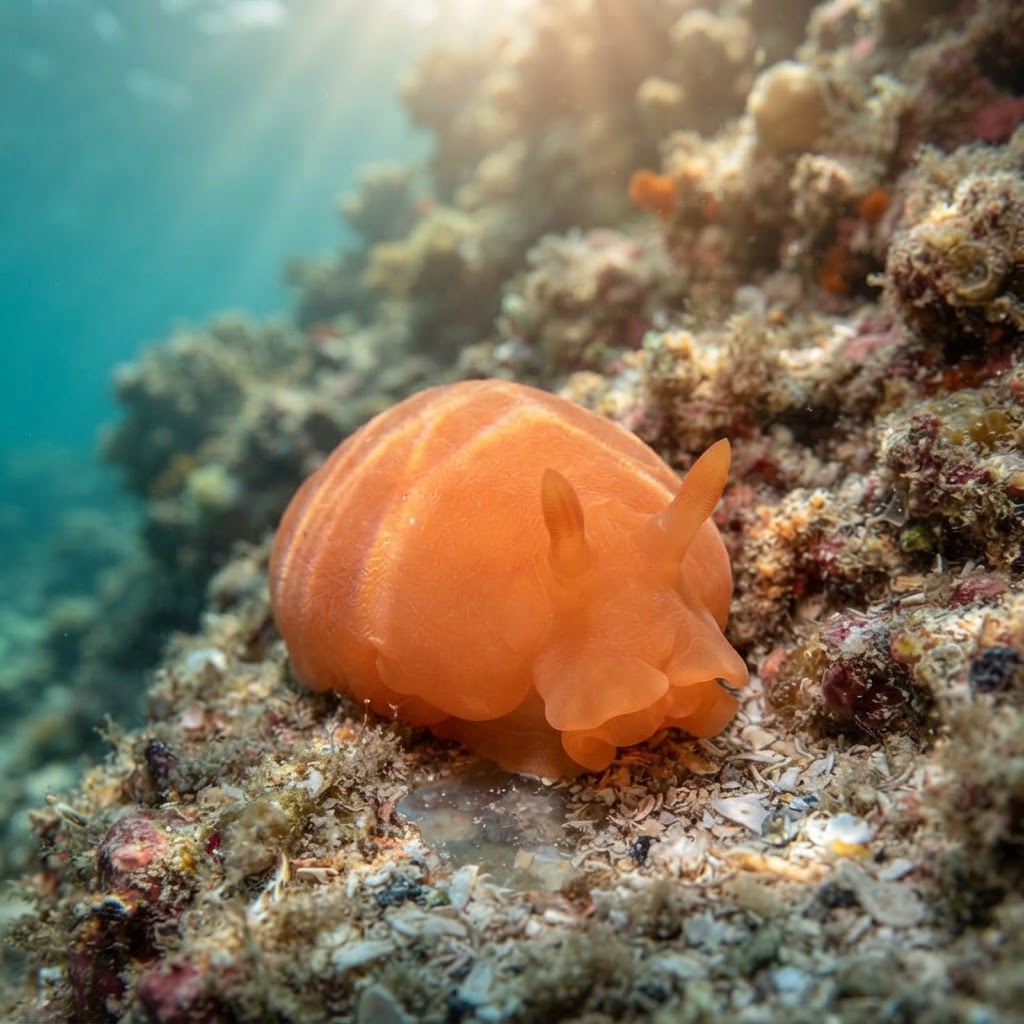
Look for a smooth, unribbed body in shades of peach, orange or salmon pink, with no obvious gills or projections rising off the back like true nudibranchs show. The mantle covers the foot almost completely, giving it a rounded, slug-like profile rather than a frilly one. It moves slowly over rock and rubble, and its plain colouring with no spots or lines is the main clue that separates it from the more decorated nudibranchs divers usually photograph.
Divers find it parked on rock, under ledges or tucked into crevices during the day, moving at the unhurried pace typical of benthic (bottom-dwelling) sea slugs. It shows no reaction to divers beyond a slow retreat if directly disturbed, and it is usually spotted while reef-hooking or macro-hunting rather than swimming in open water.
Its plain, unadorned mantle is actually a useful diagnostic in itself: most divers expect nudibranchs to be strikingly patterned, so a smooth peach-coloured slug with no obvious markings is often this species by default.
Sighting records show no clear seasonal pattern, so treat it as a year-round find in the 15.7 to 21.7 C range these sites sit in. That temperature band covers most of the diving season in the Bay of Biscay and Cantabrian Coast, so there is no need to time a trip around a bloom or migration.
France is the strongest bet, especially the Bay of Biscay and the French Riviera and Provence coast, with Spain's Cantabrian Coast close behind as a reliable region. Portugal's Algarve and the Azores, particularly Terceira, Graciosa and the Faial and Sao Jorge area, also produce regular sightings, making this largely a cool-temperate Atlantic and northeast Spanish/French Mediterranean species.
Mapping where Peach Seaslug is logged…
Most records come from France, particularly the Bay of Biscay and the French Riviera and Provence coast, with Spain's Cantabrian Coast also a strong region. Portugal's Algarve and parts of the Azores, including Terceira, Graciosa, Faial and Sao Jorge, round out the known range.
There is no detected season, so sightings happen year-round wherever water temperature sits in its 15.7 to 21.7 C comfort range. In the Bay of Biscay and Cantabrian Coast that covers most of the normal diving calendar.
Check for a smooth, rounded, unribbed body in peach or orange tones with no gill plume or obvious back markings. It moves slowly across rock and rubble and lacks the bold patterns typical of many nudibranchs, which is itself a useful identification clue.
Exact size data is not available for this species, but it sits in the small to medium range typical of pleurobranch sea slugs found on rocky reef.
No, it poses no danger to divers. It is a slow-moving, harmless bottom dweller that can be observed and photographed safely at close range without disturbing it.
Site and sighting data is aggregated from diver logs, iNaturalist and GBIF. For taxonomy and conservation status:
Blue Dragon
3,163 sites