Abudefduf troschelii
Spot the Panamic Sergeant Major in Baja California and the Galápagos. Bold stripes, curious behaviour, and peak sightings from November to April.
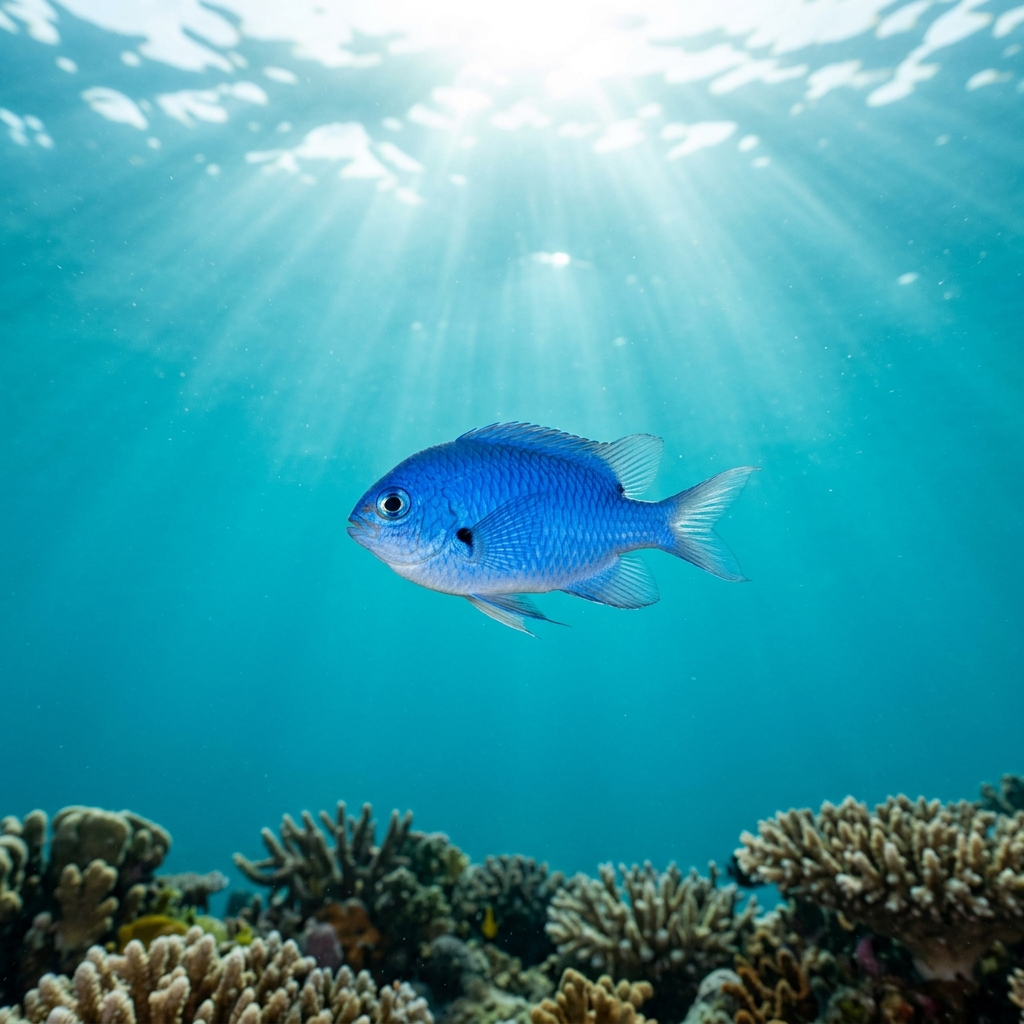
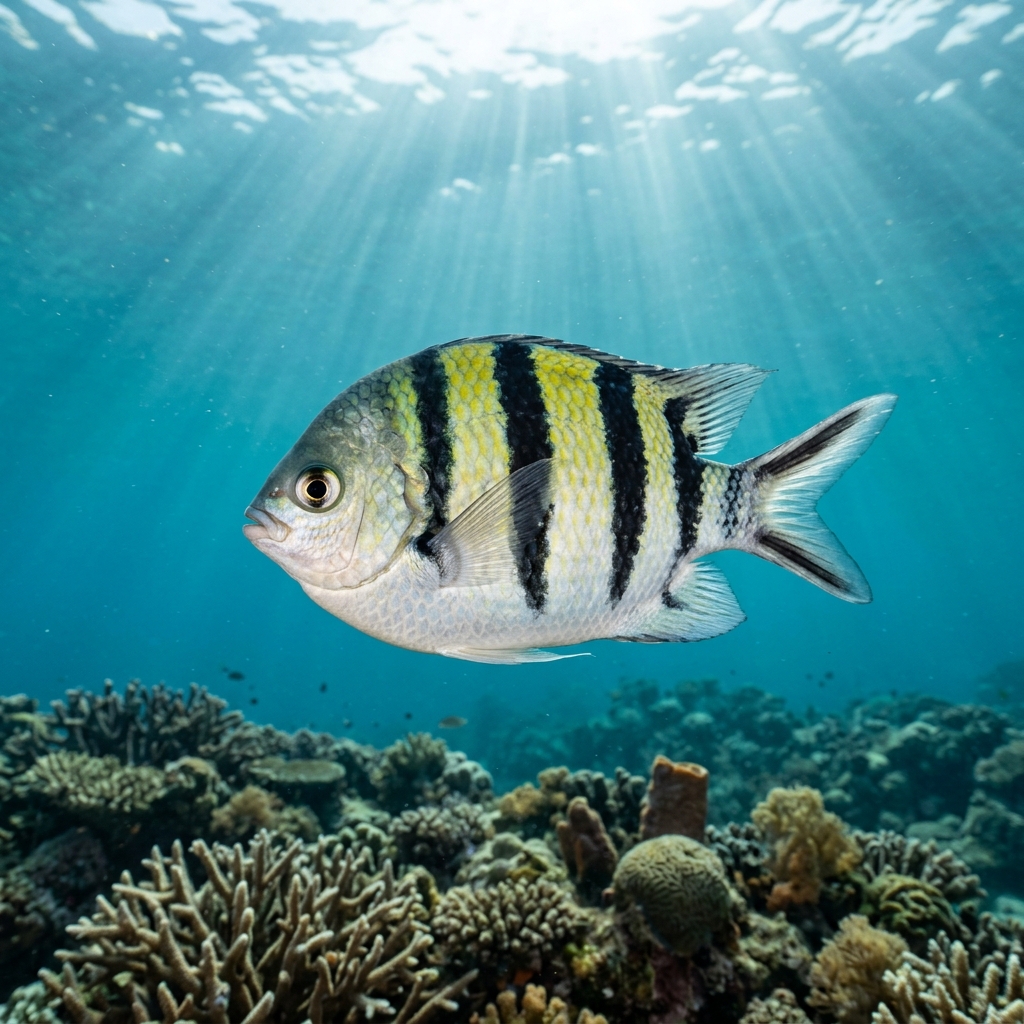
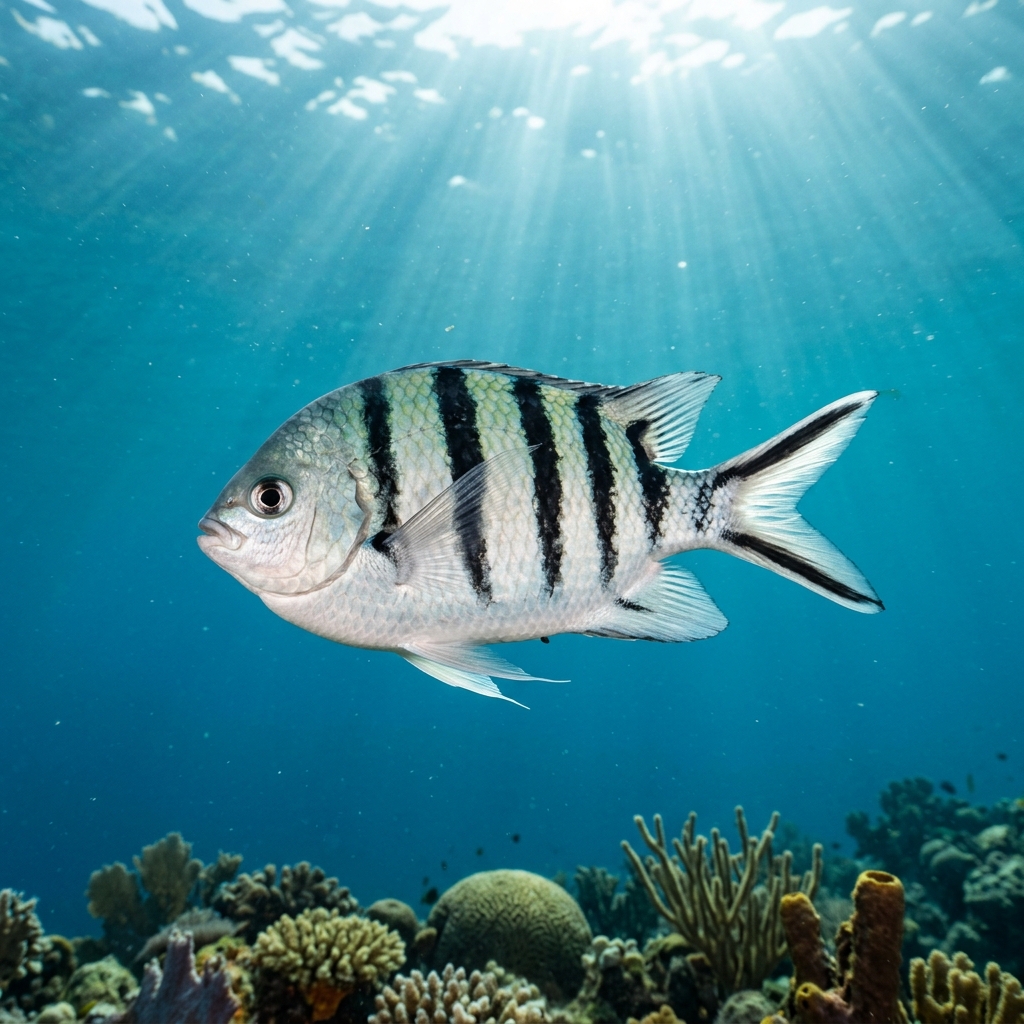
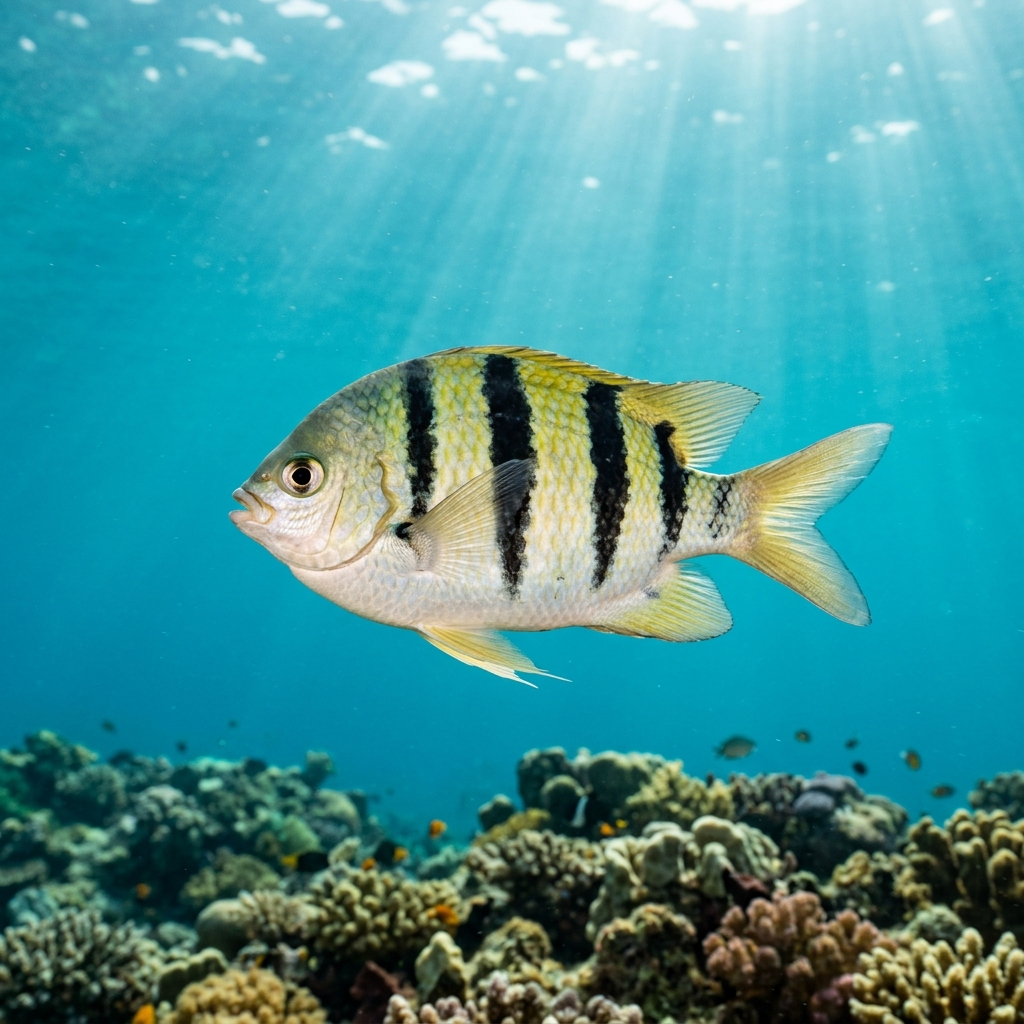
Five bold, evenly spaced black vertical bars on a pale yellowish-white body make this fish one of the easiest damsels to pick out on a shallow reef. At around 14 cm it sits comfortably in the palm of your hand, with a compact, oval profile typical of the damselfish family. Breeding males are the one curveball: they shift to a noticeably darker blue-grey overall, which can briefly throw off an ID if you are not expecting it.
You will almost always find them active during daylight, moving in loose aggregations over rocky and coral reef structure between 1 and 12 metres, where they forage constantly on algae, plankton, and small invertebrates. They tend to be curious rather than skittish, and individuals will frequently swim towards you to investigate, especially if you are moving sediment. During nesting, however, the male guarding a clutch of eggs becomes noticeably bolder and will repeatedly charge at anything that gets too close, including a diver's mask.
Nesting males actively fan their egg clutches with their fins and aggressively defend them around the clock, a level of parental investment rarely seen in reef fish this small. If you spot a darker blue-grey individual repeatedly returning to one patch of bare rock, you are almost certainly watching a male on guard duty.
In the Northern Hemisphere, sightings concentrate from November through April, so the winter and spring months are your best window across Mexico, Costa Rica, and Panama. Southern Hemisphere sites such as the Galápagos see sightings peak from January to May, which conveniently overlaps with that same window.
Mexico dominates the records, with the strongest concentrations in Baja California and along the Pacific Coast, making spots like the Sea of Cortez a reliable bet. The Galápagos Islands in Ecuador and the Papagayo Gulf in Costa Rica are also consistently well-logged, and Coiba National Park in Panama rounds out the core range. Peru and Colombia hold smaller but real populations for divers travelling those coastlines.
Mapping where Panamic Sergeant Major is logged…
The species is most commonly logged along Mexico's Pacific coast and Baja California peninsula, in the Galápagos Islands of Ecuador, and in Costa Rica's Papagayo Gulf and Isla del Caño. Coiba National Park in Panama and various sites in Peru and Colombia also hold real populations.
For most of the range in Mexico, Costa Rica, and Panama, November through April is the peak window. In the Galápagos, sightings are strongest from January to May. Water temperatures across observed sites run from roughly 22 to 29 °C, so cooler upwelling conditions during these months are well within their comfort zone.
Look for five evenly spaced black vertical bars on a pale yellowish-white body, roughly 14 cm long with a compact oval shape. The pattern is bold enough to read from several metres away. The only wrinkle is nesting males, which turn a distinctly darker blue-grey but still show the barred pattern on closer inspection.
They typically reach around 14 cm in length, roughly the size of your palm. That compact size makes them easy to overlook individually, but they are often seen in loose schools that draw the eye.
They are not dangerous, but nesting males will charge repeatedly at divers who get too close to an egg clutch. It is more of a bold bluff than a real threat, though giving the nest a bit of space is good practice and lets you watch the behaviour without disrupting it.
Males choose a patch of bare rock, coax females to lay eggs there, and then guard and fan the clutch continuously until hatching. During this period the male changes colour to a darker blue-grey, making him look like a different fish. He will defend the nest against rivals, larger predators, and curious divers alike.
Site and sighting data is aggregated from diver logs, iNaturalist and GBIF. For taxonomy and conservation status:
Dascyllus
3,697 sites