
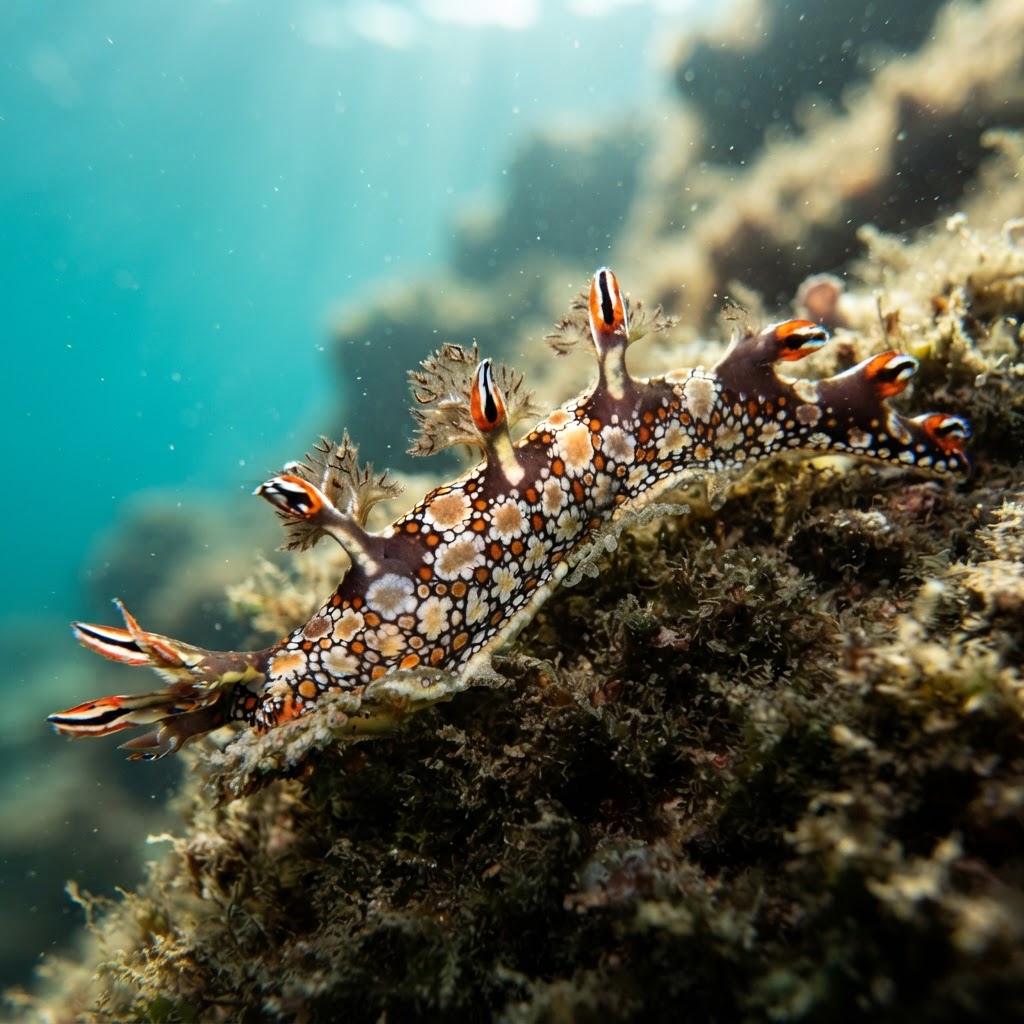
Bornella anguilla
Uncommon but reliable in Okinawa and Queensland reefs, this frilly nudibranch shows up year-round in 24-30C water.
A slender, elongated nudibranch that rarely tops 5 cm, with rows of branching, finger-like projections (cerata) running down its back that give it a frilly, almost feathered outline. Colouration typically shows translucent to pale body tones with orange or reddish tips on the cerata, creating a striped or paisley-like pattern that divers key on. Look closely at the head for a pair of rhinophores (sensory tentacles) that stand up like small horns, a helpful confirming detail once you've spotted the cerata pattern.
Divers usually find this one crawling slowly across rubble, sponge, or algae-covered substrate rather than swimming, since like most nudibranchs it relies on a muscular foot rather than open-water movement. It shows no reaction to divers beyond withdrawing its cerata slightly if touched, and it's most often spotted by divers doing slow, close-focus muck or macro dives rather than casual reef cruising. Because it's logged as uncommon to rare at most sites, finding one usually takes deliberate searching along the substrate rather than luck on a drift dive.
Those branching cerata aren't just decorative: many bornellid nudibranchs can detach or shed them defensively, and some species store stinging cells scavenged from prey inside them as a borrowed defence.
Sightings show no detectable seasonal pattern, and the water-temperature range logged (23.7 to 29.7C) spans most of the year on the reefs where it's found, so it's reasonable to treat this as a year-round find rather than a seasonal target.
Most reliably logged in Okinawa and the Ryukyu Islands in Japan, and across Queensland and Western Australia, which together account for the bulk of sightings. Smaller but consistent numbers turn up in Taiwan's Xiaoliuqiu, the Visayas in the Philippines, Saipan in the Northern Mariana Islands, and Milne Bay in Papua New Guinea, with occasional finds in Singapore's Southern Islands and Indonesia.
Mapping where Paisley Eeldragon is logged…
The strongest sightings come from Okinawa and the Ryukyu Islands in Japan and from Queensland and Western Australia. Smaller populations are logged in Taiwan, the Philippines, Saipan, and Papua New Guinea's Milne Bay.
There's no clear seasonal pattern in the sighting data, and it's been logged across a wide temperature range from about 24 to 30C, so it's best treated as a year-round find on the reefs where it occurs.
Look for a small, elongated nudibranch under 5 cm with branching, frilly cerata running along its back, often tipped in orange or red against a pale body. It moves slowly across rubble or sponge rather than swimming.
They stay small, typically reaching around 5 cm in length, which is why divers often overlook them unless doing a close, slow macro search.
Its branching cerata can act as a defensive feature, and like related bornellid nudibranchs it may repurpose stinging cells from prey it has eaten as a borrowed defence against predators.
Site and sighting data is aggregated from diver logs, iNaturalist and GBIF. For taxonomy and conservation status:
Light-spotted Aegires
3,168 sites





