
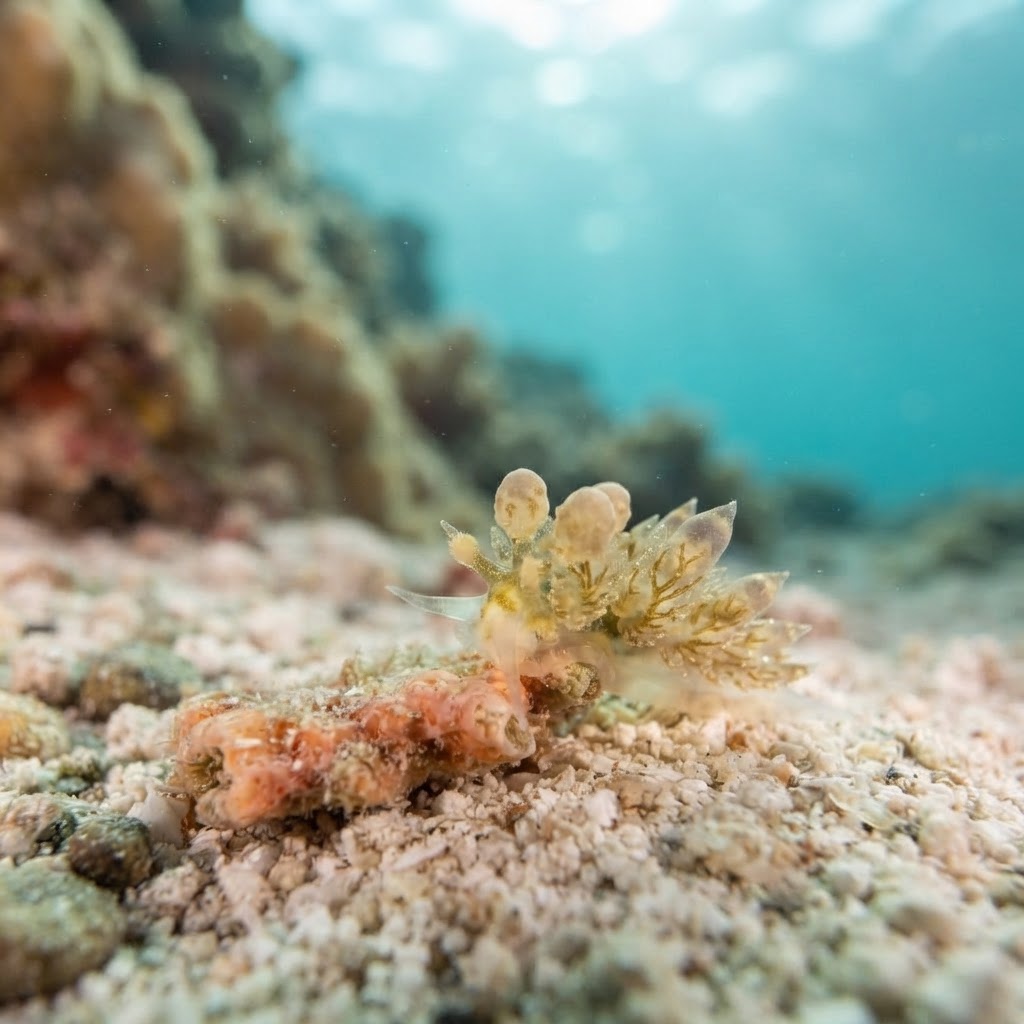
Dirona picta
A rare, translucent nudibranch turning up in California's cool waters (12-19°C), most often around Pacific Northwest and Californian dive sites.
A tiny slug at only about 2cm, its body is translucent to pale, letting internal organs show faintly through the skin. The giveaway is the row of soft, finger-like projections (cerata) along its back, each tipped in vivid orange or pink. Look closely along kelp holdfasts and rocky rubble rather than open sand, since it is easy to miss at this scale.
Divers find it moving slowly over rock and rubble, usually while doing a careful macro search rather than stumbling on it mid-dive, since most logs describe it as rare to uncommon. It shows no reaction to divers beyond its normal slow grazing pace, and its pale, see-through body means it is often spotted only when the orange cerata tips catch a torch beam. Best looked for tucked among algae-covered rock rather than in open water.
Like other dironid nudibranchs, it likely stores stinging cells from the hydroids and other prey it feeds on inside those orange-tipped cerata, turning its meals into its own defence.
Sightings are spread through the year with no clear seasonal peak in the data, consistent with a species tolerant of a fairly wide cool-water range (12.3 to 18.9°C). Treat it as a year-round possibility on California and Pacific Northwest dives rather than a seasonal target.
Logged almost exclusively along the United States west coast, with California carrying the vast majority of sightings and a smaller presence in the Pacific Northwest. Within California it turns up across a spread of sites rather than clustering at one famous spot, so it rewards divers doing slow, close-focus muck-style dives on temperate reefs.
Mapping where Painted Dirona is logged…
Nearly all logged sightings come from the United States, with California by far the strongest region and a handful of records from the Pacific Northwest. It is a species for divers specifically searching temperate California reefs rather than tropical destinations.
There is no detected seasonal pattern, so it is considered a year-round find in the 12 to 19°C waters it favours. Any month diving California's coast gives you a shot at it.
Look for a translucent, pale body only about 2cm long with a line of soft cerata along its back tipped in bright orange or pink. It sits on rock and rubble rather than open sand, and its small size means a slow, close look is usually needed to spot it.
It stays small, reaching around 2cm as an adult, making it one of the more overlooked nudibranchs on a reef unless you are searching closely.
At most sites where it has been logged, divers rate it rare to uncommon, with only a few sites reporting it as common. It rewards patient macro-focused divers more than casual reef scans.
Site and sighting data is aggregated from diver logs, iNaturalist and GBIF. For taxonomy and conservation status:
Light-spotted Aegires
3,168 sites





