Ancula pacifica
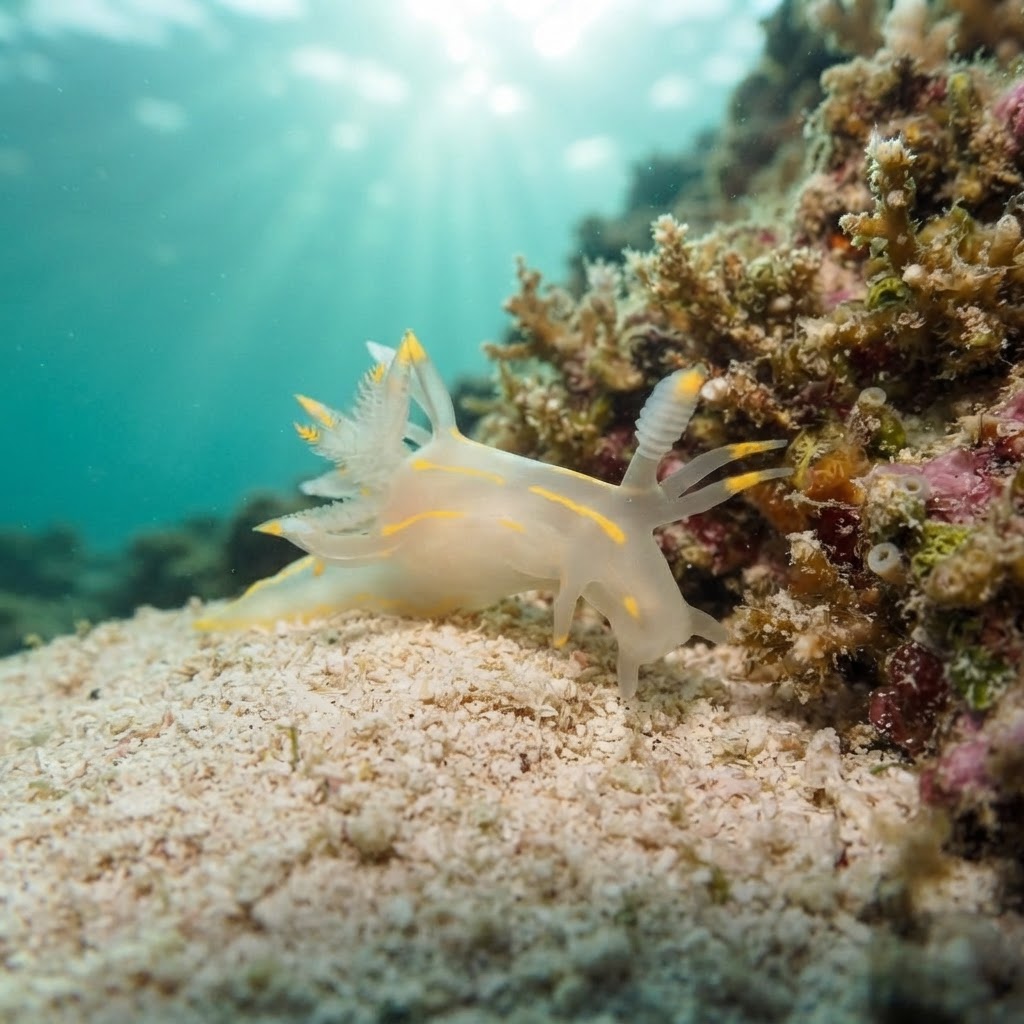
A small white nudibranch with orange-tipped gills, logged off California in water as cool as 12 to 19C.
A small, slender nudibranch with a translucent white to pale yellow body, easy to overlook against rock and algae. The giveaway is the row of finger-like projections (cerata) along its back and the feathery gill cluster near the tail, both tipped in vivid orange or yellow. Antennae-like structures on the head (rhinophores) carry the same orange tips, giving the whole animal a dotted, sparkler-like outline against duller substrate.
Look for it creeping slowly over rock, algae and hard structure rather than swimming, since like other nudibranchs it relies on a muscular foot to glide across the substrate. Divers report it as an uncommon find at some sites and a reliably common one at others, so a slow, close look along ledges and crevices pays off more than a quick reef scan. It shows no reaction to divers beyond continuing its unhurried grazing, making it an easy subject for macro photography once spotted.
Like other dorid nudibranchs, its orange-tipped cerata and gills likely serve as a warning display, since many species in this group store or produce chemical defences that make them unpalatable to predators.
There is not enough seasonal data yet to call out a peak window, so treat sightings as possible year-round on cooler Californian reefs. Its comfort range of roughly 12 to 19C lines up with conditions found through most of the diving calendar in the region rather than a narrow warm-water season.
Every logged sighting for this species so far comes from California, in the United States, making it the only real bet on the map right now. Divers have found it at sites cool enough to sit in the 12 to 19C range typical of Californian kelp forest and rocky reef diving.
Mapping where Pacific Ancula is logged…
So far it has only been logged in California, in the United States, so that is the region to target if you want to find one on a dive.
There is no clear seasonal pattern in the sightings logged so far, so it is best treated as a year-round find on Californian rocky reefs within its 12 to 19C comfort range.
Look for a small, translucent white to pale yellow nudibranch with orange-tipped cerata along its back and orange-tipped gills and rhinophores near the head and tail. It moves slowly over rock and algae rather than swimming.
Exact size data is not available, but like most species in the goniodorididae family it is a small nudibranch typically measured in centimetres rather than tens of centimetres.
No, this species poses no danger to divers. It is a small, slow-moving nudibranch that can be observed and photographed safely at close range.
Its bright orange-tipped cerata and gills likely act as a warning signal, a common defence strategy among dorid nudibranchs that carry distasteful or toxic compounds picked up from their diet.
Site and sighting data is aggregated from diver logs, iNaturalist and GBIF. For taxonomy and conservation status:
Blue Dragon
3,163 sites