Austraeolis ornata
A 2cm nudibranch most reliably found off Western Australia and Victoria, in water from 15 to 25C, year-round if you look closely.
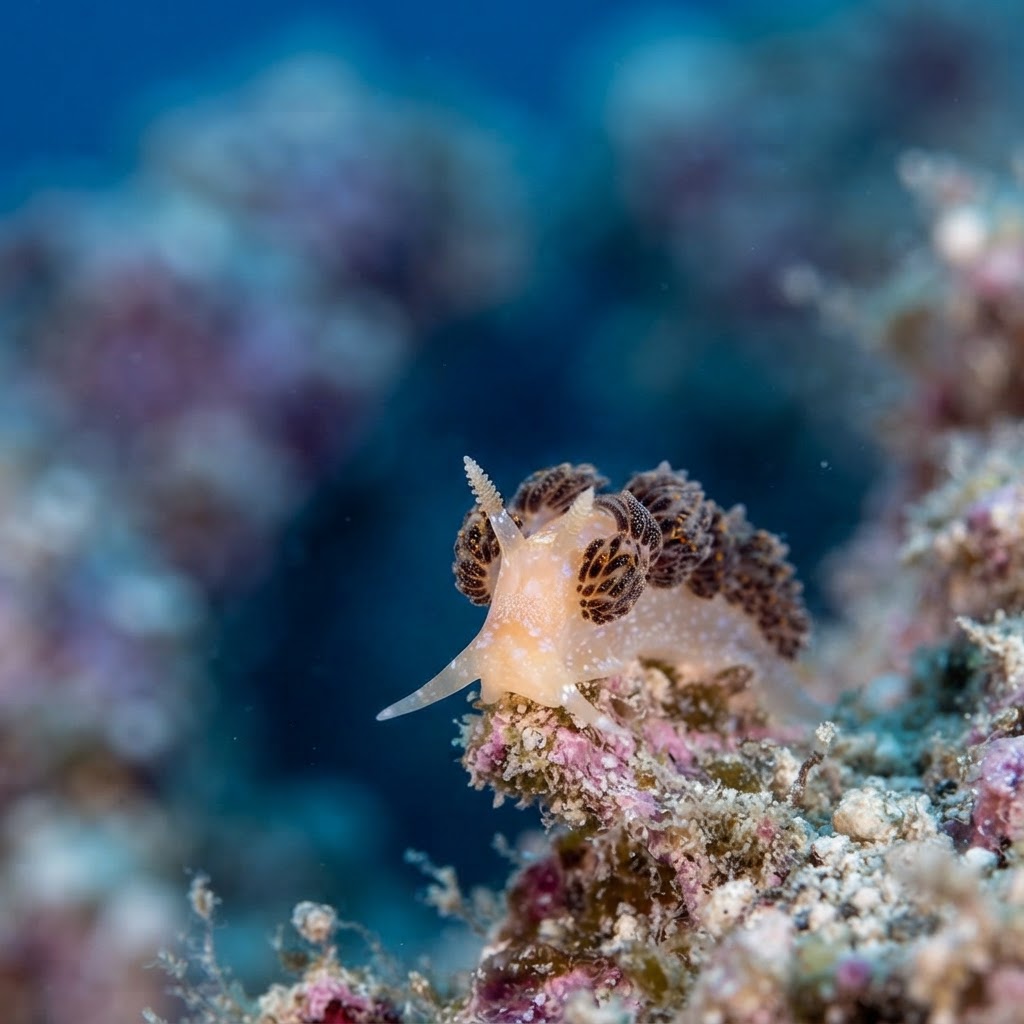
A tiny slug, rarely more than 2cm long, so you're hunting for it rather than spotting it from a distance. Look for the rows of slender finger-like projections (cerata) running down its back, often tipped in orange or bright colour against a pale or translucent body. The head end carries a pair of curled sensory tentacles (rhinophores), which is a good place to focus your torch or macro lens when scanning rubble and algae.
Divers find it slow-moving over rubble, algae mats, and low reef structure, doing what nudibranchs do: grazing rather than swimming off when approached. It shows no reaction to divers beyond retracting its sensory tentacles if bumped, so a steady hand and a macro lens are all you need to get a good look. Most sightings come from divers doing slow, deliberate reef and rubble searches rather than mid-water cruising.
Like other aeolid nudibranchs, it likely stores stinging cells from the hydroids it feeds on in the tips of those back cerata, turning its own food source into a passive defence.
No clear seasonal pattern shows up in the data, so treat it as a year-round find on the sites where it occurs. Its observed range of roughly 15 to 25C spans Australia's cooler southern waters and warmer subtropical stretches, which likely explains why sightings aren't locked to one season.
Australia is where this one turns up, with Western Australia the most productive area logged, followed by Victoria, Queensland, and New South Wales. Divers doing temperate and cool-water sites along these coasts have the best shot, though even there it's a species you have to search out among rubble and weed rather than expect to see cruising open reef.
Mapping where Ornate Facelinid is logged…
Australia is the only place it's reliably logged, with Western Australia the strongest area, followed by Victoria, Queensland, and New South Wales.
There's no detected season, so it's a year-round possibility on the sites where it's known. It's been logged across a wide temperature range, from about 15 to 25C.
Look for a slug under 2cm with rows of slender cerata along its back, often coloured at the tips, and a pair of curled rhinophores on the head. It moves slowly over rubble and algae rather than swimming.
Around 2cm at full size, so it's a macro subject best hunted with a torch and a close-focus lens rather than spotted at a glance.
Site and sighting data is aggregated from diver logs, iNaturalist and GBIF. For taxonomy and conservation status:
Light-spotted Aegires
3,168 sites