Gymnodoris impudica
A rare nudibranch find on Malaysia's east coast and the UAE, this pale slug with orange tubercles turns up on warm reefs year-round.
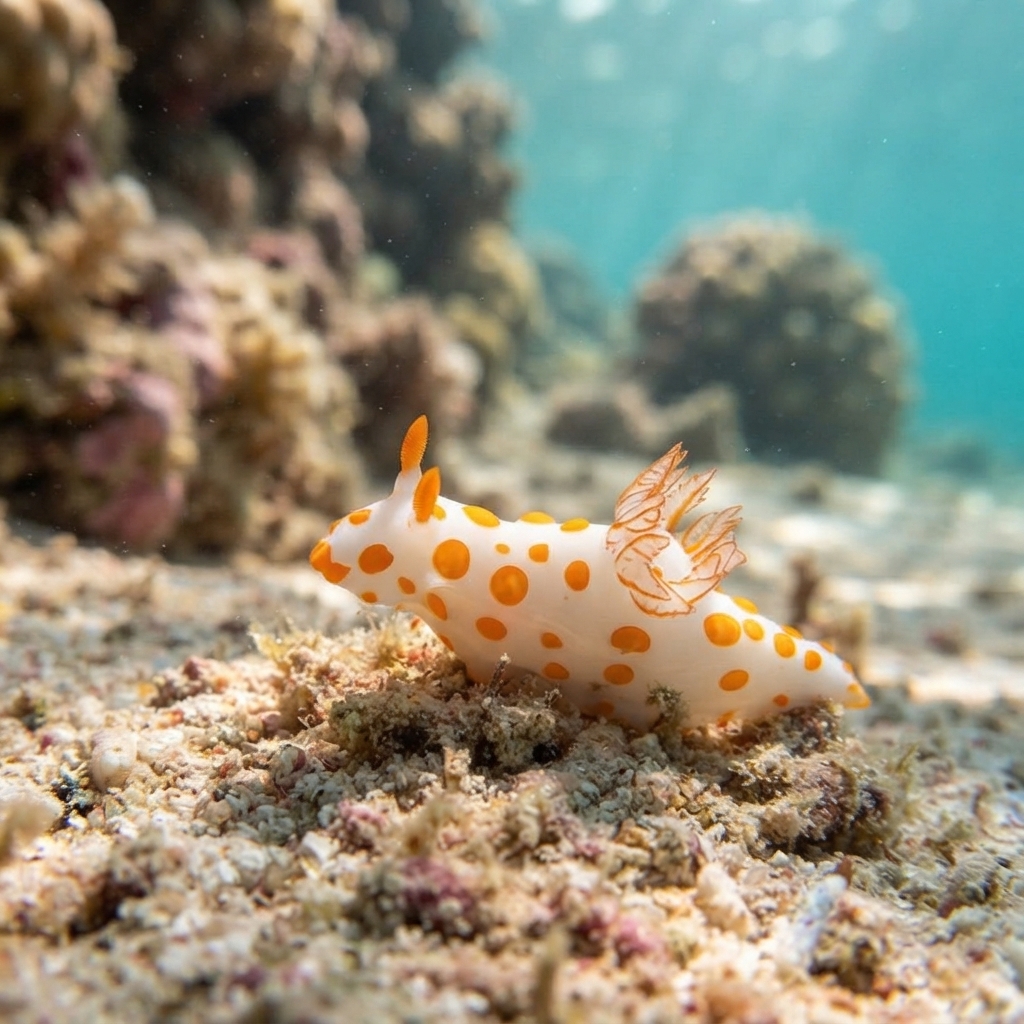
Small, elongated nudibranch with a pale, semi-translucent body scattered with distinctive orange-tipped bumps (tubercles) along its back. Look for the smooth, slug-like profile typical of dorids, with the orange spots standing out sharply against the lighter body colour as your torch beam hits it. It moves slowly across rubble and reef surfaces, so it is usually spotted while stationary or grazing rather than mid-swim.
Divers most often find it moving slowly over reef rubble or hard substrate, tucked into cracks or grazing in a way that keeps it in one small patch of reef for a while. It shows no reaction to divers and simply carries on at its own pace, making it an easy subject for a macro lens once you have located it. Most reports describe it as an occasional find rather than something you stumble across on every dive, so patient scanning of the substrate pays off.
It belongs to the Polyceridae family, many of which prey on other sea slugs and their eggs rather than sponges or hydroids, so any sighting is a clue there are other nudibranchs nearby.
Sightings are logged across the year with no clear seasonal spike, consistent with a species comfortable in the 25.6 to 31.6 C range typical of these warm tropical reefs. Plan around the dive season for your chosen region rather than a specific month for this species.
Most consistently logged along Peninsular Malaysia's east coast, where it turns up at more sites than anywhere else in the data, and along the UAE's east coast, where divers also report it regularly. Smaller numbers of sightings come from Koh Tao in Thailand, Singapore's Southern Islands, and Luzon in the Philippines, so it is worth checking macro-focused dive briefings in any of these regions.
Mapping where Orange-bobble Gobble Dorid is logged…
It is most reliably reported along Peninsular Malaysia's east coast and the UAE's east coast, with further sightings around Koh Tao in Thailand, Singapore's Southern Islands, and Luzon in the Philippines.
There is no strong seasonal pattern in the sightings data, and it is found in water between 25.6 and 31.6 C, so it can turn up on any dive within its usual regions year-round.
Look for a small, pale, elongated nudibranch with orange-tipped tubercles scattered over its back. It moves slowly across rubble or reef surfaces, so a steady light and a close look at the body texture confirms the ID.
No. It poses no threat to divers and can be observed and photographed at close range without any risk.
It is logged as rare at most sites where it has been recorded, with only a handful of locations reporting it as common, so spotting one is a real highlight of a macro dive rather than a guaranteed sighting.
Site and sighting data is aggregated from diver logs, iNaturalist and GBIF. For taxonomy and conservation status:
Light-spotted Aegires
3,168 sites