Hermissenda opalescens
A California kelp-forest regular: orange-tipped cerata and blue lines on cold water dives from 12 to 20C, most often logged as an uncommon find.
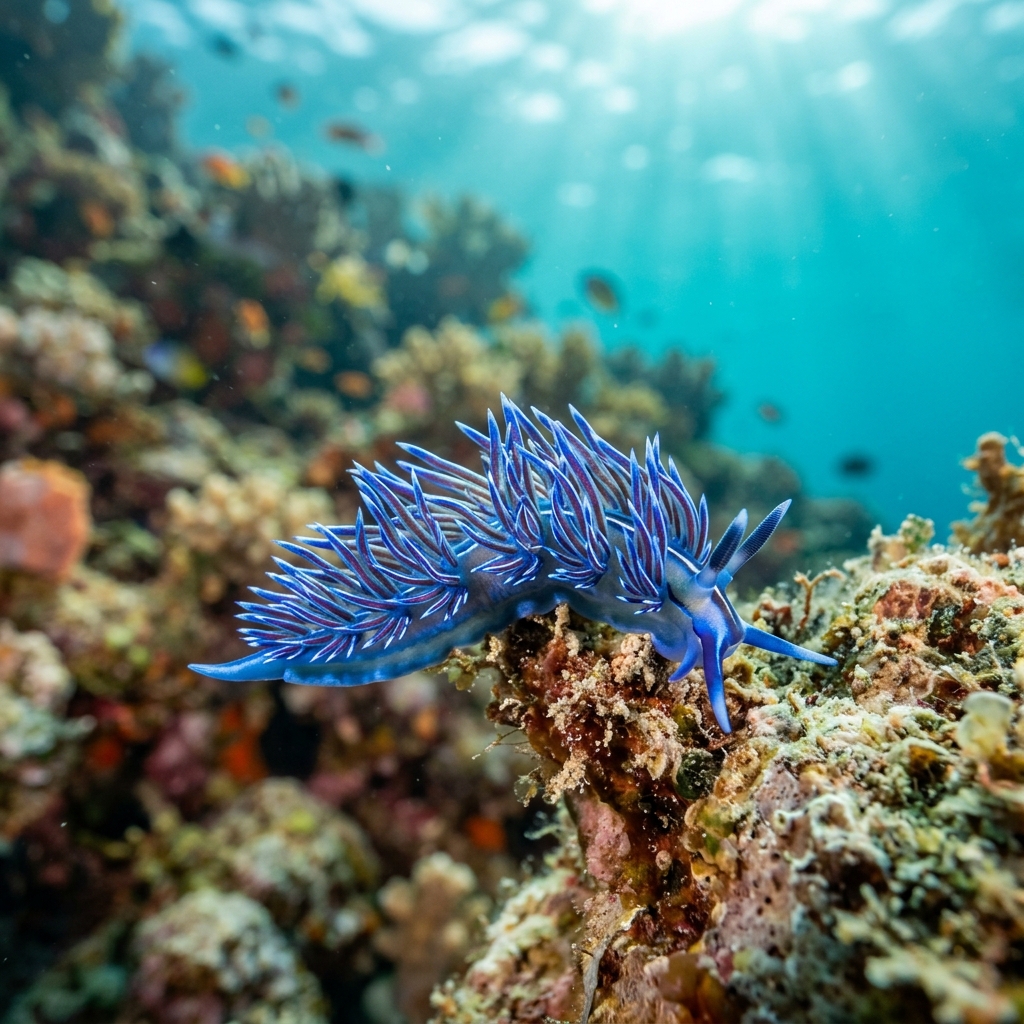
Small, slender sea slug with a translucent white or pale blue-grey body running to a few centimetres long, easy to miss until the colour catches your torch. Look for the row of finger-like projections (cerata) along its back tipped in bright orange, with a blue-white iridescent line running down the centre of the body and along the edges. Two curled, orange-banded rhinophores (sensory tentacles) sit up front, giving it a slightly horned look against the drab rock or algae it crawls over.
Divers usually spot it grazing slowly over rock, algae or hydroid growth, often tucked into cracks or moving across low-relief reef where its prey lives. It pays no attention to divers and won't react to a light or a close look, so it's a patient macro subject rather than a chase. Most logs describe it as uncommon at any given site, so finding one usually means a slower, close-focused search rather than a guaranteed spot.
It feeds on hydroids and can incorporate their stinging cells into its own cerata, giving this slow-moving slug a borrowed chemical defence despite having no shell or speed to rely on.
No strong seasonal pattern shows in the sighting data, so treat it as a year-round find. It's logged across the observed 12.3 to 19.7C range typical of California's cold-water reefs and kelp forests, so cooler months don't rule it out.
This is a California speciality: it turns up most consistently on dive sites through California itself, with a smaller but reliable presence up the Pacific Northwest and down into Baja California, Mexico. Scattered logs also come from the Southwest, Alaska and Mountain West regions of the United States, but California carries the vast majority of sightings.
Mapping where Opalescent Nudibranch is logged…
California is by far the strongest area for sightings, with additional records from the Pacific Northwest and Baja California, Mexico. It's a cold-water species, so look for it on rocky reef and kelp-forest dives rather than tropical reefs.
Sightings don't show a clear season, so it's considered a year-round find within its cold-water range. It's recorded across water temperatures from about 12 to 20C, covering most of the diving calendar in California.
Look for a slender, translucent body with orange-tipped cerata along the back and a thin iridescent blue line running down the centre. The curled, orange-banded rhinophores up front are a good confirming feature if the colour alone isn't conclusive.
Exact size data isn't confirmed for this listing, but like most Hermissenda nudibranchs it's a small animal, typically only a few centimetres long, so a close, slow look is needed to spot one.
It eats stinging hydroids and can store their unfired stinging cells in its own cerata, turning a food source into a defence system.
No, it poses no danger to divers. It's a small, slow-moving slug that can be observed and photographed at close range without any risk.
Site and sighting data is aggregated from diver logs, iNaturalist and GBIF. For taxonomy and conservation status:
Light-spotted Aegires
3,168 sites