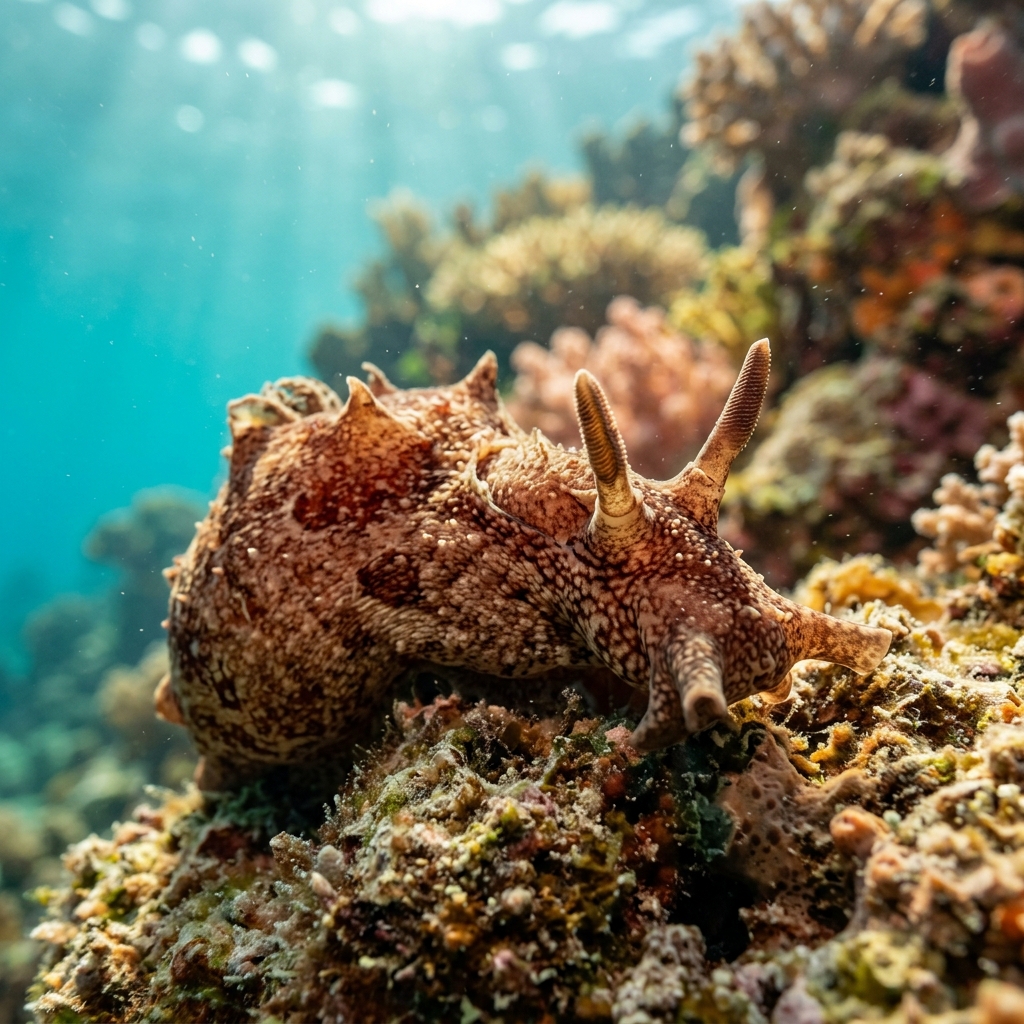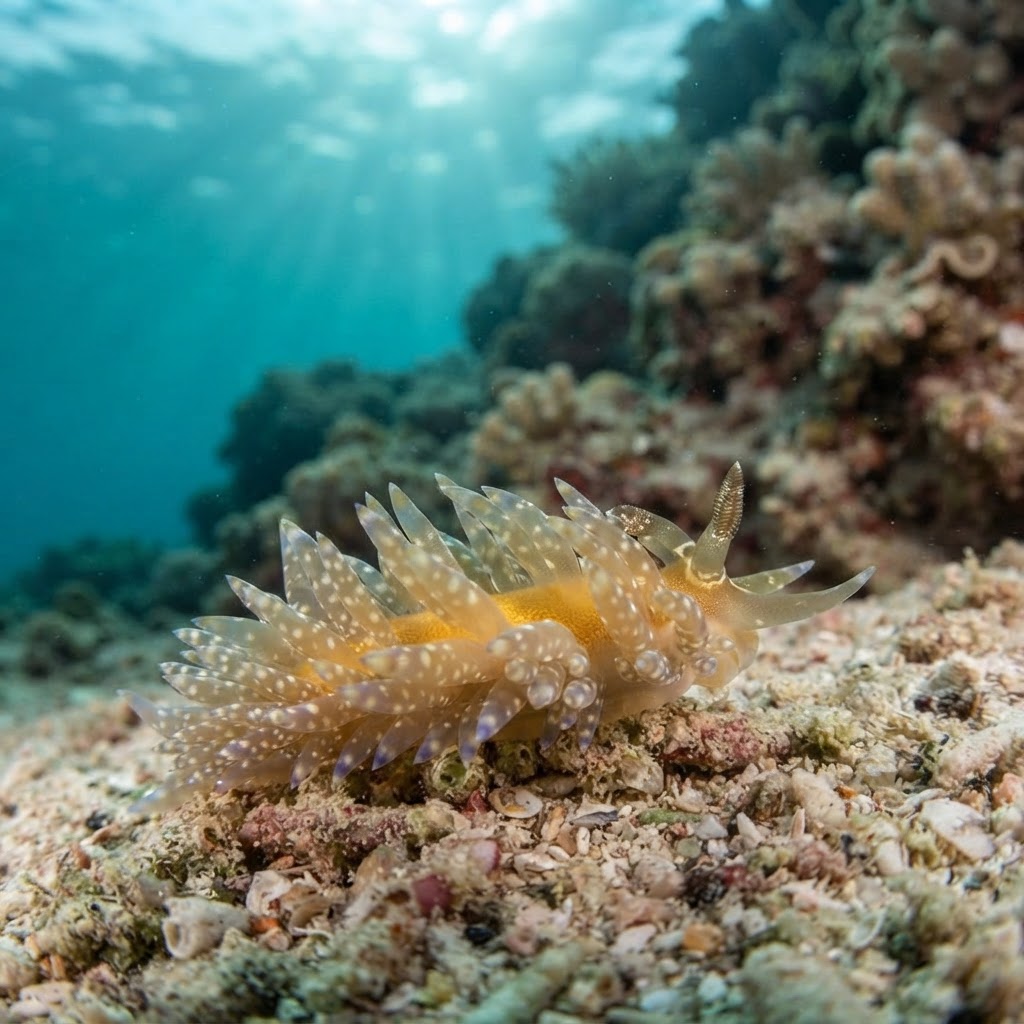
Baeolidia moebii
An uncommon aeolid nudibranch found in South Sinai, Egypt and Mindanao, Philippines, comfortable in warm 24 to 30C reef water year-round.
Look for a small, slender nudibranch covered in finger-like projections (cerata) along its back, giving it a bristly, almost fuzzy silhouette rather than a smooth-bodied look. The cerata carry mottled patches of colour that break up its outline against sponge and anemone-covered substrate, which is exactly where you tend to find it feeding. It moves slowly and stays low on the reef, so divers usually spot it by scanning encrusted rubble and rock rather than open coral.
Divers usually find this nudibranch parked on or near the anemones and cnidarians it feeds on, moving at the unhurried pace typical of aeolid slugs. It shows no reaction to divers and will not move off if a light or camera gets close, which makes it an easy macro subject once spotted. Most logs come from slow, close-focus reef and rubble searches rather than open swimming.
As an aeolid nudibranch it feeds on cnidarians like anemones and can repurpose their stinging cells for its own defence, storing them in the tips of its cerata.
Sightings show no detectable seasonal pattern, and with observed water temperatures ranging from 23.6 to 29.7C it is present on these reefs across the year rather than tied to a particular month.
This one is a reliable if uncommon find across South Sinai in the Egyptian Red Sea and Mindanao in the Philippines, with a smaller but consistent presence in Baja California, Mexico. Luzon in the Philippines adds a few more logged sites, making the Philippines overall the strongest country for sightings alongside Egypt.
Mapping where Multicoloured Anemone Eater is logged…
South Sinai in Egypt and Mindanao in the Philippines are its strongest known areas, with additional sightings in Luzon, Philippines and Baja California, Mexico.
There is no clear season in the data, and it tolerates a wide range of warm reef temperatures from about 24 to 30C, so sightings are spread across the year.
Check for a small nudibranch with a bristly covering of patterned cerata rather than a smooth back, found low on the reef near anemones or sponges. It moves slowly and does not flee when approached.
Exact size data is not confirmed for this species, but like most Baeolidia nudibranchs it stays small, typically only a few centimetres long, so close-focus searching helps spot it.
It feeds on anemones and related cnidarians and can store their stinging cells in its cerata for its own defence, a trick common to aeolid nudibranchs.
No, it poses no threat to divers and can be safely observed and photographed at close range without disturbing it.
Site and sighting data is aggregated from diver logs, iNaturalist and GBIF. For taxonomy and conservation status:
Light-spotted Aegires
3,168 sites