
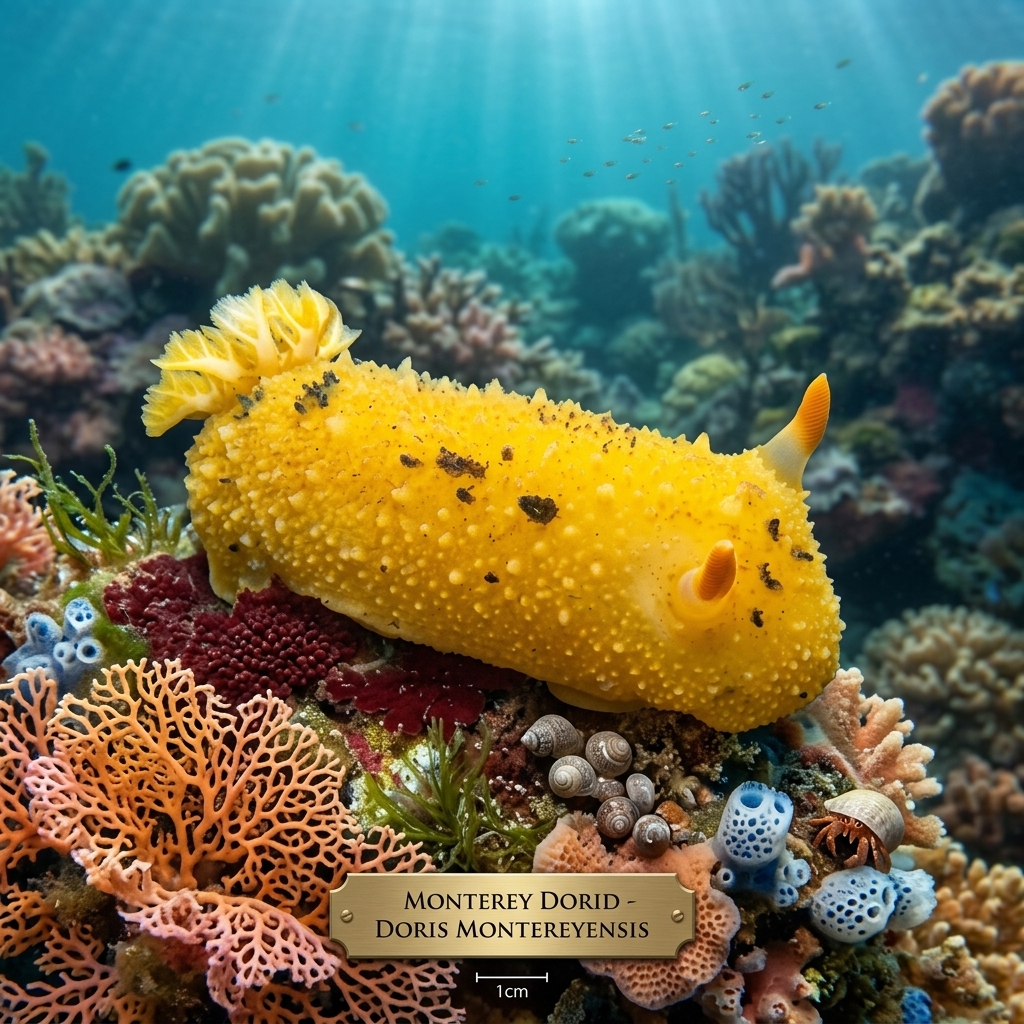
Doris montereyensis
Spot the Monterey Dorid along the Pacific Coast of the US and British Columbia. Year-round sightings, shallow reefs, water temps from 18 to 29 °C.
Reaching around 10 cm, this is one of the larger dorids (a group of nudibranchs with gills arranged in a rosette on their back) you will encounter on Pacific temperate reefs. The body is typically white to pale cream, covered in rounded bumps called tubercles, which give it a rough, warty texture that stands out against smooth rock or sponge. Look for the distinctive feathery gill plume at the rear and a ring of similar projections around the edge of the mantle. That combination of bumpy white body plus prominent gill rosette is the key field mark underwater.
When you find one, it will be moving slowly across benthic surfaces, rocks, or encrusting growth, grazing on sponges and similar sessile organisms. It shows no interest in approaching divers and no real flight response either; you can watch it feed at close range without triggering a retreat. Daytime dives are the most productive, as individuals are actively foraging rather than tucked into crevices.
Like many dorid nudibranchs, the Monterey Dorid likely sequesters chemical compounds from the sponges it eats, storing them in its own tissues as a defence against predation. Its bold, bumpy appearance may serve as a warning signal to would-be predators.
Sightings are spread across all months with no concentrated season, so this is a year-round target along the Pacific Coast. It tolerates a broad temperature window from around 18 to 29 °C, meaning seasonal water shifts on temperate reefs do not push it away.
Reef neighbours a diver could mistake it for. Use the identification notes above to tell them apart.
The Monterey Dorid is most reliably logged along the Pacific Coast of the United States, with particularly strong representation in California, and the British Columbia Coast of Canada. Baja California in Mexico also holds a solid number of recorded sites, making the wider northeast Pacific coastline the go-to range for this species.
Mapping where Monterey Dorid is logged…
The Pacific Coast of the United States is the top destination, with California sites logging the most observations. The British Columbia Coast in Canada is equally well represented. Baja California in Mexico adds further options along the same coastline.
Sightings are recorded in every season with no strong peak, so there is no single best month. Plan around dive conditions and visibility for your chosen site rather than time of year.
Look for a large, pale white nudibranch covered in rounded bumps across its mantle, with a feathery gill rosette on its back and a ring of similar projections around the mantle edge. It can reach about 10 cm, making it one of the more conspicuous dorids on Pacific temperate reefs.
Typical adults reach around 10 cm in length. That size makes them relatively easy to spot on rocky reef substrate once you know the white, bumpy body pattern to look for.
It is a carnivore that feeds on sponges and other encrusting organisms on the sea floor. By grazing selectively, it influences which species dominate the benthic community around it. It also likely retains defensive chemicals from the sponges it consumes.
No. They are completely harmless to divers and show no defensive behaviour towards people. Simply approach slowly and watch where you place your hands on the reef to avoid accidentally damaging one.
Site and sighting data is aggregated from diver logs, iNaturalist and GBIF. For taxonomy and conservation status:
Light-spotted Aegires
3,168 sites





