
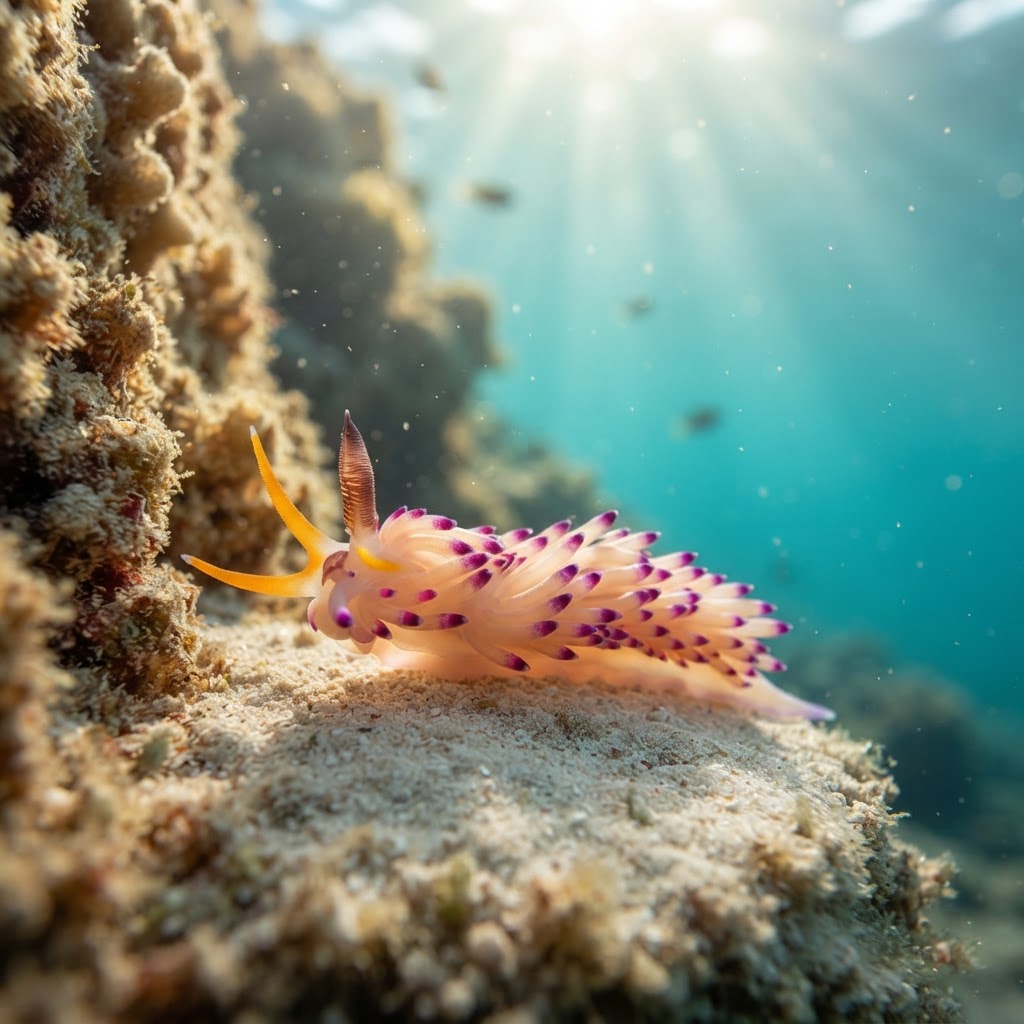
Favorinus mirabilis
A tiny egg-eating nudibranch turning up on reefs in Malaysia's East Coast and Luzon, Philippines, warm 25-31C water, year-round.
A small, slender nudibranch with a translucent to pale body and a row of finger-like projections (cerata) along its back, often tipped in orange or yellow. It moves slowly across the substrate and is easy to miss unless a guide points it out, since it blends into algae and sponge growth. Look for the slim, almost worm-like profile rather than the broad, flattened shape of many reef dorids.
Found creeping slowly over rubble, algae, or sponge patches on the reef floor, usually during the day when divers and macro photographers are scanning the bottom closely. It shows no reaction to divers beyond continuing its slow crawl, since it has no eyes or senses geared toward detecting a hovering diver. Most sightings are single individuals rather than groups, and it takes a sharp-eyed guide or a slow macro pass to spot one at all.
True to its common name, this species specialises in eating the egg masses of other sea slugs and nudibranchs rather than sponges or hydroids like most of its relatives, making it one of the few nudibranchs that preys on its own kin's offspring.
No clear seasonal pattern shows up in the data, so treat it as a year-round find on tropical reefs. Observed water temperatures of 25.4 to 31.4 C match warm reef conditions in the region for most of the year.
Most reliably logged along Peninsular Malaysia's East Coast and across Luzon in the Philippines, with a smaller but steady presence in Bali, Indonesia. A single record from Kwajalein Atoll in the Marshall Islands shows it turns up further into the Pacific too, though sightings there are far less common.
Mapping where Miraculous Egg-eater is logged…
It shows up most often on reefs along Peninsular Malaysia's East Coast and in Luzon, Philippines, with additional sightings in Bali, Indonesia and a rare record from Kwajalein Atoll in the Marshall Islands.
There is no strong seasonal pattern in the sighting data, so it is considered a year-round find on warm tropical reefs where water sits between roughly 25 and 31 C.
Look for a small, slender, translucent nudibranch with orange or yellow tipped cerata running along its back, crawling slowly over reef substrate. Its slim shape sets it apart from broader, more colourful dorid nudibranchs.
Exact size data is not confirmed for this species, but like most Favorinus nudibranchs it is small, typically only a centimetre or two long, making it a macro-photography target rather than an easy spot.
Unlike most nudibranchs that graze on sponges or hydroids, this species feeds on the egg masses of other sea slugs, effectively preying on the next generation of its own relatives.
Site and sighting data is aggregated from diver logs, iNaturalist and GBIF. For taxonomy and conservation status:
Light-spotted Aegires
3,168 sites





