
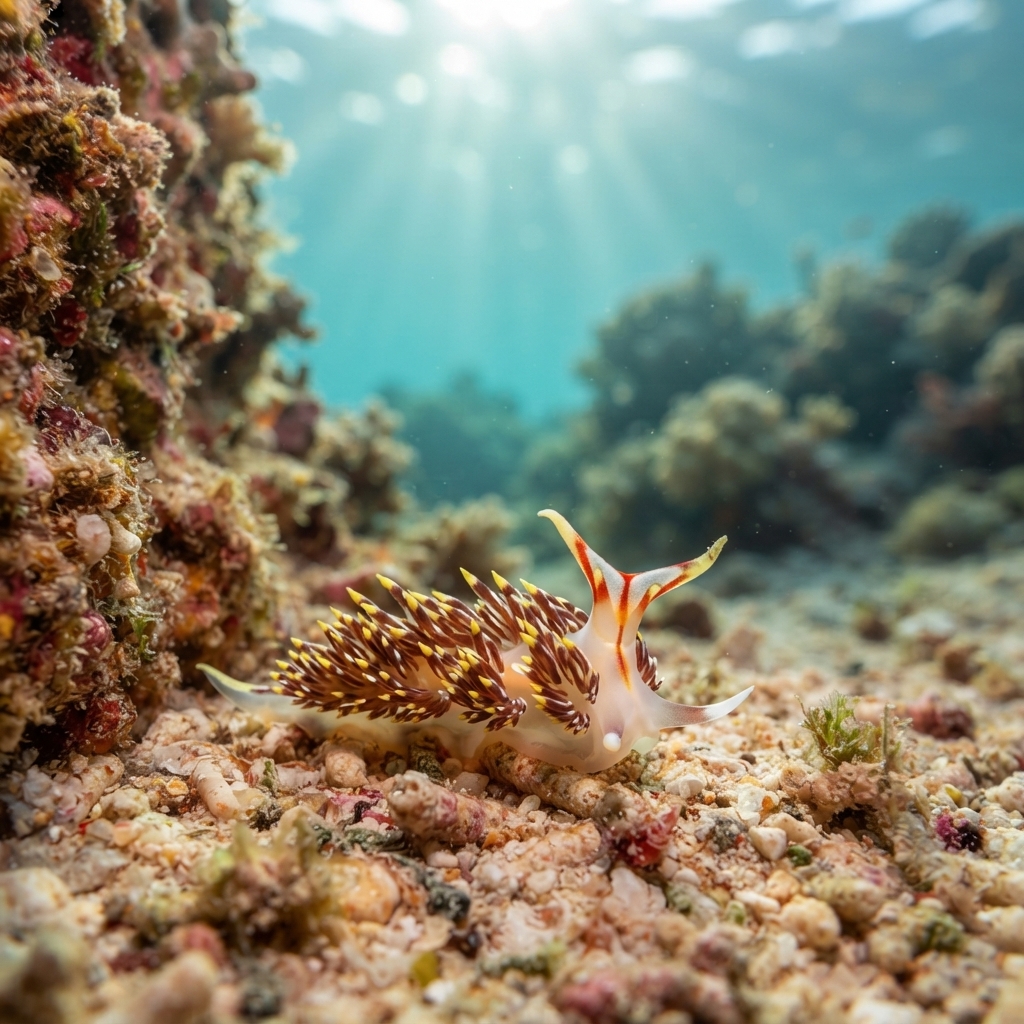
Caloria militaris
Spot this small aeolid nudibranch on reefs in Goa, the UAE east coast and Muscat, in warm 23.5 to 29.5°C water year-round.
A small, slender aeolid nudibranch (a group with finger-like projections called cerata covering its back rather than a smooth mantle). Look for a row of narrow, tentacle-like cerata running down both sides of the body, often tipped in a contrasting shade from the base colour. The body is thin and elongated compared to the rounder dorid nudibranchs, and it moves slowly across rubble, sponge and algae-covered surfaces where it is easy to overlook at a glance.
Divers find it grazing slowly over rubble, sponge patches and algal turf, usually tucked close to the substrate rather than out in the open water column. It shows no reaction to divers beyond continuing its slow crawl, making it an easy macro subject once spotted, though its slender shape and muted colouring mean most divers scan right past it.
Like other aeolid nudibranchs, it likely stores stinging cells from the hydroids or cnidarians it feeds on inside its cerata, repurposing its prey's own defences for its own protection.
No clear seasonal pattern shows up in the data, and its comfort range of 23.5 to 29.5°C matches warm reef water year-round in these regions, so it turns up any month you go looking.
Most reliably logged in Goa, India, and along the East Coast of the United Arab Emirates, with a solid secondary population around Muscat, Oman, and along Israel's Mediterranean Coast. It shows up as an uncommon find at most of these sites rather than a guaranteed sighting, so pair it with a broader macro dive rather than planning a trip around it alone.
Mapping where Military Tentacle Aeolid is logged…
Best-known sites are in Goa, India, and along the East Coast of the United Arab Emirates, with additional sightings around Muscat, Oman, and Israel's Mediterranean Coast.
There is no strong seasonal pattern in the sighting data, and warm water in the 23.5 to 29.5°C range holds year-round across its main dive regions, so it can be found in any month.
Check for a slender body with rows of narrow, tentacle-like cerata along both sides, often with contrasting tips, and a slow crawl over rubble or sponge rather than open sand.
Exact size data is not confirmed, but like most aeolid nudibranchs it stays small, likely in the centimetre-scale range typical of the family, making it a macro-lens subject.
No, it poses no threat to divers. It is a small, slow-moving grazer that can be observed and photographed safely at close range without disturbing it.
Site and sighting data is aggregated from diver logs, iNaturalist and GBIF. For taxonomy and conservation status:
Light-spotted Aegires
3,168 sites





