Melibe leonina
Spot the lion nudibranch along the Pacific Coast and British Columbia in cold 9-17 °C waters. Best sightings run May through January.
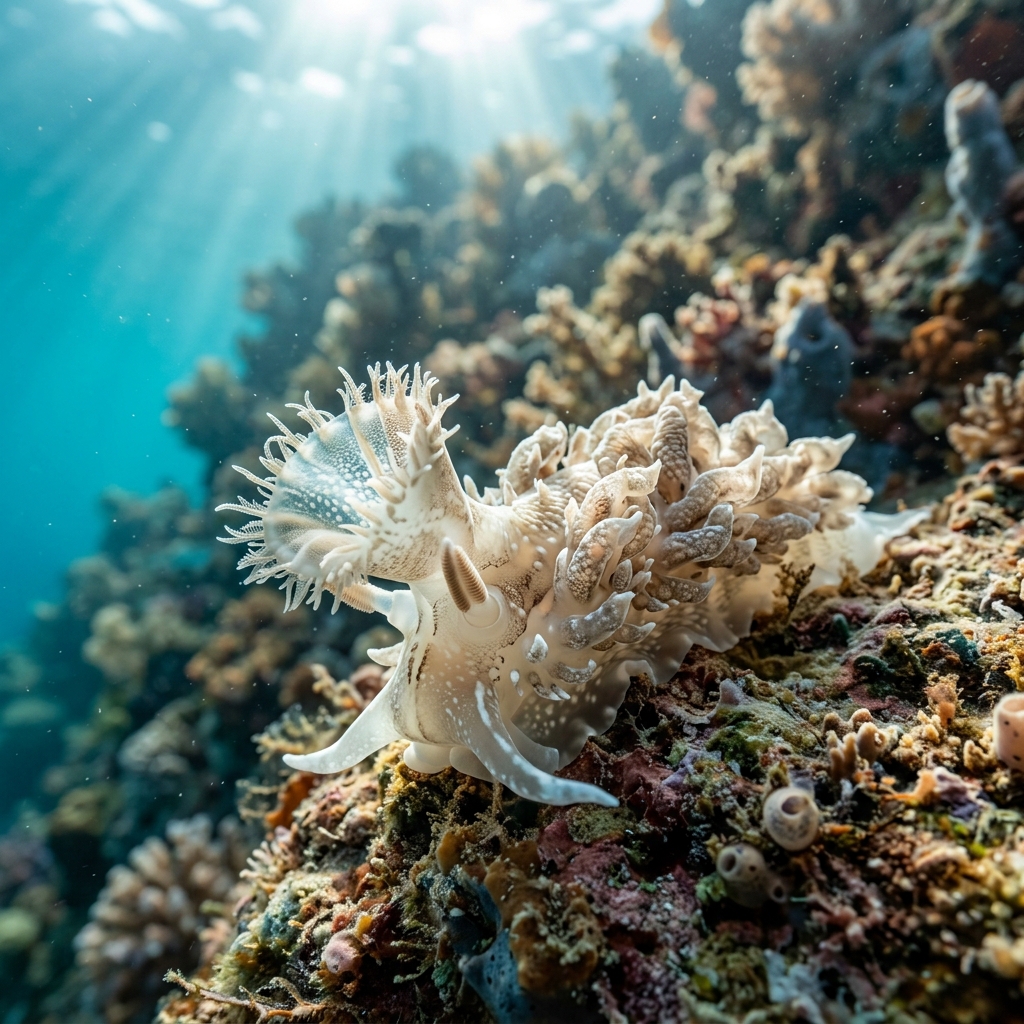
A pale, translucent amber or yellowish body immediately sets this nudibranch apart from most Pacific species, it looks less like a typical nudibranch and more like a small, ghostly jellyfish draped over kelp. Its most striking feature is the enormous, net-like oral hood (a fleshy trap it spreads to capture prey), which dominates the front of the body and can be wider than the animal is long. Clusters of bushy, paddle-shaped cerata (branched projections used for gas exchange) line the back in rows. In the water it often sways loosely, giving it an almost plant-like appearance.
You'll most often find it drifting slowly through kelp forests or eelgrass beds, or perched on kelp fronds with its oral hood spread wide, passively trapping small crustaceans and zooplankton. It's not particularly wary of divers and tends to keep doing what it's doing when you approach, move slowly and it may stay open long enough for a good look. Reports of colonies sometimes releasing a coconut-like scent into the water make for one of the more memorable Pacific nudibranch encounters.
The lion nudibranch is one of very few nudibranchs that feeds by ambush rather than by rasping. It spreads its wide oral hood like a net, then snaps it shut to trap small swimming prey, a strategy more reminiscent of a jellyfish than a typical mollusc.
Sightings concentrate from May through January across Northern Hemisphere sites, suggesting a long active season rather than a sharp peak. The species favours cool to cold water between about 9 and 17 °C, so the chillier months on the Pacific Coast keep conditions within its preferred range.
Nearly all logged sightings come from the Pacific Coast of the United States and the British Columbia Coast of Canada, making cold northeast Pacific waters the definitive place to look. The Pacific Coast of the United States accounts for the majority of sites, with British Columbia a strong second and a handful of records reaching into Alaska. If you're diving the Pacific Northwest, you're already in prime lion nudibranch territory.
Mapping where Lion Nudibranch is logged…
Lion nudibranchs are found almost exclusively in the northeast Pacific. The strongest concentration of sightings comes from the Pacific Coast of the United States and the British Columbia Coast of Canada, with a small number of records from Alaska. Kelp forests and eelgrass beds in these regions are the best places to search.
Based on diver logs, sightings run from May through January, giving a long window with no single month standing out as dramatically better than others. The species prefers cold water around 9-17 °C, so Pacific Northwest dive conditions suit it for much of the year.
Look for a pale amber, translucent body with a very large, net-like oral hood at the front, this hood is unique among Pacific nudibranchs and makes the animal instantly recognisable. Rows of bushy, paddle-like cerata run along its back. Its loose, swaying posture in the water column can make it look more like a floating piece of kelp than a nudibranch.
Lion nudibranchs are among the larger Pacific nudibranchs, known to reach around 10-15 cm in length, and occasionally larger. Their broad oral hood makes them appear even bigger underwater, especially when it is fully spread.
Unlike most nudibranchs that rasp algae or prey with a tooth-lined tongue, the lion nudibranch spreads a wide, fleshy oral hood and snaps it shut to trap small crustaceans and zooplankton, a form of ambush predation unusual for any mollusc. Watching this behaviour underwater is one of the highlights of a Pacific Northwest dive.
Site and sighting data is aggregated from diver logs, iNaturalist and GBIF. For taxonomy and conservation status:
Nudibranch
3,168 sites