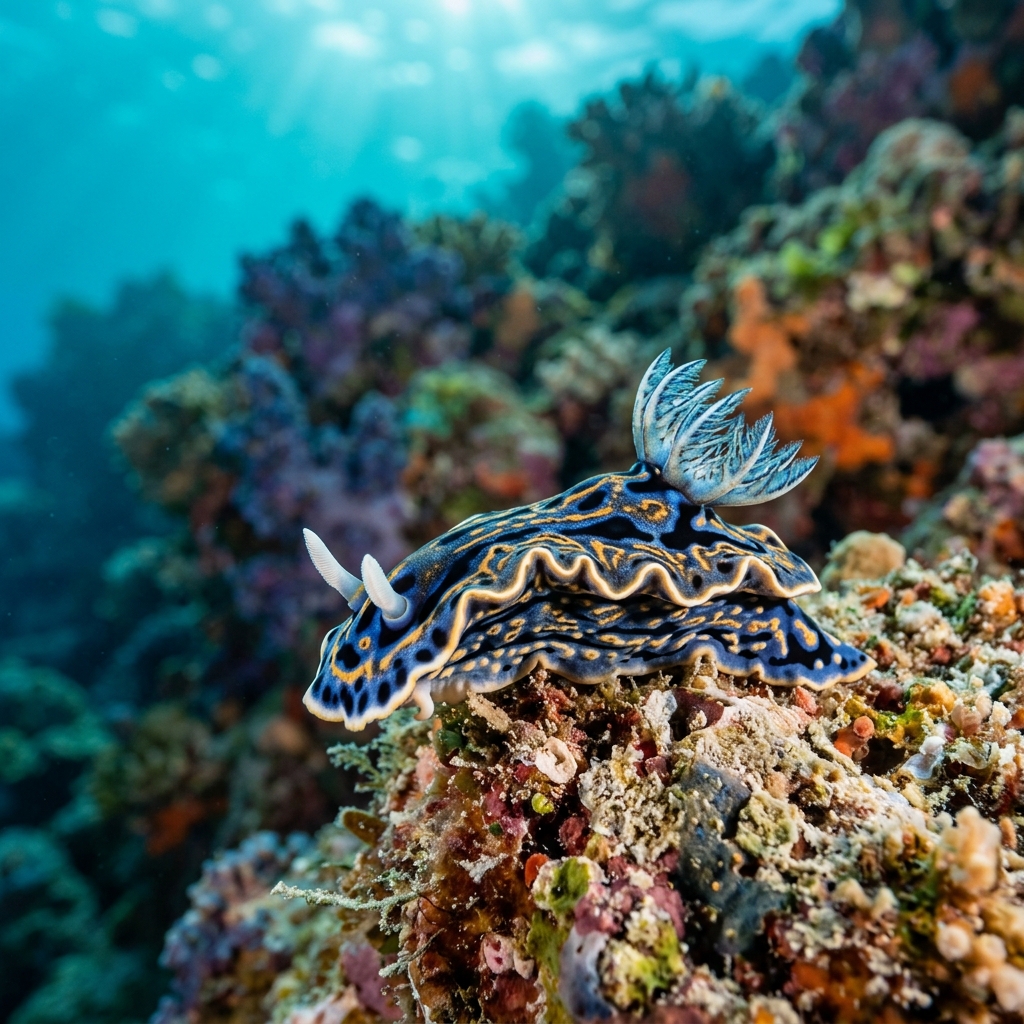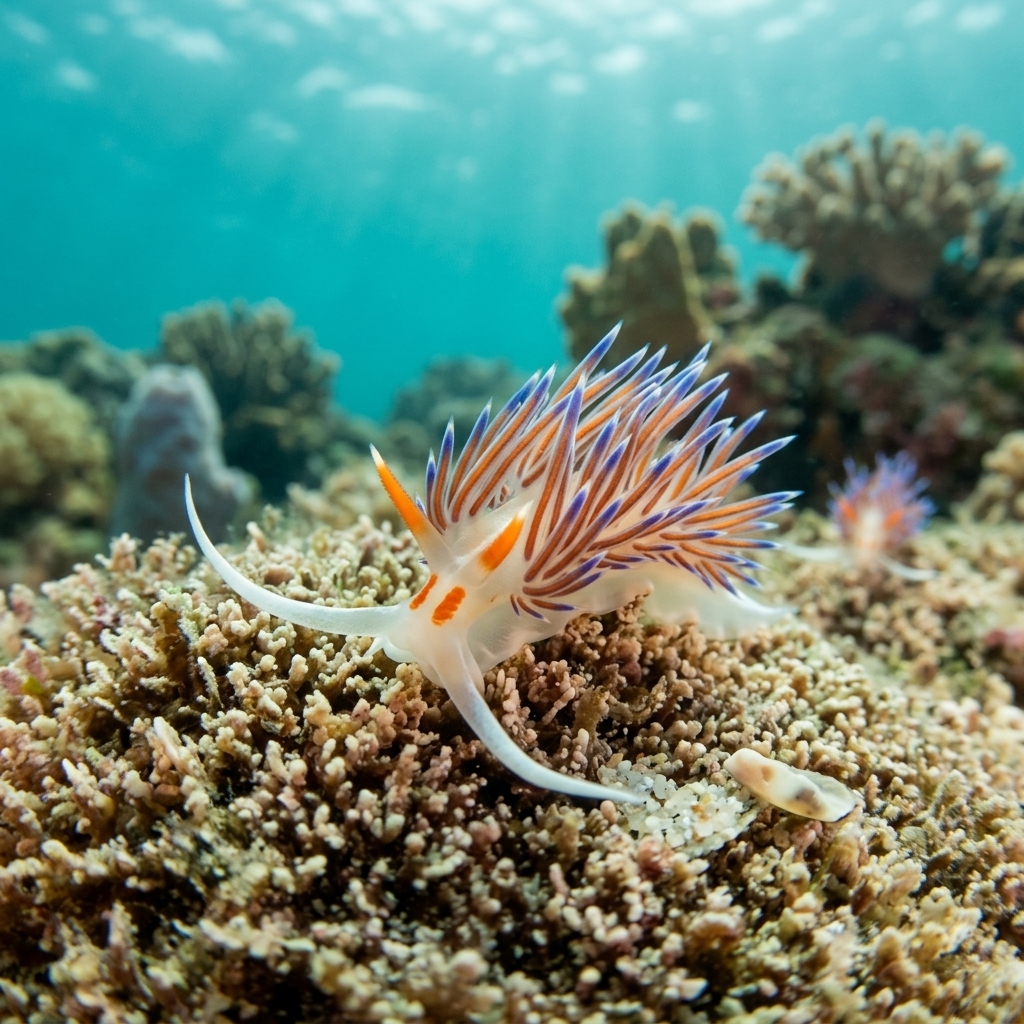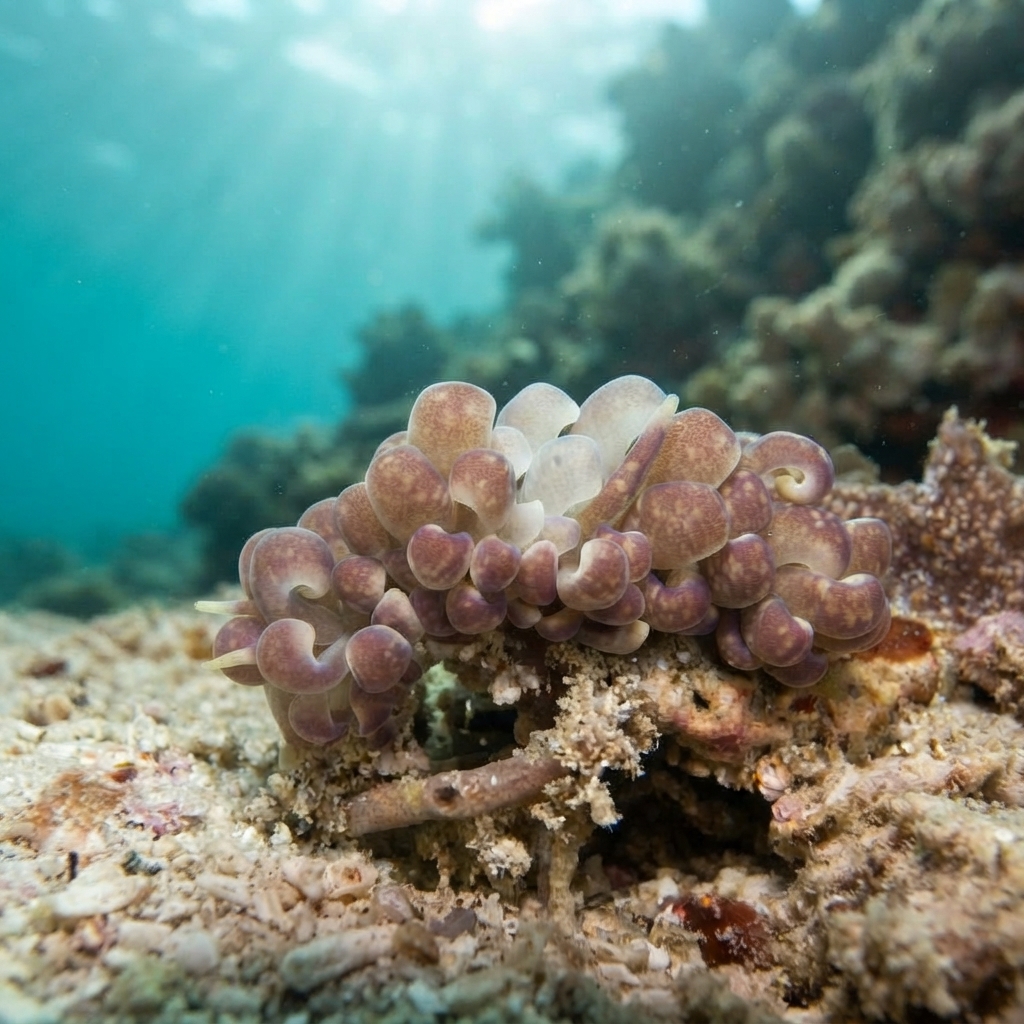
Phyllodesmium magnum
Rare nudibranch find: best odds in Mindanao, Philippines, in warm 24-30°C water, year-round with no set season.
Grows to around 9 cm, a large size for a nudibranch, with a soft, elongated body covered in branching, leaf-like projections called cerata. The cerata often carry colour and pattern borrowed from the soft coral it has been feeding on, so individuals can vary from pale cream to mottled brown depending on diet. Look for the dense, frond-like cerata coverage along the back rather than a smooth or spiky profile, and check for the slug moving slowly across or beside soft coral colonies.
Divers find this one moving slowly over or right beside soft coral colonies, which it feeds on directly, often blending into the coral's colour and texture enough to be missed on a first pass. It shows no reaction to divers and simply continues grazing, so a slow scan of soft coral heads with a torch or macro lens is the best way to spot it. Most logs describe it as a rare encounter, so sightings tend to be one-offs rather than repeat finds at the same coral head.
Like other members of its family, it feeds on soft coral polyps and can incorporate the coral's own pigments and even its stinging cells into its cerata, effectively wearing its food source as camouflage and defence.
No clear seasonal pattern shows up in the sighting data, and its comfort range of roughly 24 to 30°C matches warm tropical reefs year-round, so any month is fair game at the sites where it turns up. Treat it as a lucky find rather than a seasonal target.
Most consistently logged in Mindanao, Philippines, which accounts for the majority of recorded sightings, with a smaller but reliable presence around Nosy Be, Madagascar. Queensland, Australia and Sulawesi, Indonesia also have confirmed records, making this a wider Indo-Pacific find rather than a single-site specialty.
Mapping where Magnificent Soft Coral Eater is logged…
Mindanao in the Philippines has the strongest run of sightings, with additional records from Nosy Be in Madagascar, Queensland in Australia, and Sulawesi in Indonesia. It is logged as rare to uncommon everywhere it appears, so no single site guarantees a sighting.
There is no detected season in the sighting data, and its warm-water niche of roughly 24 to 30°C holds year-round on the tropical reefs where it lives. Any time you are diving Mindanao or similar warm reef sites is as good as any other.
Look for a soft-bodied slug up to about 9 cm long, covered in dense, branching cerata that often mimic the colour of the soft coral it is feeding on. It moves slowly and is usually found on or right next to soft coral colonies rather than on open reef.
They reach around 9 cm in length, which is on the larger end for a nudibranch and makes the branching cerata pattern easier to pick out once you spot one.
It feeds directly on soft coral polyps and can take on the coral's colouring and even its stinging cells for its own defence, essentially disguising itself as the coral it eats.
Site and sighting data is aggregated from diver logs, iNaturalist and GBIF. For taxonomy and conservation status:
Nudibranch
3,168 sites