Goniodoridella savignyi
A rare find in Sai Kung, Hong Kong and Central Japan, this tiny nudibranch turns up year-round in 19 to 26C water.
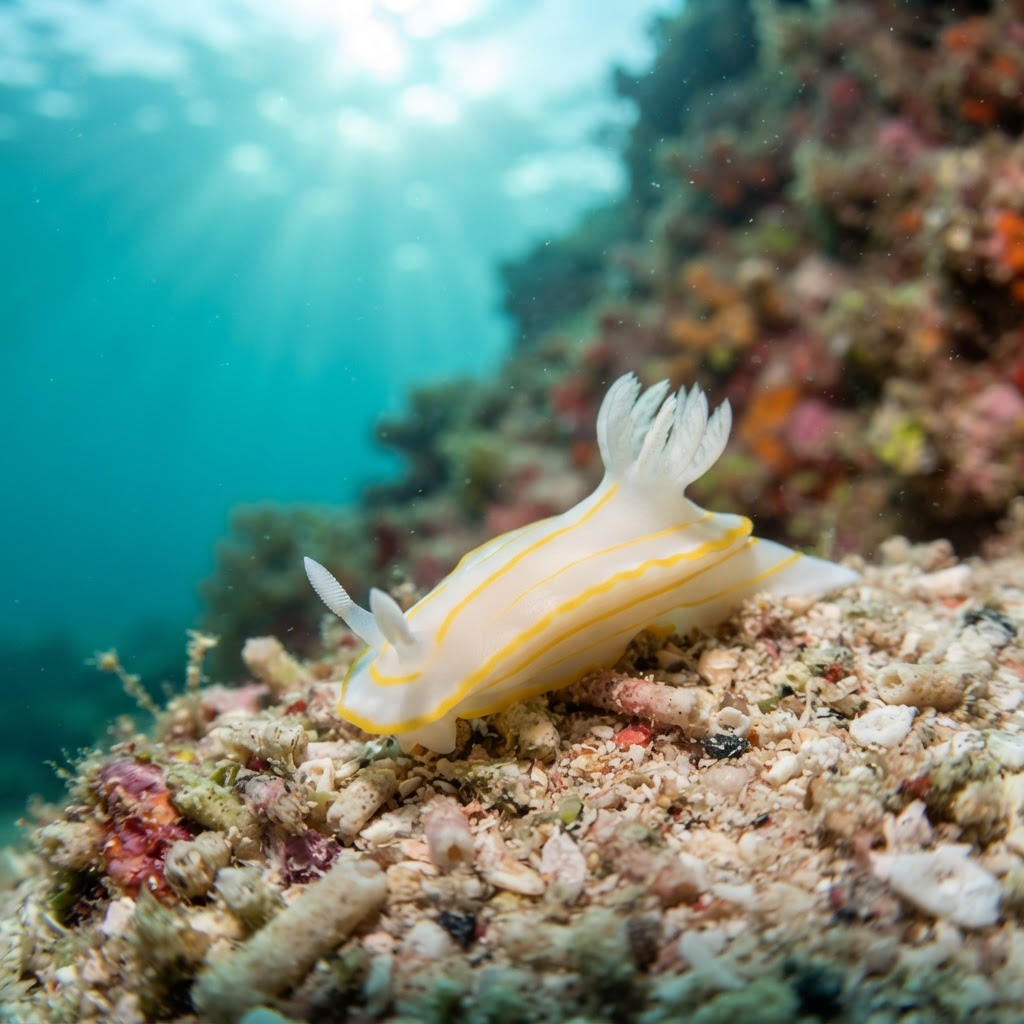
A small nudibranch (sea slug) with a translucent to pale body and the tufted gill cluster typical of dorid nudibranchs sitting toward the rear. Look closely for the pair of horn-like rhinophores (sensory stalks) on the head, which give this species its common name. Its small size and understated colouring mean it is easy to swim past unless you are already scanning sponge-covered rubble or rock closely.
Divers find this species tucked against rock or rubble surfaces, likely grazing on the encrusting invertebrates that small dorid nudibranchs typically feed on. It moves slowly and shows no reaction to divers beyond retracting its gills if disturbed, so a careful, close look with a torch is the best way to spot one. Given how rarely it is logged, most sightings come from divers deliberately searching small crevices and sponge patches rather than spotting it in open view.
Like other dorid nudibranchs, it likely relies on camouflage and possibly chemical defences from its diet rather than speed or shells to avoid predators, which is part of why it goes unnoticed on so many dives.
No clear seasonal pattern shows up in the data, so treat sightings as possible year-round. It has been recorded in water from 19.3 to 25.5C, a range that spans typical conditions in both Hong Kong and Central Japan across much of the year.
Logged sightings come from Sai Kung in Hong Kong and Central Japan, making these two regions the known spots for this species. Sightings are sparse at both, so it is more a case of checking the right microhabitat on any given dive in these areas than picking a hotspot.
Mapping where Longhorn Pump Dorid is logged…
Confirmed sightings come from Sai Kung in Hong Kong and Central Japan. It is logged as rare to uncommon at both locations, so finding one takes a patient, close search of the substrate.
There is no strong seasonal pattern in the sighting data, so it is best treated as a year-round possibility. It has been recorded in water temperatures from 19.3 to 25.5C, which covers most of the diving season in Hong Kong and Central Japan.
Look for a small, pale to translucent nudibranch with a tufted gill cluster near the rear and a pair of horn-like rhinophores on the head. It sits low on rock or rubble and is easy to overlook without a close, slow search.
Exact size data is not confirmed, but as a member of the goniodorididae family it is a small nudibranch, likely only a centimetre or two long, so it takes a careful eye to spot.
No, this nudibranch poses no danger to divers. It is a small, slow-moving invertebrate that you can safely observe up close without any risk.
Site and sighting data is aggregated from diver logs, iNaturalist and GBIF. For taxonomy and conservation status:
Light-spotted Aegires
3,168 sites