Limacia clavigera
Spot the orange-clubbed nudibranch in cold Atlantic waters from SW England to Norway. Key ID tips, best seasons, and top dive regions.
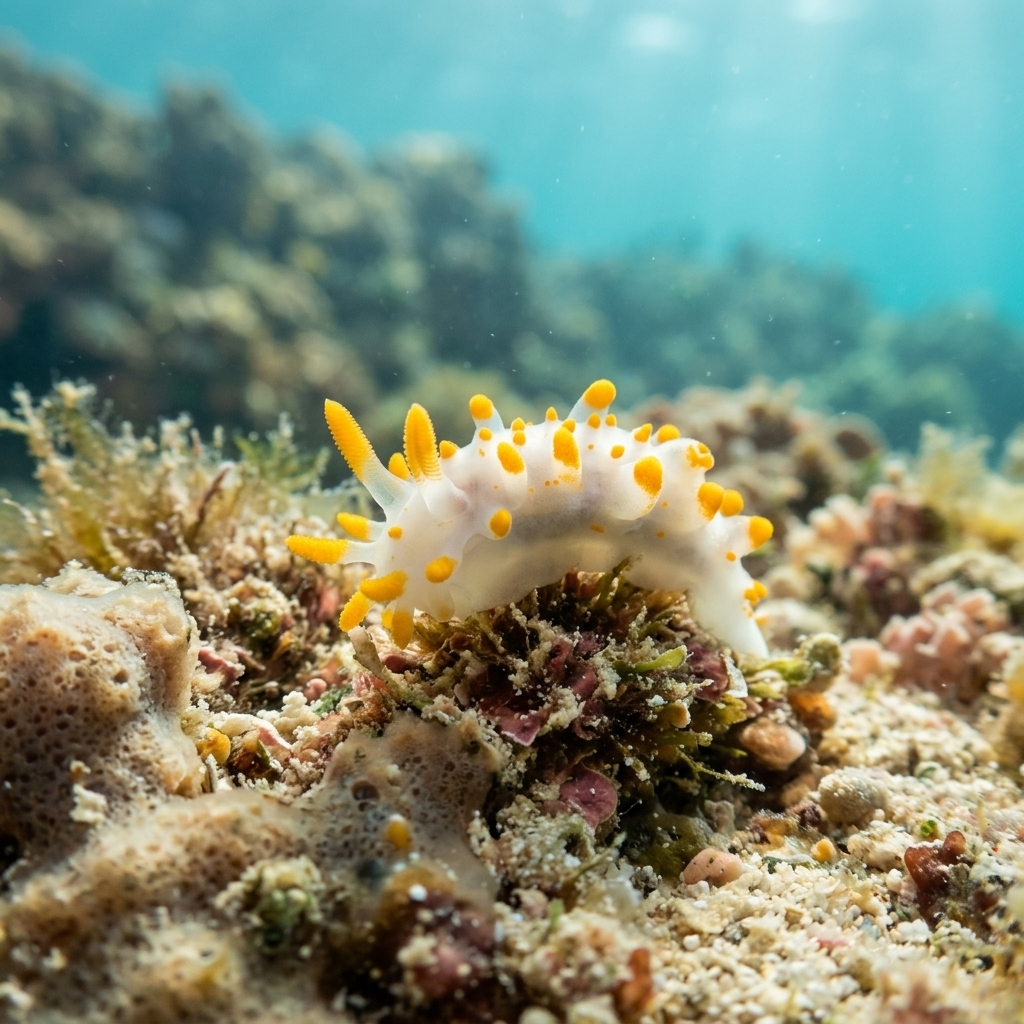
Look for a small, pale white body covered in club-shaped projections (called tubercles) tipped with vivid orange or yellow-orange, which give the species its name. A row of orange-tipped cerata (finger-like appendages) runs along each side of the body, while the gills and rhinophores (sensory head appendages) share the same warm orange colouring. The overall effect is a white slug sprinkled with tiny orange dots, a pattern that stands out well against encrusting algae and bryozoans in cold temperate water.
You will typically find it moving slowly over rocky reef surfaces encrusted with bryozoans and hydroids, which form its preferred prey. It tends to stay very close to the substrate, often tucked into crevices or creeping along the underside of ledges, so methodical searching at low depth is more productive than a fast swim-through. It pays little attention to divers and will simply continue its steady crawl if left undisturbed.
Like many polycerid nudibranchs, this species feeds almost exclusively on bryozoans, the lacy colonial animals that form white or orange crusts on cold-water rock. Its colouring likely advertises its unpalatability to fish rather than offering any camouflage.
Sightings are concentrated from September through to July across Northern Hemisphere sites, suggesting only a brief mid-summer gap in peak activity. Cold-water conditions between roughly 8 and 17 °C match the species' comfort zone, so autumn through to late spring is your best window.
Most commonly logged across the United Kingdom, with South West England and Wales, Northern Ireland, and the South Coast of England being the strongest areas. France's Brittany and Normandy coastline and Portugal's Lisbon Coast are also reliable hunting grounds, and sightings extend north into Southern Norway and the Bohuslän coast of Sweden. Spain's Galicia region rounds out the Atlantic arc where this species appears regularly.
Mapping where Orange-clubbed Nudibranch is logged…
The species is most consistently logged along the Atlantic coasts of the United Kingdom, particularly South West England, Wales, and Northern Ireland. Strong sightings also come from Brittany and Normandy in France, the Lisbon Coast of Portugal, Galicia in Spain, Southern Norway, and the Bohuslän coast of Sweden.
Sightings peak from September through to July, covering autumn, winter, and spring. The species prefers cold water between about 8 and 17 °C, so the cooler months in temperate Atlantic regions are consistently the most productive time to look.
Focus on the body colour combination: a translucent white base covered in club-shaped projections with bright orange tips, plus matching orange rhinophores and gill plumes at the rear. The all-over orange-spotted appearance on a pale body is distinctive among nudibranchs in cold North Atlantic waters.
They are small nudibranchs, typically reaching around 10 to 20 mm in length, though size can vary. In the water they can appear almost jewel-like due to their vivid markings, but you need to search carefully on encrusted rock to spot them.
They feed on bryozoans, the lacy colonial animals that coat rocky reefs in temperate Atlantic waters. This specialist diet means you are most likely to find them on encrusted vertical or overhanging rock faces where bryozoan colonies flourish.
Site and sighting data is aggregated from diver logs, iNaturalist and GBIF. For taxonomy and conservation status:
Light-spotted Aegires
3,168 sites