Dendrodoris citrina
A rare, custard-yellow sea slug logged almost exclusively off North Island, New Zealand, in cool 13-19C water year-round.
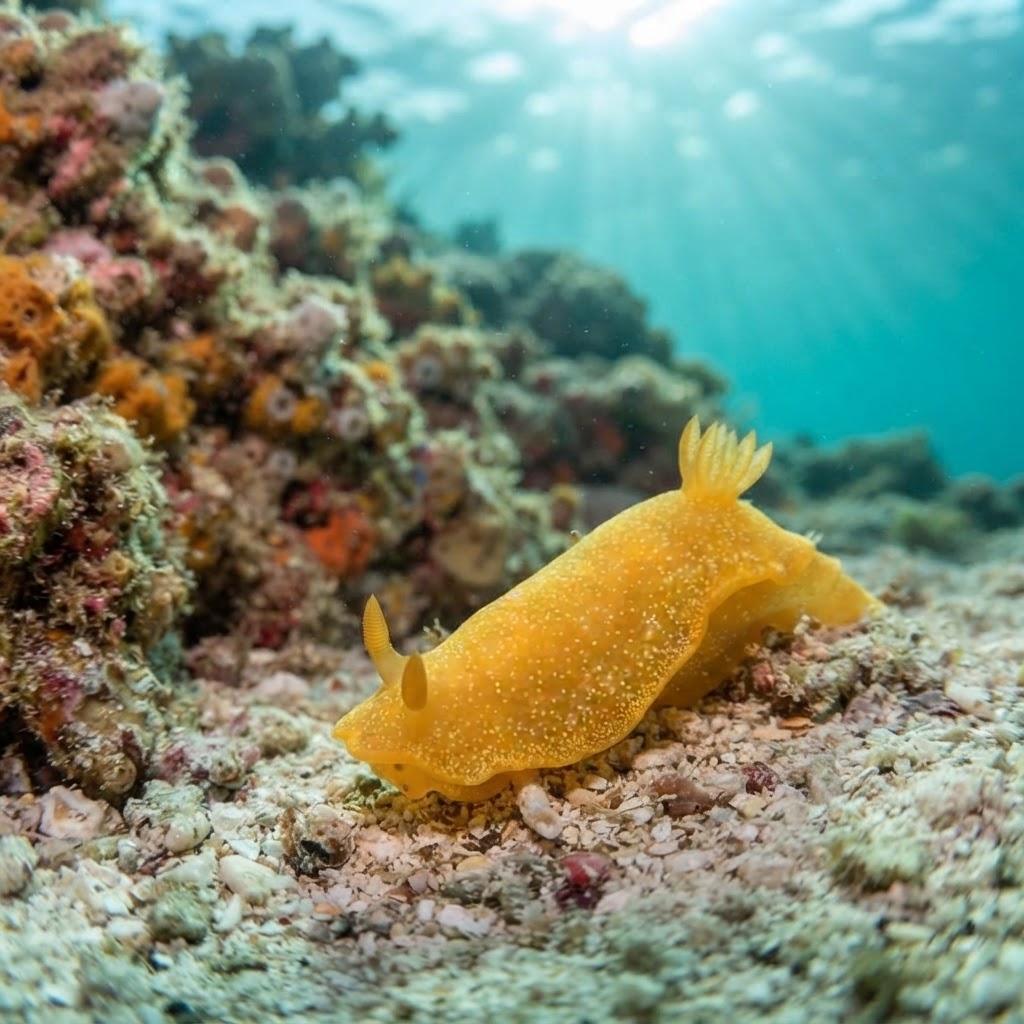
Look for a smooth, glossy body in solid lemon-yellow to mustard tones, without the frilly gill plumes or bold contrast stripes many nudibranchs show. The soft-bodied mollusc sits low and rounded on the reef, usually small enough to miss unless you are already scanning rock and rubble closely. There is no showy rhinophore colour break or mantle edging to key on, so the plain, saturated yellow tone against darker reef surfaces is the main clue.
Divers find it moving slowly over rock and reef surfaces, grazing rather than swimming, and it shows no reaction to a diver's presence beyond the usual unhurried nudibranch pace. Given how often it is logged as rare rather than uncommon, most sightings are a single animal spotted during a slow, close look at the substrate rather than multiple individuals together. There is nothing in the record to suggest strong day/night or depth preference beyond typical reef nudibranch habits.
Like other Dendrodoris species, it likely feeds on sponges and relies on chemical defences from that diet rather than speed or camouflage to avoid predators, which is why it can sit exposed on open rock without hurrying off.
Sightings show no detectable seasonal pattern, so treat it as a year-round possibility on North Island reefs. It has been logged across a fairly wide temperature band, from about 13C to nearly 19C, which is consistent with a species that does not disappear in cooler months.
This one is essentially a North Island, New Zealand species as far as logged sightings go, with every recorded site clustered there rather than spread across other countries. Within that region it turns up at a scatter of individual sites rather than a single famous location, so it rewards divers who search reef nooks and rubble patches rather than open sand.
Mapping where Lemon Nudibranch is logged…
Nearly all logged sightings come from North Island, New Zealand, where it turns up scattered across a handful of dive sites rather than one reliable hotspot. It has not been reported in numbers anywhere outside this region.
There is no clear seasonal pattern in the sightings, so it is considered a year-round find. It has been logged across a decent temperature range, from around 13C to 19C, suggesting it stays put through cooler and milder months alike.
Look for a smooth-bodied sea slug in a solid, saturated yellow, without the frilly gills or bold patterning seen in many other nudibranchs. Its plain colouring against darker rock or rubble is the main giveaway.
No. They pose no threat to divers and can be observed and photographed up close without any risk.
Yes, most logged encounters describe it as rare, with a smaller share rated uncommon, so spotting one usually takes a deliberate close search of the reef rather than a casual glance.
Site and sighting data is aggregated from diver logs, iNaturalist and GBIF. For taxonomy and conservation status:
Light-spotted Aegires
3,168 sites