Diversidoris flava
A small yellow nudibranch logged as an uncommon find on Hawaii reefs in water around 22 to 29 C, year-round.
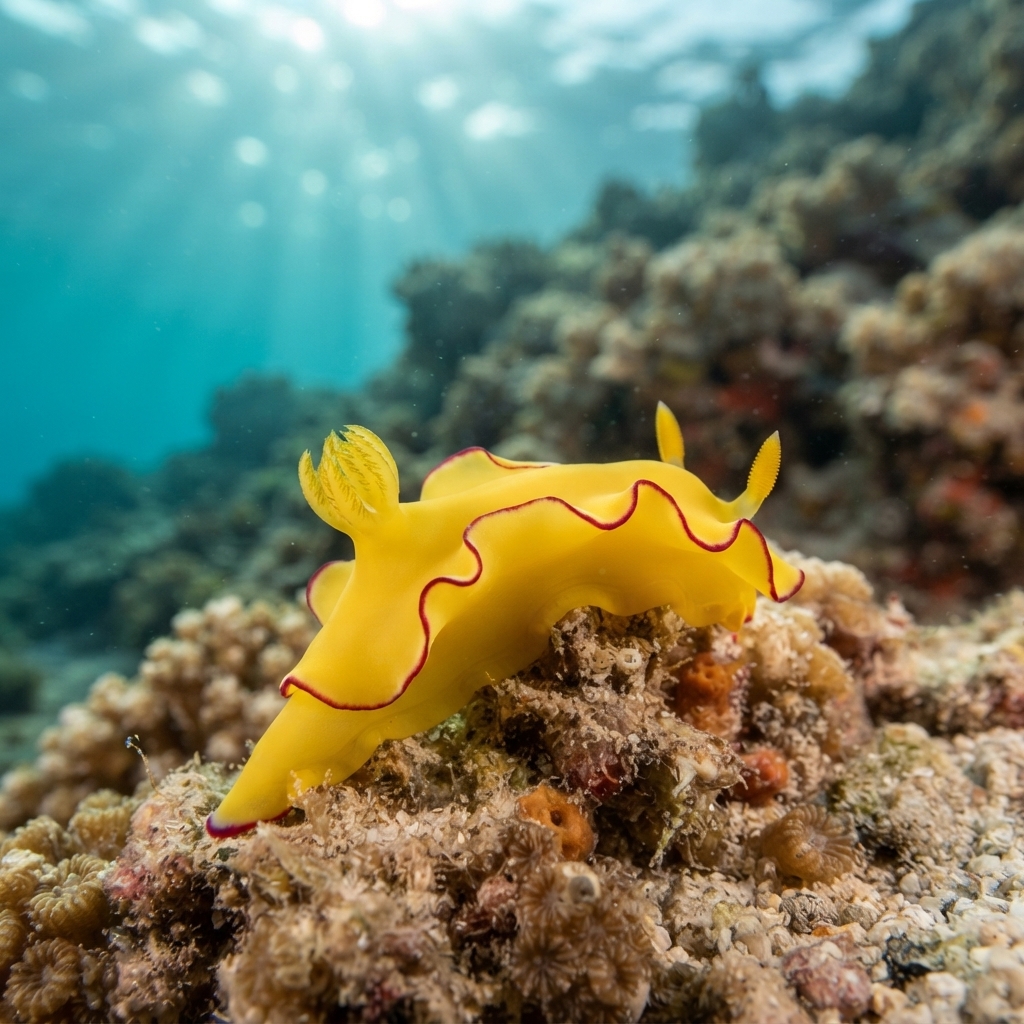
A small, solid yellow nudibranch (sea slug) with a smooth, unspotted body and a slightly elongated tail region that gives it its common name. There is no contrasting border or spot pattern to look for, which actually helps rule out most lookalike species. Size in the water reads as tiny, easy to swim past if you are not scanning the substrate closely.
Divers find it moving slowly over rubble and reef surfaces, doing what most dorid nudibranchs do: grazing quietly rather than swimming or fleeing. It shows no reaction to divers beyond continuing its crawl, so a slow, close look with a light is usually all it takes to get a good view without disturbing it.
Its plain yellow colouring, without the bold stripes or spots seen in many chromodorid nudibranchs, is itself a useful field mark, since it rules out most of the flashier lookalikes in the same family.
Recorded water temperatures range from 21.9 to 29.5 C, comfortable across the year on Hawaiian reefs, and there is no detected seasonal pattern in sightings, so it is logged as a year-round find rather than tied to particular months.
Reef neighbours a diver could mistake it for. Use the identification notes above to tell them apart.
All logged sightings so far come from Hawaii in the United States, making it the region to target if you want to look for this species specifically. It has not yet been reported elsewhere in diver records, so treat Hawaiian reef and rubble sites as the known ground for it.
Mapping where Lemon-drop Longtail Dorid is logged…
The only confirmed diver sightings so far are from Hawaii, United States, where it turns up as an uncommon to rare find on reef and rubble.
There is no clear season in the sighting data. Water temperatures on its Hawaiian sites stay between about 22 and 29.5 C year-round, so it is considered a year-round species rather than seasonal.
Look for a small, plain yellow nudibranch with no spots or stripes and a slightly elongated tail. Its uniform colour without a patterned border helps separate it from most other yellow dorid nudibranchs.
Exact size data is not confirmed, but it reads as one of the smaller reef nudibranchs, easy to overlook unless you are scanning rubble and reef surfaces closely.
No. Like other dorid nudibranchs it poses no threat to divers and simply continues grazing when approached.
Site and sighting data is aggregated from diver logs, iNaturalist and GBIF. For taxonomy and conservation status:
Blue Dragon
3,163 sites