
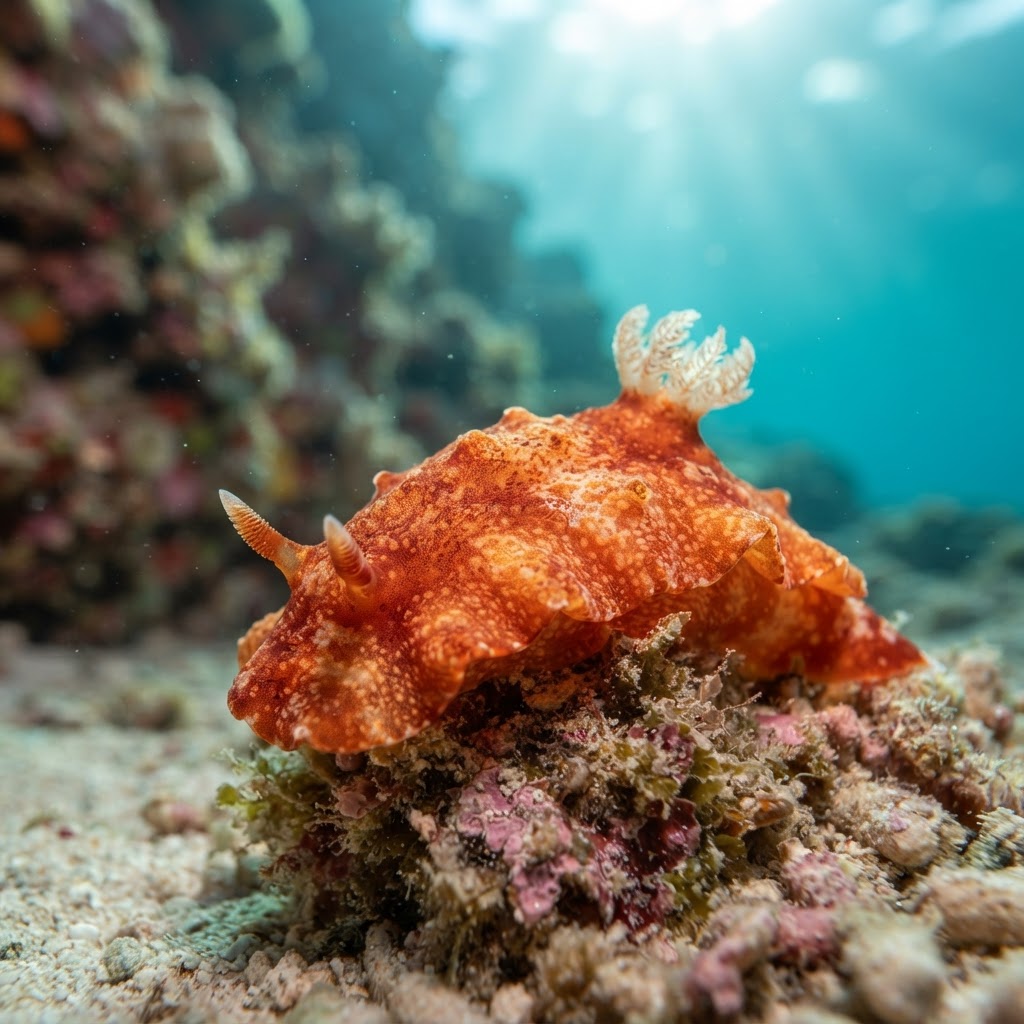
Platydoris angustipes
Uncommon flat brown-grey nudibranch found on reef and rock across Grande-Terre, Guadeloupe, in water around 25 to 31C, year-round.
Broad, flattened oval body with a thick, leathery-textured mantle in muted brown to grey tones, often with darker mottling that breaks up its outline against rock and rubble. Unlike the brightly patterned nudibranchs divers usually chase, it relies on a low-key, almost sponge-like appearance to stay unnoticed. Look for the short, feathery gills clustered on the rear upper surface and a pair of small rhinophores (sensory tentacles) near the front.
Divers find it parked on rock, rubble, or reef substrate, moving slowly across the surface as it grazes rather than swimming or drifting. It's unbothered by divers and won't react to a light or a camera, so it's an easy, patient subject if you spot one against the similarly muted background it blends into. Most logs come from daytime dives on shallower rocky and reef terrain.
Its leathery, textured mantle is thought to help it go unnoticed on algae-covered rock, which is likely why it's logged as uncommon even at sites where it's present, divers simply swim past it.
Sightings don't show a clear season, and with water sitting comfortably between about 25 and 31C year-round in Guadeloupe, there's no obvious time-of-year advantage. Treat it as a possible find on any dive there, any month.
Every logged sighting in the data comes from Guadeloupe, with Grande-Terre standing out as the most reliable area and smaller numbers from Basse-Terre and the Îles des Saintes. If you're diving Guadeloupe's reef and rocky-bottom sites, this is one to keep an eye out for on the substrate rather than in open water.
Mapping where Leather Backed Doris is logged…
All recorded sightings come from Guadeloupe, with Grande-Terre the most productive area and further finds around Basse-Terre and the Îles des Saintes.
There's no detected season in the data, and warm water year-round (roughly 25 to 31C) means it can turn up on any dive in Guadeloupe at any time of year.
Look for a flat, oval, leathery-looking body in dull brown or grey with mottled patterning, feathery gills near the tail, and a slow crawl across rock or rubble. It lacks the bright colours of many reef nudibranchs, which is part of why it's easy to miss.
No, they pose no danger to divers. They're slow-moving, stay on the substrate, and have no means of harming a diver who gets close.
Its thick, textured mantle mimics the look of encrusted rock or sponge, a form of camouflage that likely explains why it's logged as uncommon even where it's present.
Site and sighting data is aggregated from diver logs, iNaturalist and GBIF. For taxonomy and conservation status:
Light-spotted Aegires
3,168 sites





