Learchis poica
A 1cm nudibranch most reliably found in Guadeloupe and Florida, comfortable year-round in warm Caribbean waters.
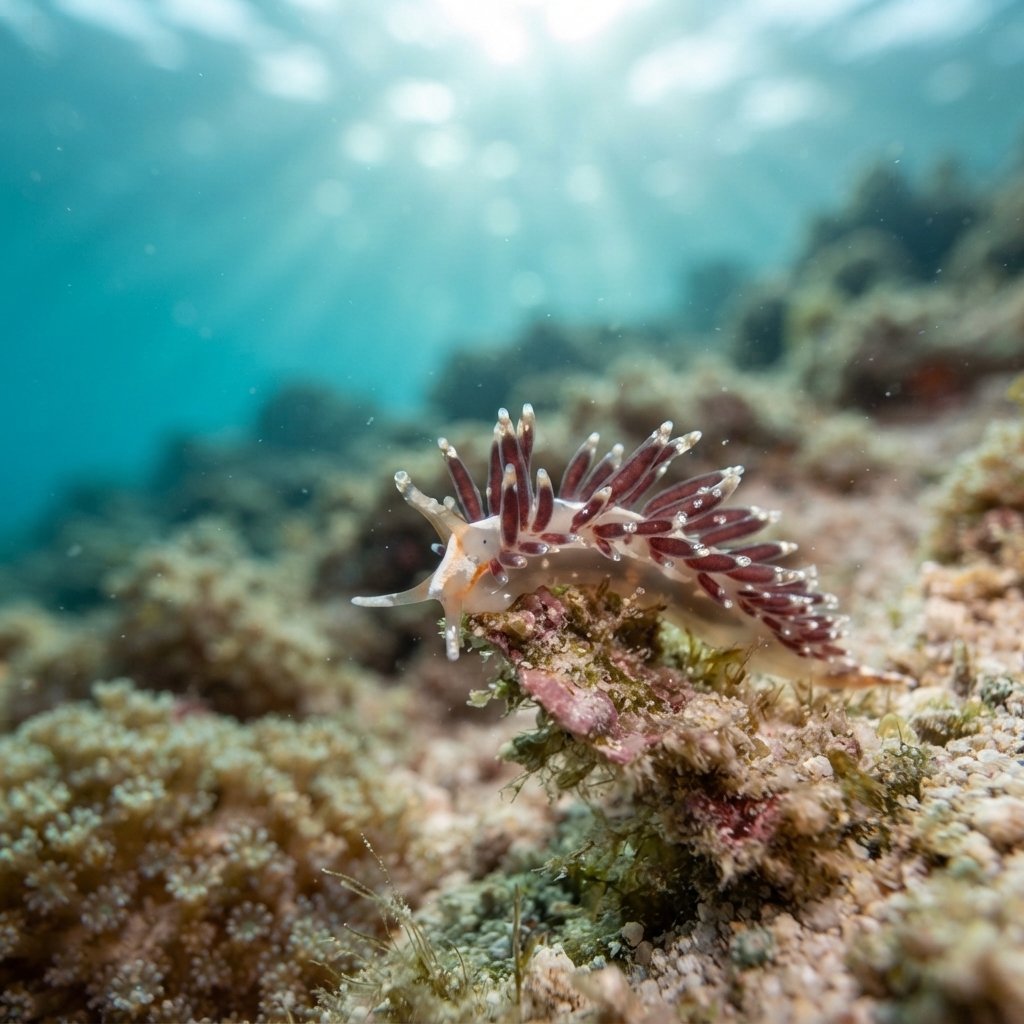
At just 1cm long, this nudibranch is one you have to actively hunt for rather than expect to notice in passing. Look for a slender, translucent body covered in finger-like projections called cerata (the fleshy tufts on its back that house its gills and often reflect its gut colour). Its small size and pale, semi-transparent look mean a torch and a slow, close look at rubble or algae-covered surfaces is usually what it takes to pick one out.
This is a slow-moving, bottom-dwelling species usually found grazing over rubble, algae or hydroid growth rather than swimming or drifting. Divers typically spot it during slow macro-focused dives, moving methodically over a small patch of reef rather than covering ground, since the animal itself barely moves and blends easily into its surroundings. It shows no real reaction to divers, being far too small and focused on feeding to register a torch or a close approach.
Like many aeolid nudibranchs, its cerata likely let it store stinging cells from the hydroids it feeds on, repurposing them as its own defence rather than making venom from scratch.
Sightings show no clear seasonal pattern, and with a comfortable range of roughly 19 to 29C it seems at home on Caribbean reefs across the year. Treat it as a year-round find rather than something tied to a particular month.
This one turns up most reliably in Guadeloupe, with sites across Grande-Terre, Basse-Terre and the Îles des Saintes all producing sightings, and it is equally well logged along Florida's coast in the United States. Smaller numbers have been recorded in Saint Martin and on Dog Island in Anguilla, so the wider Caribbean basin is worth checking if you're on the hunt for it.
Mapping where Christmas Tree Hydroid Nudibranch is logged…
Guadeloupe is the strongest area for this species, with sightings spread across Grande-Terre, Basse-Terre and the Îles des Saintes. It is also regularly logged along Florida's coastline, with occasional records from Saint Martin and Anguilla.
There is no strong seasonal pattern in the sightings, and its warm-water tolerance of roughly 19 to 29C means it can be found year-round on Caribbean reefs.
Look for a tiny, translucent nudibranch around 1cm long with slender cerata covering its back. Its small size and pale colouring mean you generally need a torch and a slow search of rubble or algae to spot one.
This species stays tiny, reaching only about 1cm in length, which makes it one of the smaller nudibranchs divers might try to find on a macro dive.
No, this nudibranch poses no danger to divers. It is far too small to interact with divers at all and has no venom delivery mechanism aimed at anything larger than the prey it hunts.
It likely feeds on hydroids and stores their stinging cells within its cerata, turning a prey defence into its own protection, a trick common among aeolid nudibranchs.
Site and sighting data is aggregated from diver logs, iNaturalist and GBIF. For taxonomy and conservation status:
Light-spotted Aegires
3,168 sites