Janolus mokohinau
An uncommon find off New Zealand's North Island in water around 15 to 21C, year-round for patient reef scanners.
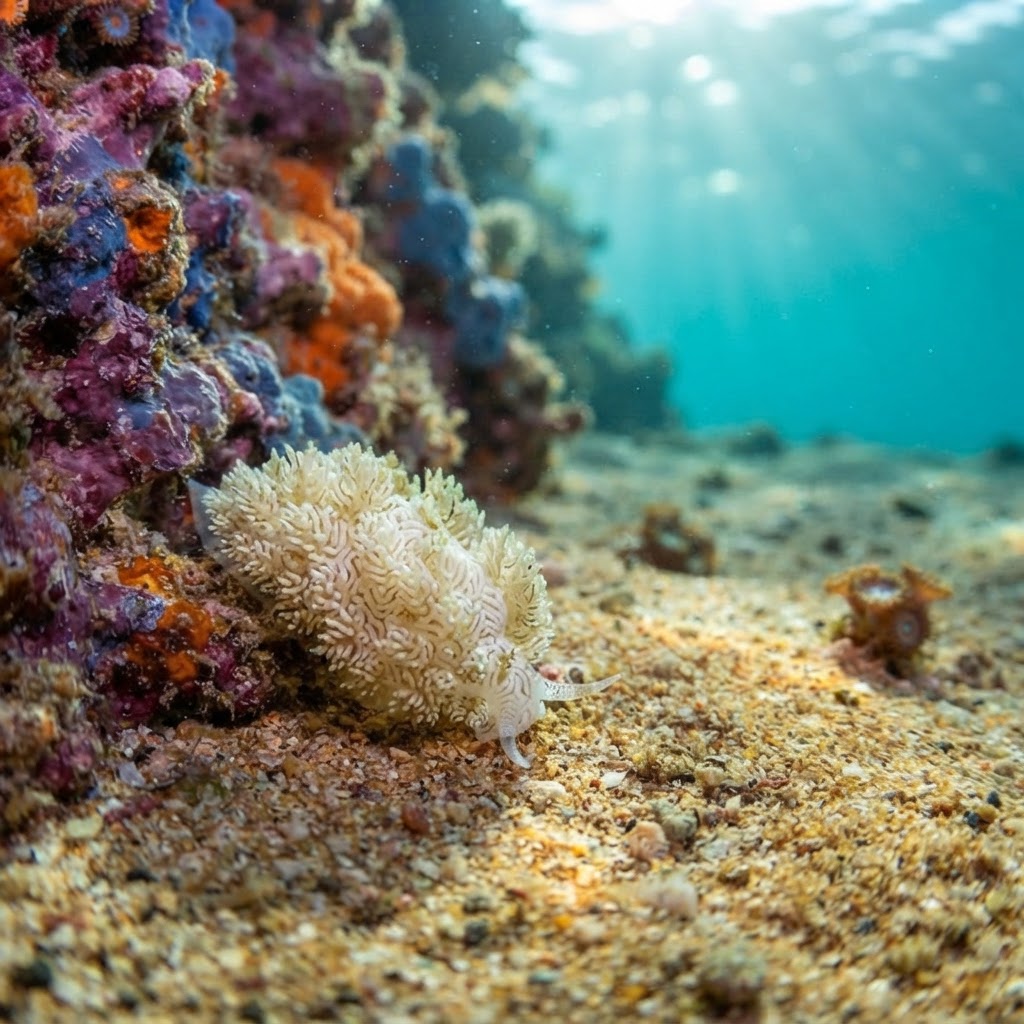
A small, soft-bodied sea slug with a translucent to pale body covered in slender, finger-like projections (cerata) along its back, which often carry a hint of colour at the tips from the digestive gland showing through. It moves slowly across rock and rubble, low to the substrate, and lacks the bold gill rosette of many better-known dorid nudibranchs. Look closely at the cerata arrangement and translucency rather than any single flashy marking.
Divers find it moving slowly over rocky reef and rubble surfaces, grazing rather than swimming, and it shows no reaction to divers beyond continuing its slow crawl. It is logged as uncommon at the sites where it does appear, so sightings tend to come from divers deliberately scanning rock crevices and encrusting growth rather than spotting it in open view.
Like other members of the Janolidae family, it likely feeds on hydroids and bryozoans, using its cerata both for this feeding and for a degree of chemical defence borrowed from its prey.
Sightings don't show a clear seasonal peak, and the species turns up across a temperature range of roughly 15 to 21C, consistent with year-round presence rather than a narrow window. Plan on any month, though cooler and warmer ends of that range both have confirmed records.
Every logged sighting comes from New Zealand, concentrated on the North Island, making it a North Island specialty rather than a species you will stumble on elsewhere. There is no meaningful record of it outside these waters, so divers chasing it should plan trips specifically around North Island reef sites.
Mapping where Janolus mokohinau is logged…
All confirmed sightings are from New Zealand, with the North Island the strongest region for records. It hasn't been logged elsewhere, so it's effectively a North Island specialty.
There's no detected seasonal pattern, and it's been recorded across water temperatures from about 15 to 21C, so it appears to be present year-round rather than tied to a specific season.
Look for a small, translucent to pale nudibranch with slender finger-like cerata covering its back, moving slowly over rock and rubble. It lacks bold contrasting patterns, so identification relies on the cerata shape and overall translucency rather than colour.
Exact size data isn't well documented for this species, but like most Janolidae it's a small nudibranch, likely only a few centimetres long at most, making it easy to overlook on a reef.
It's logged as uncommon even at the North Island sites where divers have found it, so spotting one usually takes a deliberate, close search of rocky surfaces rather than a casual glance.
Site and sighting data is aggregated from diver logs, iNaturalist and GBIF. For taxonomy and conservation status:
Blue Dragon
3,163 sites