
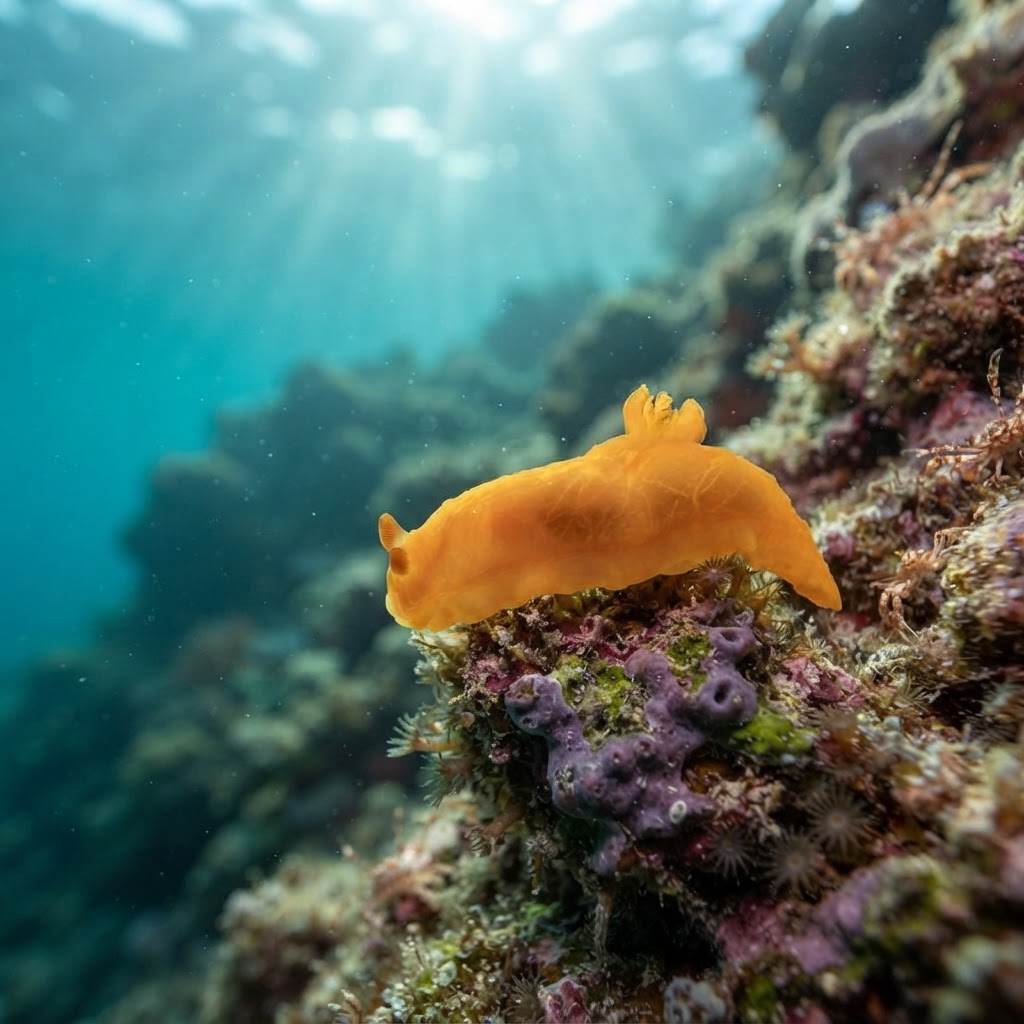
Gymnodoris inornata
A slug-eating nudibranch turning up on muck dives around Sihanoukville and Sai Kung, best spotted on slow night crawls.
A small, slender nudibranch with a translucent to pale cream body, often flecked with fine darker speckling that gives it a slightly dusty look against sand or rubble. It lacks the loud colour blocking of many reef nudibranchs, relying instead on a smooth, elongated slug shape with a modest set of rhinophores (the paired sensory horns on the head) and gill plume toward the rear. Its plain look is actually the best clue: divers hunting for something showy usually swim right past it.
Divers typically find it moving slowly over sand, rubble, or low reef structure, often at night or on muck dives where the lighting picks out its pale body against darker substrate. Like other Gymnodoris species it is thought to hunt other slugs and small invertebrates rather than grazing algae or sponges, so a static sighting is usually one that is mid-hunt rather than resting. It shows little reaction to divers and can be watched closely without disturbing it.
Gymnodoris nudibranchs are unusual among sea slugs in being active predators of other nudibranchs and small snails rather than sponge or coral feeders, so finding one near a cluster of smaller slugs is not a coincidence.
Sightings are spread across the year with no clear seasonal peak in the data, and the observed water temperature range of 23.3 to 29.4°C covers most of the diving calendar in these regions. Treat it as a year-round find rather than something tied to a particular month.
Most divers log this one in Cambodia, particularly around Sihanoukville, with a second strong pocket in Hong Kong's Sai Kung region. Outside these two areas it turns up only sparingly, so muck and rubble sites in these regions are the reliable bet.
Mapping where Inornate Gymnodoris is logged…
It is most reliably logged around Sihanoukville in Cambodia and Sai Kung in Hong Kong, both areas known for muck and rubble diving. Sightings elsewhere are sparse, so these two regions are the best bet for a targeted search.
There is no strong seasonal pattern in the sighting data, and it has been observed across a temperature range of roughly 23 to 29°C. It is best treated as a year-round find rather than tied to a specific season.
Look for a small, slender, pale cream to translucent nudibranch with fine speckling and a plain, unshowy appearance compared to reef nudibranchs. Its subtlety is the key ID clue, it is often overlooked because it lacks bold colour patterns.
No, it poses no danger to divers. It is a small, harmless sea slug that can be observed and photographed up close without any risk.
Like other members of its genus, it is believed to prey on other nudibranchs and small invertebrates rather than sponges or algae, making it one of the reef's smaller predators.
Site and sighting data is aggregated from diver logs, iNaturalist and GBIF. For taxonomy and conservation status:
Light-spotted Aegires
3,168 sites





