
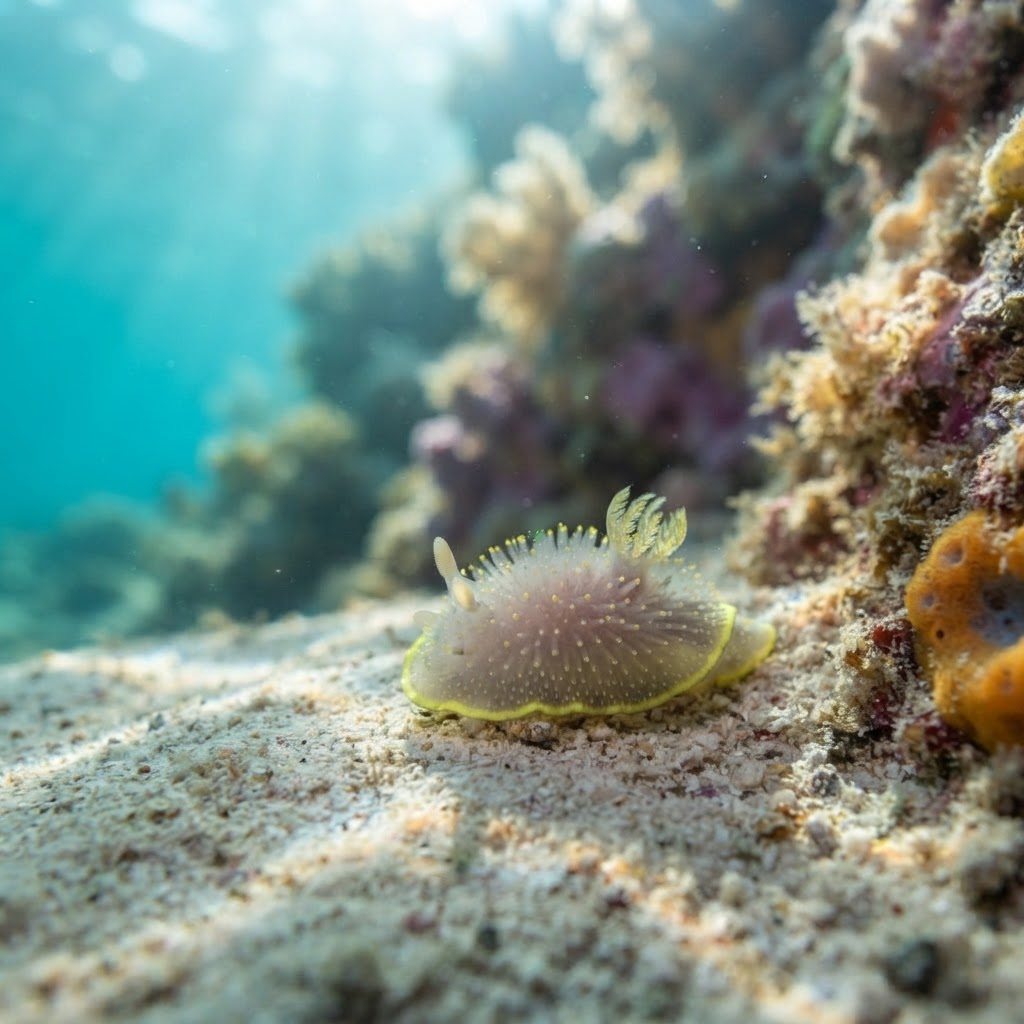
Acanthodoris hudsoni
A 1cm nudibranch logged mostly in British Columbia's cold water, 8.5-14.5C, seen year-round on chilly Pacific dives.
A tiny slug barely a centimetre long, easy to miss unless you're scanning slowly with a torch or macro lens. Body is pale, often whitish to grey, covered in short, blunt tubercles (spiky-looking bumps) that give it a fuzzy, textured look rather than smooth skin. Look for a compact oval shape with feathery gills clustered near the rear and short rhinophores (the paired sensory stalks) up front, both retractable if disturbed.
Divers find it parked on rock and reef surfaces, moving at the unhurried pace typical of dorid nudibranchs as it grazes. It shows no reaction to divers beyond retracting its gills and rhinophores if bumped or disturbed, so a slow approach and a steady light are all you need for a good look. Most logs describe it as uncommon to rare, so expect to search rather than stumble across one.
Like other dorid nudibranchs, it likely feeds on sponges, using its exposed gill cluster to breathe while its spiky tubercles help it blend into the encrusted rock and rubble it sits on.
Sightings don't show a clear seasonal pattern, so it's logged year-round in the cold water it prefers. It sits happily in the 8.5 to 14.5C range typical of British Columbia's coastal dives, meaning conditions suit it whenever you're willing to get in that water.
Almost every logged sighting comes from British Columbia, Canada, making it the place to look if you want a real shot at finding one. A single site in the Pacific Northwest region of the United States rounds out the known range, so treat this firmly as a cold-water British Columbia specialty rather than something to search for elsewhere.
Mapping where Hudson Spiny Doris is logged…
British Columbia, Canada is by far the strongest region for this species, with a single additional site logged in the Pacific Northwest, United States. Outside these cold-water areas it isn't reliably recorded.
There's no strong seasonal pattern in the sightings, so it's considered a year-round find in its cold-water range. It's recorded in water between 8.5 and 14.5C, typical of British Columbia diving throughout the year.
Look for a pale, spiky-textured slug about 1cm long, with short tubercles covering its body and a small gill cluster near the tail. It sits low on rock surfaces and moves slowly, so a careful, close look is needed to spot it.
It's a tiny nudibranch, typically reaching about 1cm in length, so divers usually need a macro lens or a sharp eye to notice it at all.
No, it poses no danger to divers. It's a small, slow-moving grazer with no sting or bite to worry about.
Site and sighting data is aggregated from diver logs, iNaturalist and GBIF. For taxonomy and conservation status:
Light-spotted Aegires
3,168 sites





