Doto amyra
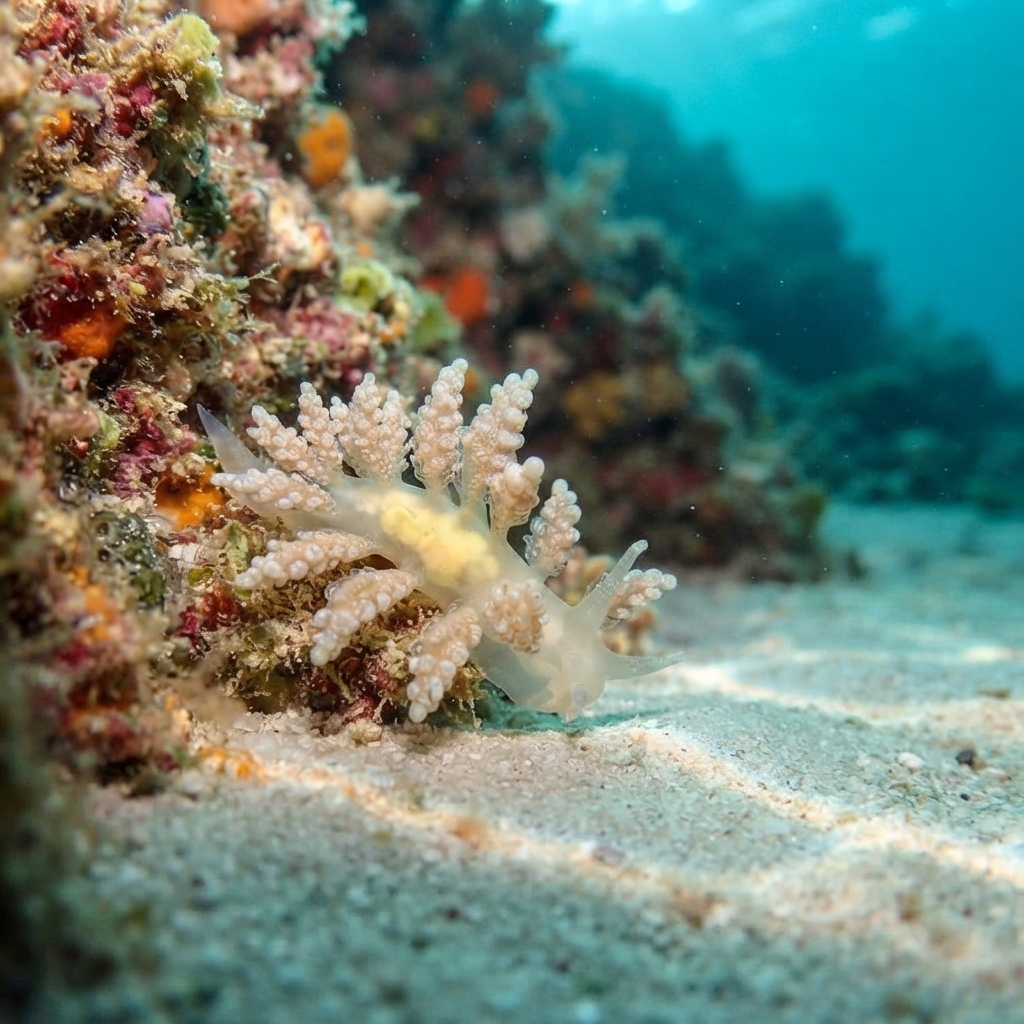
A 1cm nudibranch found on cold Pacific Northwest reefs at 8.5-14.5C, seen year-round if you know where to look on the hydroids.
Barely a centimetre long, this nudibranch has a translucent white to pale grey body covered in a few large, rounded tubercles (bumps) held up on stalks, giving it a knobbly, almost hammer-headed profile compared to smoother slugs. Look closely on hydroid branches rather than open rock, since its size and colour let it disappear against the strands. There is no reported difference between individuals worth noting underwater.
Divers find this one sitting motionless or grazing slowly along the branches of hydroids, its main food source, often tucked in close enough to the stalk that a slow, careful look is needed to spot it at all. It shows no reaction to divers beyond the passive stillness typical of small nudibranchs, and it is usually found during macro-focused dives rather than casual reef swims. Most logs come from sheltered, current-light sites where hydroid colonies are established.
Like other Doto species, it feeds exclusively on hydroids and can store stinging cells from its prey in the tips of its tubercles as a passive defence, a trick borrowed rather than built from scratch.
Sighting records do not show a clear seasonal spike, so treat it as a year-round find within its 8.5 to 14.5C temperature niche. That range matches Pacific Northwest waters for most of the year, so timing your dive around hydroid growth matters more than the calendar.
Most reliably logged in the Pacific Northwest of the United States, with the bulk of sightings from Washington's cold-water sites, plus a scattering of records from California and British Columbia in Canada. This is a cold-water specialist, so do not expect it on warm tropical reefs.
Mapping where Hammerhead Doto is logged…
It is most often logged in the Pacific Northwest of the United States, particularly Washington state, with additional sightings in California and British Columbia, Canada. Look for it on hydroid-covered structure at cold-water sites in these regions.
There is no strong seasonal pattern in the sighting data, so it is considered a year-round find. It lives in water between 8.5 and 14.5C, which covers most of the Pacific Northwest diving season.
Look for a translucent white or pale slug about 1cm long with a few large, stalked, club-shaped bumps along its back. It sits directly on hydroid branches, which is the best clue since its size and colouring blend in against them.
Around 1cm, making it a true macro find that is easy to swim past without noticing. Bring a torch and a slow eye for hydroid colonies to spot one.
It feeds only on hydroids and can repurpose the stinging cells from that prey, storing them in its body tubercles for its own defence rather than producing toxins itself.
No. It poses no risk to divers and is harmless to touch, though its small size means it is best left undisturbed for photography.
Site and sighting data is aggregated from diver logs, iNaturalist and GBIF. For taxonomy and conservation status:
Blue Dragon
3,163 sites