
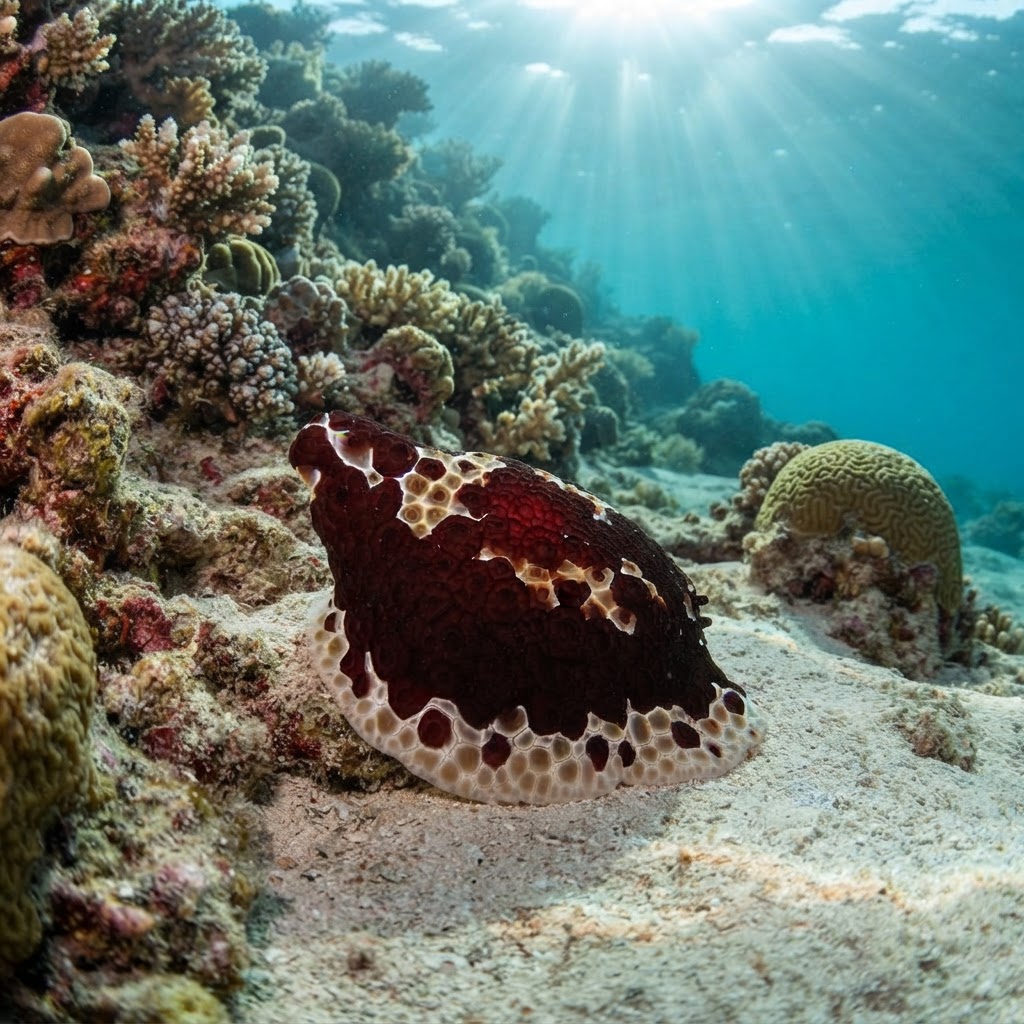
Pleurobranchus grandis
A large mottled sea slug logged across South Sinai and Eilat, comfortable year-round in warm 23-29C Red Sea water.
This is a big, soft-bodied sea slug, growing to around 15 cm, with a broad oval body that looks more like a mottled sponge or a lump of wet leather than a typical nudibranch. Colouring runs through brown, grey and tan blotches, giving it a marbled, camouflaged look against sand and rubble. It lacks the bright gills and rhinophores that make many nudibranchs pop underwater, instead relying on a low, flattened profile and a slightly ruffled mantle edge that you notice once your eyes adjust to the reef floor.
Divers usually find it out in the open on sand, rubble or low reef structure rather than tucked into a crevice, moving slowly across the substrate as it grazes. It shows no real reaction to divers and will simply keep crawling at its own pace, making it an easy subject once spotted, though its camouflage means most divers cruise straight past without noticing it.
Like other pleurobranchs, it feeds on sponges and tunicates and can absorb chemical compounds from that diet into its own tissue, which likely helps make it unappetising to predators despite having no shell or obvious defences.
No clear season shows up in the sighting data, and with a comfortable range of 23.1 to 29.5C it has no need to migrate seasonally, so treat it as a year-round find on Red Sea and Indo-Pacific reefs.
Most reliably logged in South Sinai, Egypt, which accounts for the bulk of sightings, with further records from Eilat in Israel and Muscat in Oman. Smaller numbers turn up in Indonesia, across Nusa Tenggara and Sulawesi, and it has also been recorded in Hawaii, so it is not confined to the Red Sea even though that is where divers see it most.
Mapping where Grand Pleurobranch is logged…
South Sinai in Egypt is the most consistent region for sightings, with further records in Eilat, Israel, and Muscat, Oman. It also turns up occasionally in Indonesia's Nusa Tenggara and Sulawesi, and in Hawaii.
There is no strong seasonal pattern in the sightings, and it tolerates a wide temperature range of roughly 23 to 29.5C, so it is a fair year-round find on the reefs where it occurs.
Look for a large, flattened, mottled brown-and-tan sea slug up to 15 cm long, resting or crawling openly on sand or rubble. It lacks bright colours or obvious gills, so it reads more as a camouflaged blob than a classic nudibranch.
They reach around 15 cm, making them one of the larger sea slugs a diver is likely to encounter on a reef, noticeably bulkier than most colourful nudibranch species.
No, they pose no threat to divers. They have no stinging cells or venom that affect humans and simply graze slowly across the substrate when encountered.
They feed on sponges and tunicates, and can take up chemical compounds from these prey into their own body tissue, which is thought to make them less palatable to predators.
Site and sighting data is aggregated from diver logs, iNaturalist and GBIF. For taxonomy and conservation status:
Light-spotted Aegires
3,168 sites





