Flabellina funeka
A small, vivid Flabellina found almost exclusively on South Africa's Western Cape reefs in cool 13 to 19 C water. Here's how to spot one.
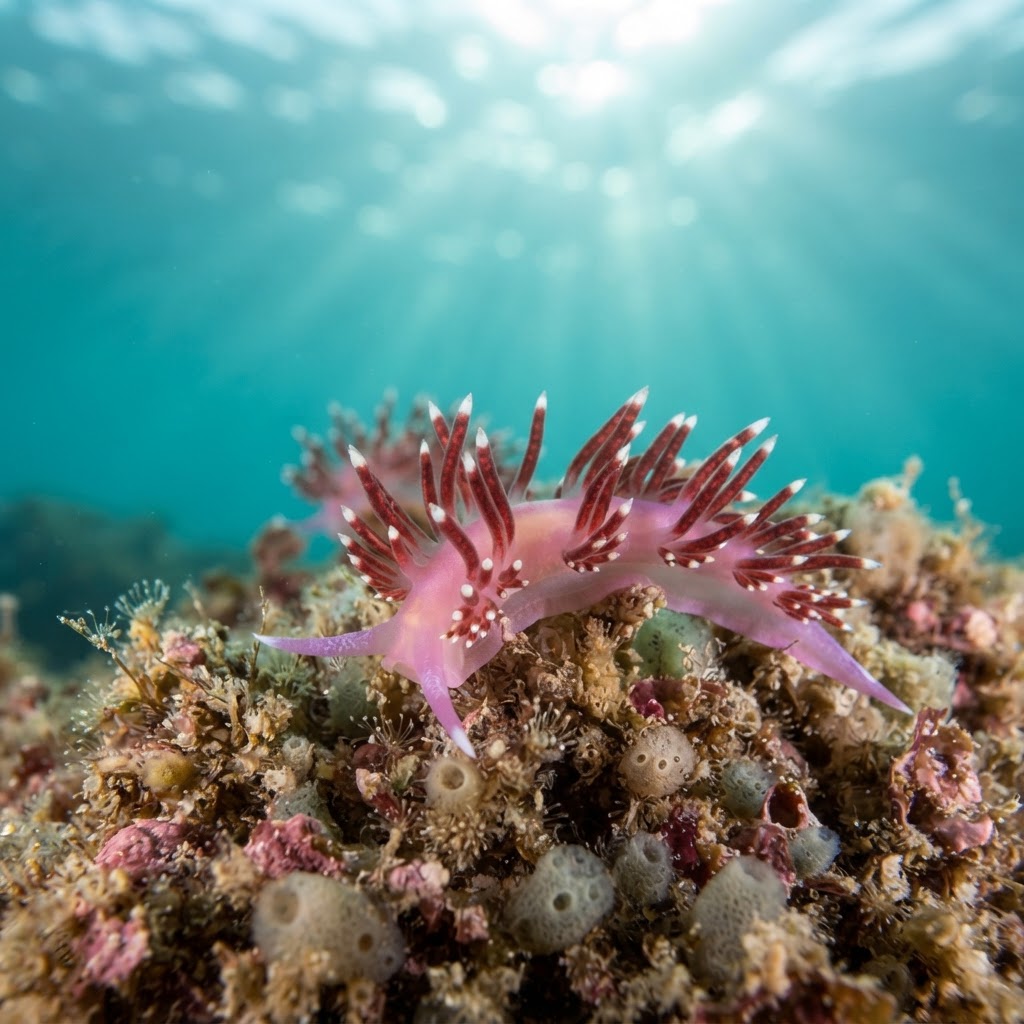
A small, slender sea slug with rows of finger-like projections (cerata) rising off its back, typically flushed pink, violet or reddish with paler tips. The body is narrow and translucent-looking, with the cerata doing most of the visual work rather than the base colour of the skin. Look for it tucked among hydroids and algae on rocky reef rather than out in the open on sand.
Divers find it grazing slowly over rock and encrusting growth, most often tucked into gullies and ledges rather than exposed on open reef. It shows no reaction to divers beyond its usual unhurried crawl, so a slow, close look with a torch is the best way to pick one out among the algae and hydroids it feeds on.
Like other Flabellina species, it likely feeds on hydroids and can recycle their stinging cells into its own cerata as a defence, which is part of why those cerata carry such vivid colour.
There's no clear seasonal pattern in the sightings, and it sits comfortably in the 13.4 to 19.4 C range typical of Western Cape water year-round, so plan around good diving conditions rather than a particular month.
This one is a Western Cape speciality: every logged sighting in the data comes from South Africa, concentrated in the cool reefs of the Western Cape region. If you're diving that coastline and searching rocky reef and kelp-adjacent sites, this is where to look rather than further afield.
Mapping where Gorgeous Triple-tooth is logged…
It's essentially a Western Cape, South Africa speciality, logged across a range of rocky reef sites in that region and nowhere else in the current data. Divers in that area have the best odds of finding it.
Sightings don't show a clear season, and it's found in water from about 13.4 to 19.4 C, which covers most of the Western Cape diving year, so there's no strong reason to time a trip around a particular month.
Look for a small, slender nudibranch with rows of pink or violet-tinged cerata along its back, usually tucked into rocky reef among hydroids rather than out in the open. The narrow, semi-translucent body and colourful cerata are the main things to key on.
Exact size isn't well documented for this species, but like most Flabellina nudibranchs it's a small animal, likely only a few centimetres long, so it's easy to swim past without noticing.
It's thought to feed on hydroids, and many Flabellina species can repurpose the stinging cells from that prey into their own cerata for defence. That borrowed weaponry is part of why the cerata are so brightly coloured.
Site and sighting data is aggregated from diver logs, iNaturalist and GBIF. For taxonomy and conservation status:
Light-spotted Aegires
3,168 sites