Glaucus atlanticus
Spot the Atlantic Sea Swallow off New South Wales, Andalusia and the Canary Islands. A pelagic nudibranch most logged between 16-26 °C.
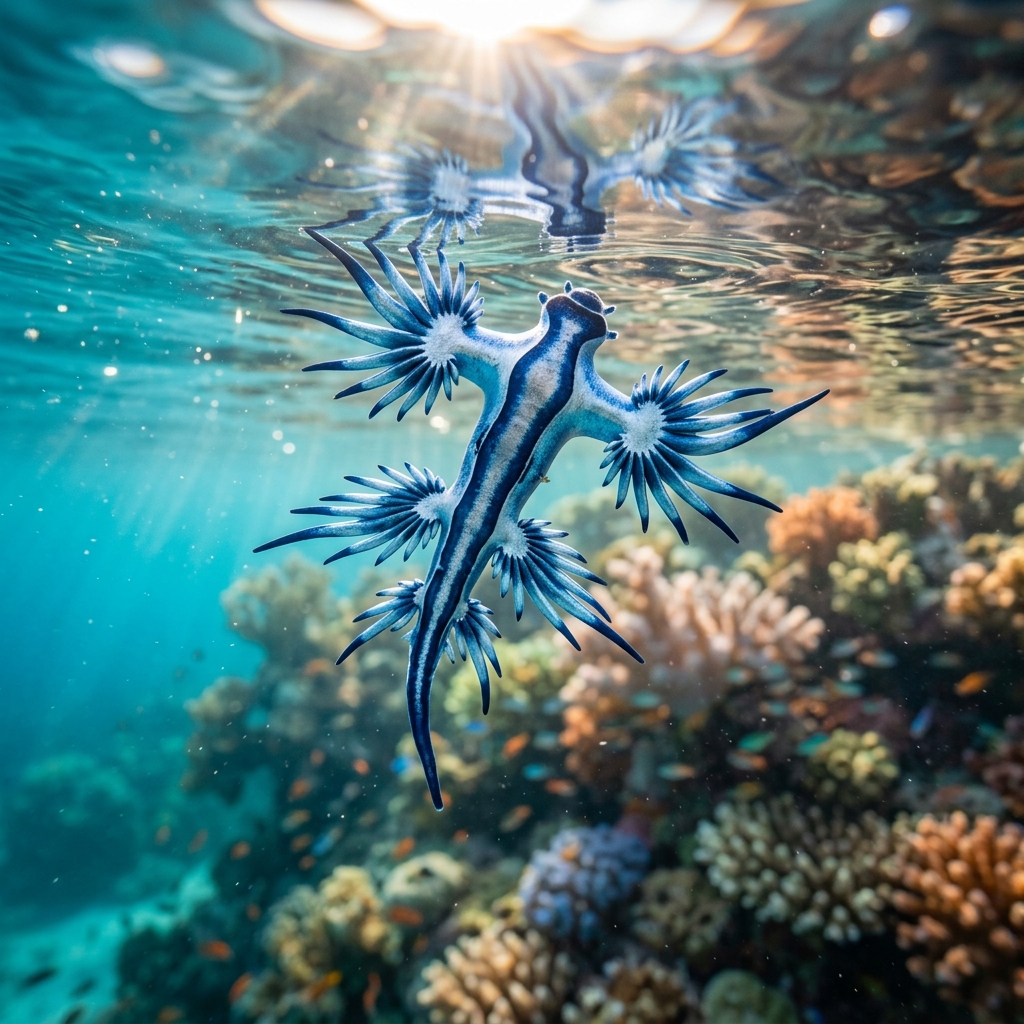
Floating upside-down at the sea surface, the Atlantic Sea Swallow presents a silvery-blue back and a pale whitish belly, a colour pattern that works as counter-shading in open water. The body is small and flattened, with distinctive finger-like cerata (fleshy appendages) arranged in star-shaped clusters along each side. Because it drifts with the current rather than crawling on a reef, the setting itself is a key identification clue: if you see a small blue nudibranch at the surface in open water, this is likely it.
Unlike reef nudibranchs, this species lives entirely at the open-ocean surface, hanging upside-down from a self-made raft of trapped air bubbles and drifting with wind and current. Divers most often encounter it washed close to shore or beached, rather than on a conventional dive, making snorkellers and shore-walkers just as likely to find one as scuba divers. It shows no particular reaction to observers and can be watched closely without disturbing it.
The Atlantic Sea Swallow preys on the venomous Portuguese man o' war and other siphonophores, storing their stinging cells (nematocysts) in its own cerata and deploying them for defence, making its sting potentially more concentrated than its prey's.
Northern hemisphere data points to March as the peak period, though the global spread of sightings suggests this animal turns up whenever ocean currents deliver it to shore. It tolerates water temperatures from roughly 16 to 26 °C, so it is most reliably encountered in temperate and warm-temperate seas rather than the tropics.
Most commonly logged in Australia, particularly along the New South Wales and Queensland coasts, where sightings come from a wide spread of sites. Spain's Andalusia coast and the Canary Islands, especially Fuerteventura, account for a strong cluster of European records, while South Africa's Western Cape and Durban and North Coast round out the main hot spots. Smaller numbers of sightings come from Mexico's Pacific Coast and northern Taiwan.
Mapping where Atlantic Sea Swallow is logged…
Most sightings come from the New South Wales and Queensland coasts of Australia, Spain's Andalusia coast, the Canary Islands around Fuerteventura, and South Africa's Western Cape and Durban regions. Smaller numbers of records exist for Mexico's Pacific Coast and northern Taiwan. Because this species drifts at the surface, encounters are often opportunistic near shore rather than at planned dive sites.
In northern hemisphere locations, March is the month with the most recorded sightings. More broadly, the species appears wherever ocean currents carry it into water between about 16 and 26 °C, so timing depends heavily on local current patterns rather than a fixed season.
Look for a tiny, flat nudibranch floating upside-down at the sea surface with a blue-grey back and pale white belly. The clustered, finger-like cerata along its sides are distinctive. Its open-water, surface-drifting lifestyle is itself a strong identification clue, since very few nudibranchs live this way.
They are very small animals, typically reaching only a few centimetres in length. Their small size means they are easy to overlook, especially when floating among sea foam or debris lines at the surface.
It lives its entire life floating upside-down at the open ocean surface, suspended from a raft of air bubbles it produces itself. It actively hunts venomous jellyfish and man o' war, recycling their stinging cells into its own body for defence, a trick called kleptocnidy.
They are not considered dangerous to divers. However, because they store stinging cells taken from venomous prey such as the Portuguese man o' war, handling one is not recommended, as contact with the cerata could cause a mild sting.
Site and sighting data is aggregated from diver logs, iNaturalist and GBIF. For taxonomy and conservation status:
Light-spotted Aegires
3,168 sites