Hypsypops rubicundus
Bright orange and fiercely territorial, Garibaldi are most reliably spotted along the US Pacific Coast from May to October in cool 15-19°C water.
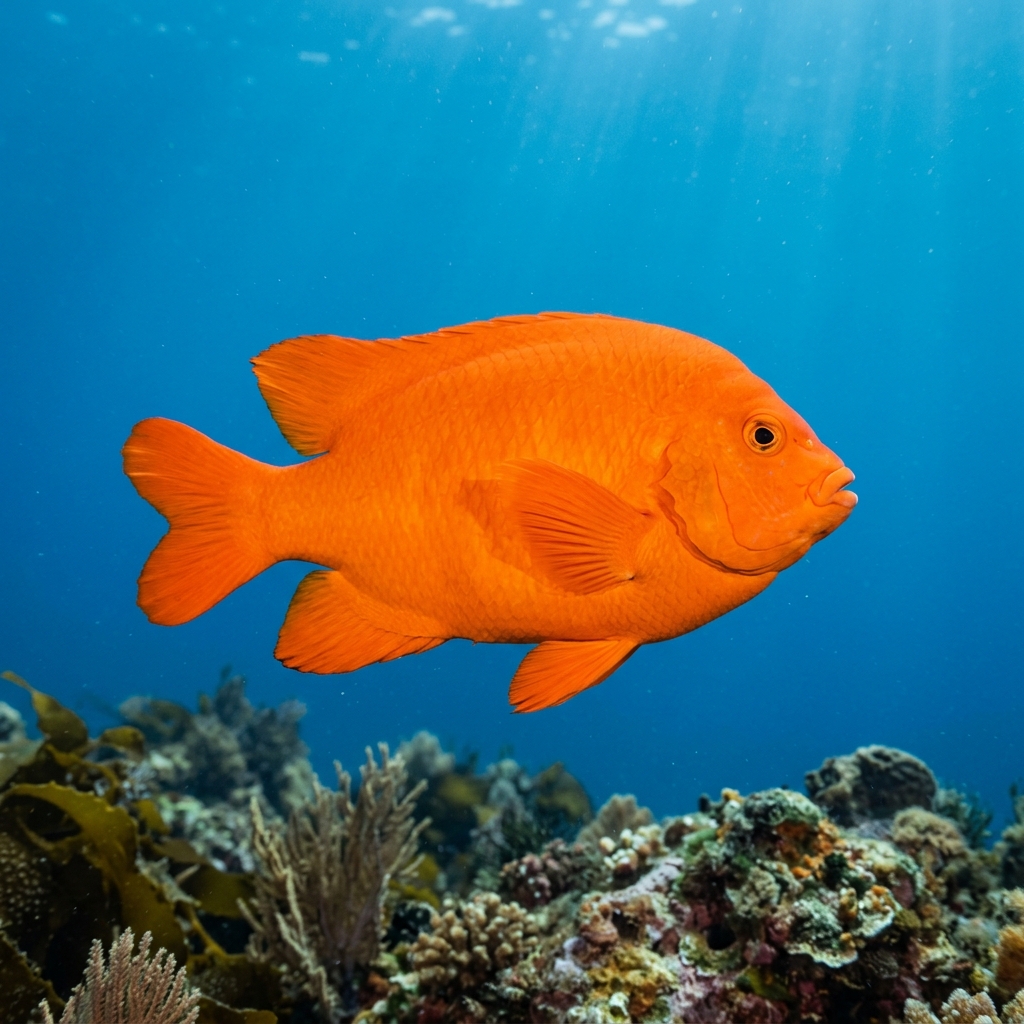
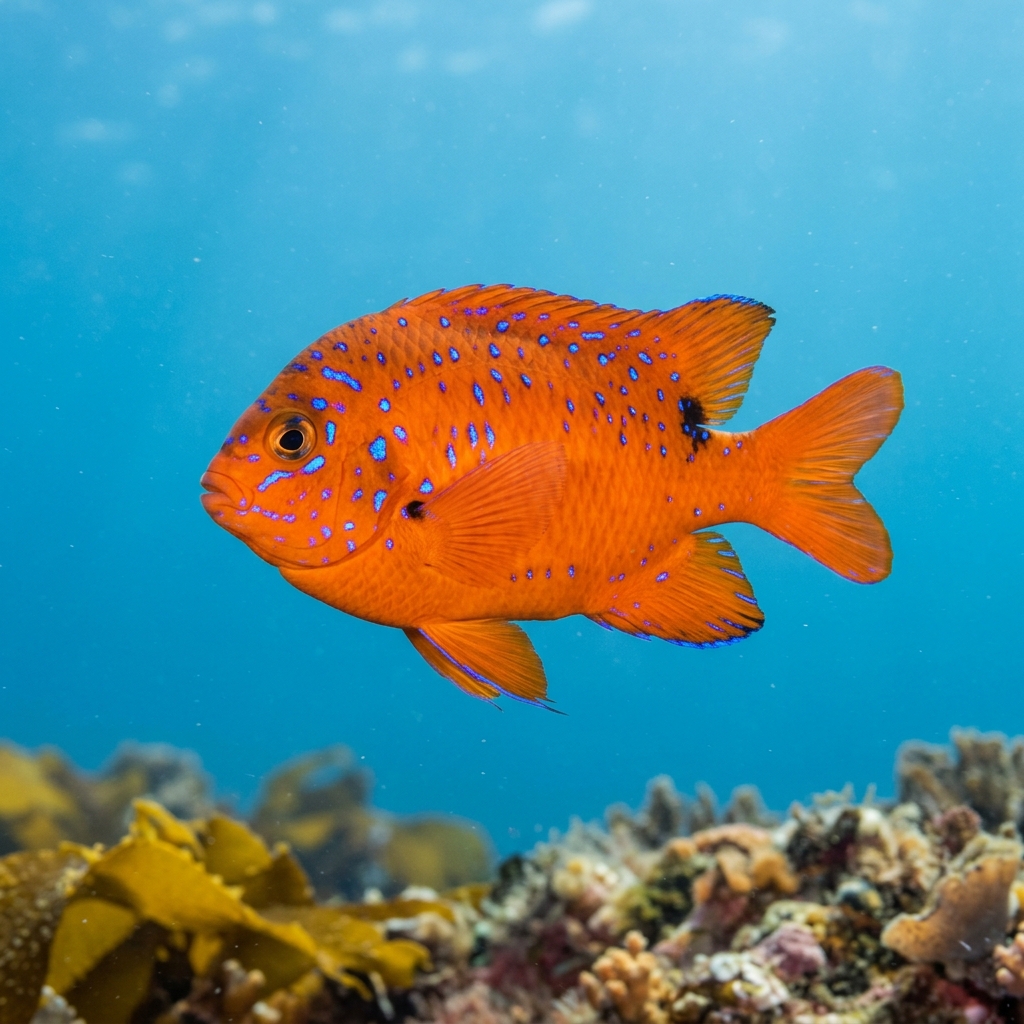
Few reef fish are easier to spot: a solid, vivid orange body roughly 20 cm long with no stripes, spots, or contrasting markings makes the adult unmistakable on any California or Baja rocky reef. The body is deep and oval, and that uniform flame-orange colouration holds true whether the fish is in sunlight or shade. Juveniles are the same warm orange but are scattered with iridescent electric-blue spots and streaks across the body and fins, making them look like an entirely different species.
Garibaldi are diurnal (active during daylight) and conspicuous; they rarely hide and will often approach divers with apparent curiosity rather than flee. Males are intensely territorial around their nesting sites, which are carefully maintained patches of red algae on rocky substrate, and may dart at or nip a diver who gets too close to the nest. Outside of breeding season they are bolder and more relaxed, but expect a resident fish to hold its ground and eye you with obvious interest rather than scatter.
Male Garibaldi are dedicated nest-keepers: they spend weeks cultivating a specific patch of red algae, pruning it to the right texture before courting females and then guarding the eggs alone until they hatch. Watching a male tend his algal garden is one of the more unusual fish behaviours you'll witness on a temperate reef.
Sightings concentrate between May and October in the Northern Hemisphere, which aligns with the species' preference for cool water in the 15 to 19°C range typical of the California Current during those months.
Garibaldi are overwhelmingly a US Pacific Coast animal, with the vast majority of logged sightings coming from California's rocky reefs and kelp forests. A secondary population is recorded in Northern Pacific Mexico, making Baja California the natural southern extension of any trip targeting this species. Sites elsewhere are sparse and peripheral.
Mapping where Garibaldi is logged…
Garibaldi are concentrated along the US Pacific Coast, where California's rocky reefs and kelp forests hold strong populations. Northern Pacific Mexico, particularly Baja California, is the next most reliable area. Sightings outside these two regions are rare.
Sightings peak between May and October along the US Pacific Coast. This matches the cooler water temperatures the species favours, typically 15 to 19°C, which are most consistent during the warmer months of the California upwelling season.
Adults are a solid, bright orange with no markings whatsoever, making them one of the easiest reef fish to name on sight. Juveniles share the orange base colour but are decorated with iridescent electric-blue spots and streaks. No other common fish in their range looks similar.
Adults typically reach around 21 cm in length. They have a deep, rounded body that makes them look bulkier than that length suggests, and that compact shape combined with vivid colouration makes them very easy to spot.
They are territorial, especially males guarding nesting sites, and may dart at or briefly nip a diver who approaches too closely. This is defensive posturing rather than a real threat. Give nesting males a little extra space and you will have no trouble.
Male Garibaldi cultivate and prune specific red algae patches to use as nests. They attract females to spawn on this prepared surface, then guard the eggs alone until hatching. The behaviour is a well-documented example of parental care in fish and is one of the most interesting things to watch on a temperate Pacific reef.
Site and sighting data is aggregated from diver logs, iNaturalist and GBIF. For taxonomy and conservation status:
Dascyllus
3,697 sites