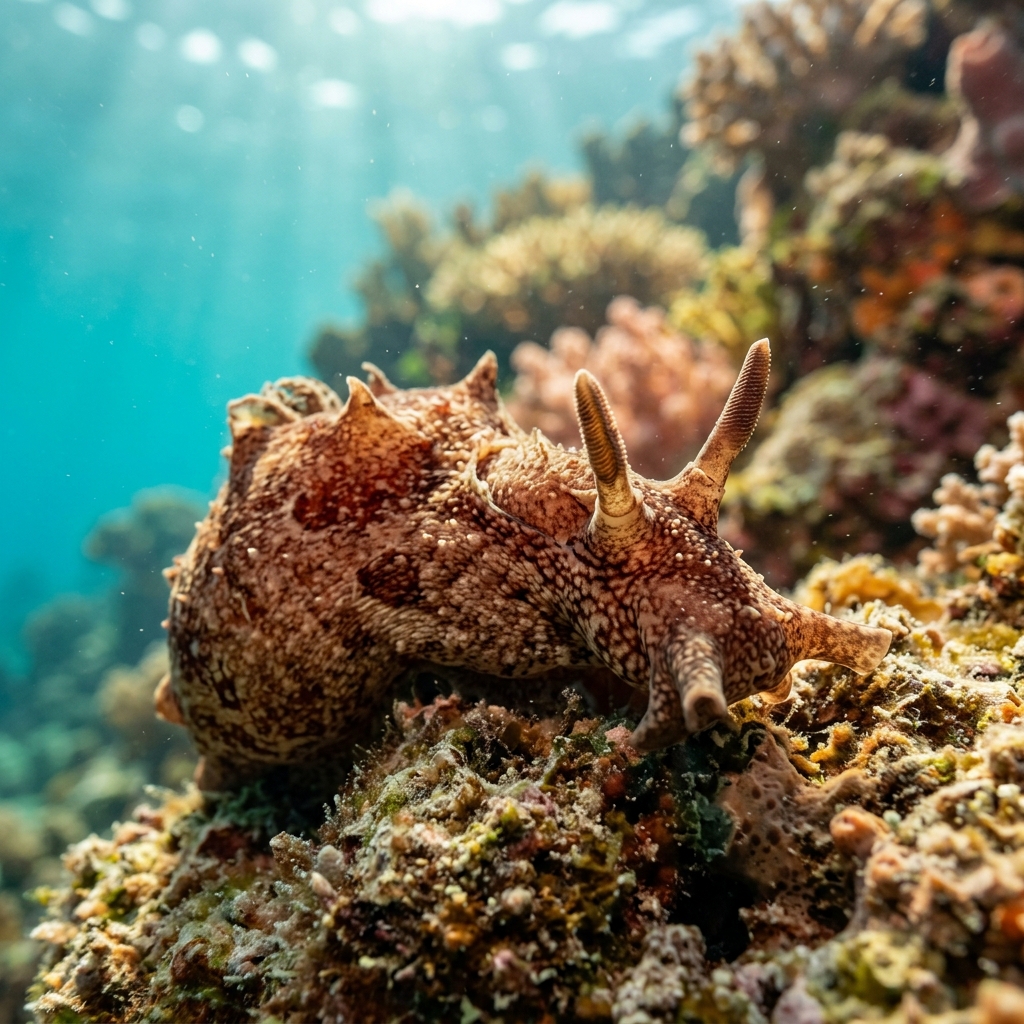
Notodoris gardineri
A yellow-spotted egg-shaped nudibranch turning up on reefs in Sulawesi, Raja Ampat and Queensland year-round in warm 23-29C water.
Egg-shaped and unmistakably yellow, with a soft-looking body covered in small raised bumps (tubercles) that give it a slightly warty texture rather than a smooth or frilled look. At around 5 cm it sits low and rounded on the reef, lacking the tall gills and rhinophores that make many other nudibranchs look spiky. Its plain, almost glowing yellow colouring with no contrasting stripes or spots is the single easiest clue to lock in an ID underwater.
Look for it parked in the open on rock or reef rubble rather than tucked into a crevice, moving slowly across the surface as it grazes. Divers generally find it during the day on standard reef dives, and it pays no attention to a camera hovering close by since it has no real means of fleeing anyway.
Like other members of its family, it almost certainly feeds on sponges, and its plain yellow colouring is thought to work as a warning to predators that it is not worth the trouble to eat.
No clear seasonal pattern shows up in the sightings, and its comfortable temperature range of roughly 23 to 29C spans tropical reefs all year, so any month is fair game.
Most reliably logged across Indonesia and the Philippines, with strong numbers of sites in Sulawesi and Raja Ampat, plus Luzon, Palawan, Mindanao and the Visayas. It also turns up well beyond that core range in Queensland (Australia), Okinawa and the Ryukyu Islands, Thailand, Malaysia, Japan, Micronesia and Vietnam, making it a wide Indo-Pacific find rather than a one-region specialty.
Mapping where Gardiner's Nudibranch is logged…
It's most commonly logged in Indonesia and the Philippines, particularly Sulawesi, Raja Ampat, Luzon, Palawan and the Visayas, with further sightings in Queensland, Australia, and Okinawa, Japan.
There's no strong seasonal pattern in the data, and it sits comfortably in 23 to 29C water, so it's a realistic find on tropical reef dives at any time of year.
Look for a small, egg-shaped sea slug, roughly 5cm long, coloured a plain warm yellow with a slightly bumpy skin texture and no bold stripes or spots. Its rounded, low-profile shape sets it apart from spikier, more colourful nudibranch species on the same reef.
They typically reach around 5cm in length, making them a small but reasonably visible find against reef rubble or rock thanks to their bright yellow colour.
No. It has no sting or bite of concern to divers and is completely safe to observe or photograph at close range.
It almost certainly grazes on sponges, in keeping with its family, and its bright yellow body is thought to advertise to predators that it isn't worth attacking.
Site and sighting data is aggregated from diver logs, iNaturalist and GBIF. For taxonomy and conservation status:
Light-spotted Aegires
3,168 sites