Dondice occidentalis
Orange-tipped cerata and a translucent body make this 4cm slug a Guadeloupe reef favourite, seen year-round in 25-31°C water.
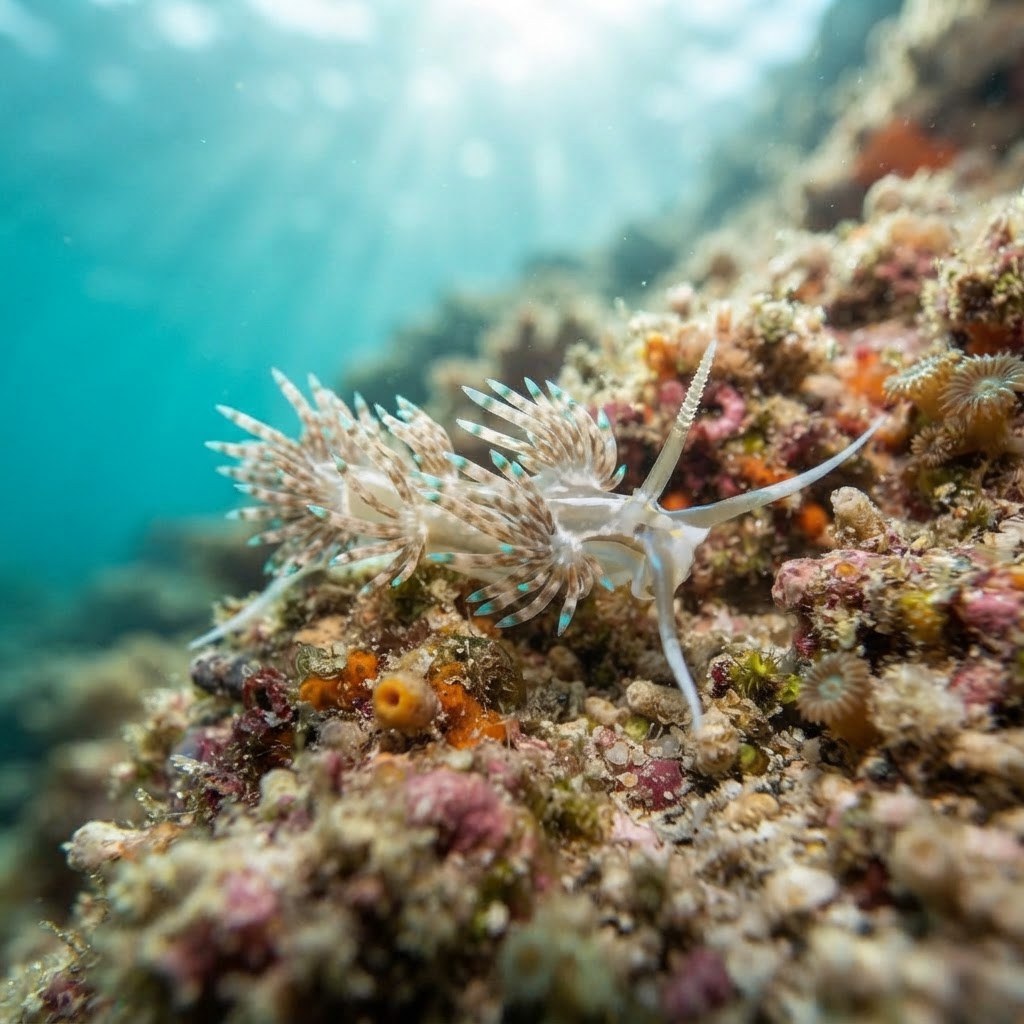
A small, slender slug around 4cm long, with a translucent to pale body covered in rows of finger-like projections (cerata) that carry bright orange or reddish tips. The head bears two rhinophores (sensory tentacles) that often show the same warm colour as the cerata tips, giving the whole animal a fringed, almost feathery silhouette against the reef. Look for it moving slowly across rubble or algae rather than sitting still, since its low bulk and pale base colour make it easy to swim straight past.
Divers typically spot this slug creeping slowly over rubble, algae mats or low reef structure while grazing, rather than out in the open water column. It shows no reaction to divers beyond its usual unhurried pace, so a slow look with a torch or magnifier is the best way to actually notice one. Most reports describe it as uncommon to rare at any given site, so finding one is more a matter of careful searching than a guaranteed sighting.
Like many aeolid nudibranchs, it likely feeds on hydroids and can store stinging cells from its prey in those orange-tipped cerata as a defence against predators.
No clear seasonal pattern shows up in the data, and with a comfortable range of roughly 25 to 31°C it stays active on these reefs all year. Plan around site conditions and visibility rather than a particular month.
This one is most reliably found around Guadeloupe, especially Basse-Terre and Grande-Terre, which together account for the bulk of logged sightings, with Îles des Saintes also worth checking. Outside Guadeloupe it turns up around Grand Cayman in the Cayman Islands, and in smaller numbers in Anguilla and Florida.
Mapping where Fringe-back Nudibranch is logged…
Guadeloupe is the strongest area, particularly Basse-Terre and Grande-Terre, with further sightings around Grand Cayman in the Cayman Islands and smaller numbers in Anguilla and Florida.
There's no detected seasonal pattern, and it tolerates a wide warm-water range of about 25 to 31°C, so it can be found on tropical reefs throughout the year.
Look for a translucent, slender body around 4cm long covered in cerata with orange or reddish tips, plus similarly coloured rhinophores on the head. It moves slowly over rubble and algae rather than swimming.
They reach around 4cm in length, making them a small find that's easy to miss without a slow, close look at the substrate.
No, they pose no danger to divers. They have no sting or bite that affects humans, so they're safe to observe and photograph at close range.
Site and sighting data is aggregated from diver logs, iNaturalist and GBIF. For taxonomy and conservation status:
Light-spotted Aegires
3,168 sites