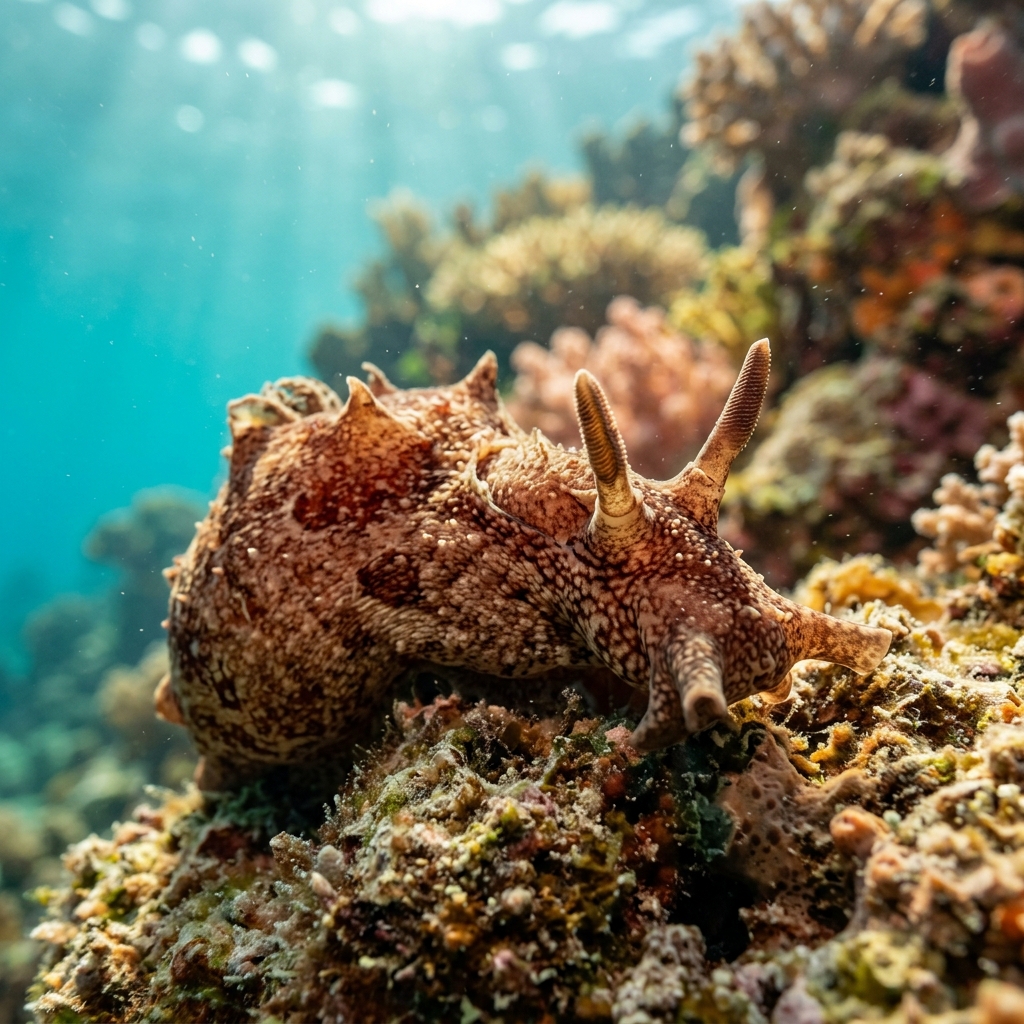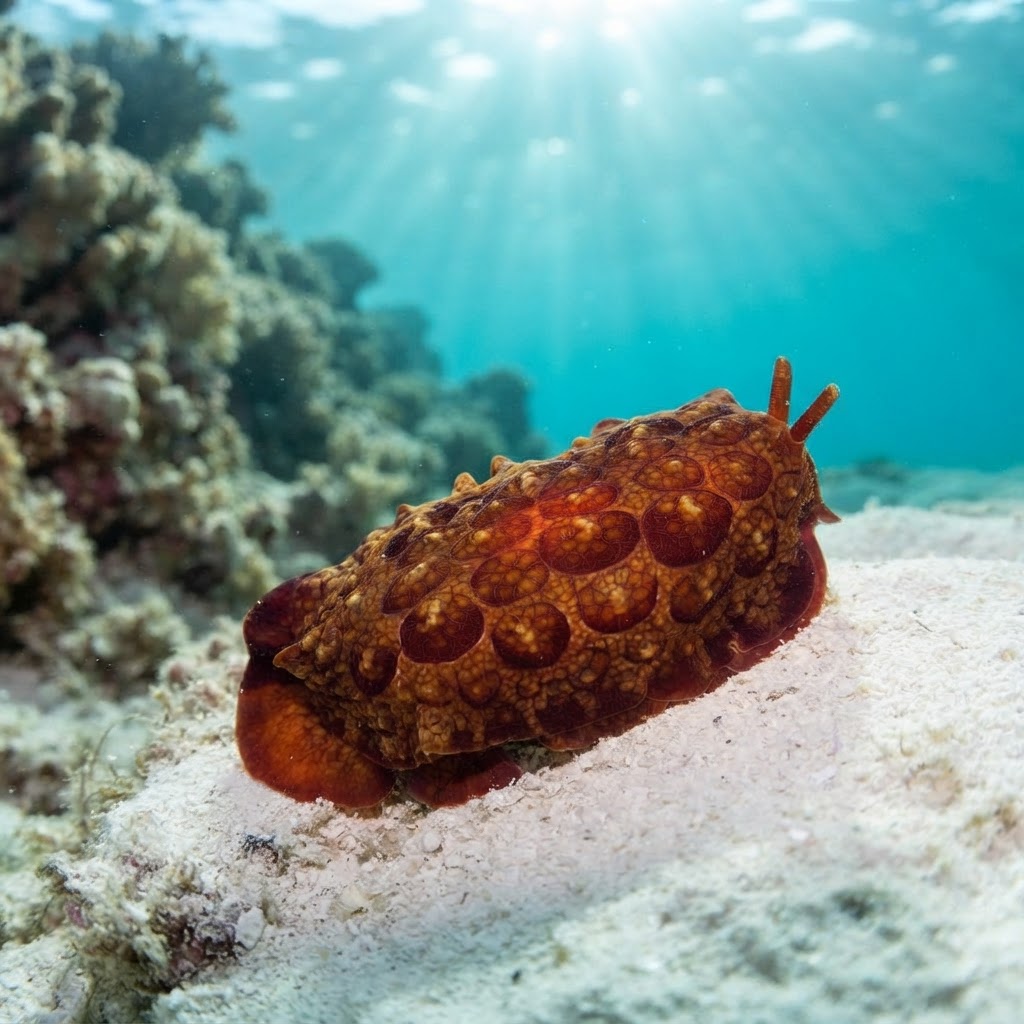
Pleurobranchus forskalii
Warty orange-brown slug logged across Luzon and Bali reefs in warm 24-30C water, mostly spotted uncommon on night dives.
Look for a broad, flattened slug with a warty, mottled surface in shades of orange, brown and cream that can look almost like a sponge from a distance. It has a large oral veil at the front and gills tucked under the right side of its mantle rather than on its back, which separates it from the more familiar back-gilled nudibranchs. Sizes reported by divers vary widely, so treat body pattern and that lumpy, blotched skin as the main giveaway rather than scale.
Divers usually find this slug crawling slowly over rubble, sand patches or sponge-covered substrate, often on night dives when it seems more active. It shows no real reaction to divers beyond continuing its slow grazing pace, making it an easy, patient subject for close-up photos once spotted. It rates as uncommon at most sites where it does appear, so finding one usually takes a guide who knows to check the right patch of reef.
Its gills sit hidden beneath the right side of the mantle rather than exposed on the back, a trait shared by all sidegilled slugs and a useful clue when the body pattern alone is not conclusive.
Sightings show no clear seasonal pattern, and the species has been recorded in water from about 23.6 to 29.7C, so it is a year-round find on tropical and subtropical reefs rather than a seasonal special.
Most consistently logged in the Philippines, especially around Luzon and the Visayas, and in Indonesia, with strong numbers from Bali, Sulawesi and West Papua. Smaller but reliable populations turn up in Timor-Leste's Atauro Island, Egypt's South Sinai, and Japan's Okinawa and Ryukyu Islands, with occasional sightings in Tanzania, Malaysia and Australia.
Mapping where Forskal's Sidegilled Slug is logged…
It shows up most reliably in the Philippines, particularly Luzon and the Visayas, and in Indonesia around Bali, Sulawesi and West Papua. Smaller numbers are logged in Timor-Leste, Egypt's South Sinai and Japan's Okinawa region.
There is no strong seasonal pattern in the data, and it tolerates a wide warm-water range from roughly 23.6 to 29.7C, so it can be found on tropical reefs throughout the year.
Look for a flattened, warty-skinned slug in mottled orange, brown and cream tones with gills hidden under the right side of the body instead of exposed on top. Its texture often reads more like a lumpy sponge than a typical smooth nudibranch.
No, it poses no threat to divers and can be observed and photographed up close without any risk.
Unlike typical back-gilled nudibranchs, it carries its gills tucked beneath the right side of its mantle, a defining trait of the sidegilled slug group it belongs to.
Site and sighting data is aggregated from diver logs, iNaturalist and GBIF. For taxonomy and conservation status:
Light-spotted Aegires
3,168 sites