Flabellina cavolini
A small violet-tipped nudibranch found on rocky reefs from the French Riviera to Catalonia, year-round in 15 to 21 C water.
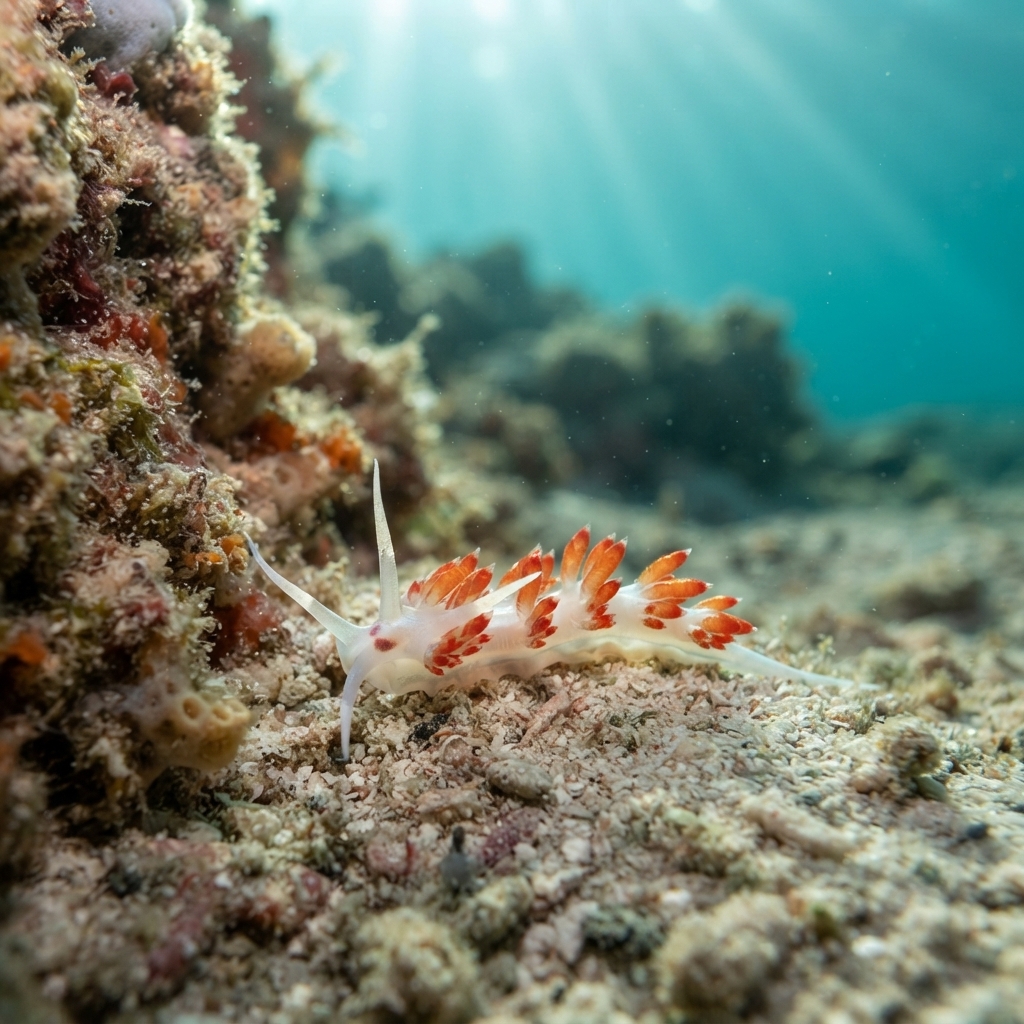
A slender, translucent white to pale pink body carrying rows of finger-like projections (cerata) along its back, each tipped with a vivid violet or purple band. Look closely and you will spot orange-red cores running through the cerata, visible through the translucent skin. Most individuals are small enough that you need to get close to the rock or algae they are grazing on to notice them at all, and the two curled head tentacles (rhinophores) are usually the same violet shade as the cerata tips.
Found slowly grazing over rock, algae and hydroid-covered surfaces where it feeds, moving little and ignoring divers entirely. It shows up most often on careful, slow-paced dives where divers are scanning walls and boulders at close range rather than cruising past, since its small size means it is easy to swim straight over. Most logs describe single animals rather than groups, and sightings run from uncommon to rare at most sites, with a smaller number of sites producing common or very common counts.
Like other Flabellina species, it feeds on hydroids and can recycle their stinging cells (nematocysts) into its own cerata tips, turning a food source into a defence.
No clear seasonal peak shows up in the sightings, so treat it as a year-round find on Mediterranean rock and algae reefs where water sits between 15.1 and 21.1 C. Cooler months on the low end of that range and warmer summer water on the high end both produce sightings.
Most reliably logged in Spain, particularly Valencia, Catalonia, the Balearic Islands and Murcia, with France close behind, especially the French Riviera and Provence. Croatia adds a smaller but steady presence in Central Dalmatia and Kvarner, making this a broadly Mediterranean sighting rather than a single-site specialty.
Mapping where Cavolini's Flabellina is logged…
It turns up across the Mediterranean, most often logged in Spain's Valencia, Catalonia and Balearic Islands regions, along France's Riviera and Provence coast, and in Croatia's Central Dalmatia and Kvarner areas.
Sightings do not show a strong season, so it is logged year-round on Mediterranean reefs where water temperature ranges from about 15 to 21 C.
Look for a small translucent white body with rows of cerata tipped in violet or purple, often with an orange-red core visible through the skin. The matching violet rhinophores on the head are a useful confirming detail.
No, it poses no risk to divers. It has no ability to harm humans and simply grazes on hydroids at its own pace.
It grazes on stinging hydroids and repurposes their nematocysts, storing them in its own cerata tips as a borrowed defence against predators.
Site and sighting data is aggregated from diver logs, iNaturalist and GBIF. For taxonomy and conservation status:
Light-spotted Aegires
3,168 sites