Felimare tricolor
Spot the Tricolor Doris along the French Riviera, Costa Brava and Algarve. A cool-water nudibranch, sighted from late autumn through summer.
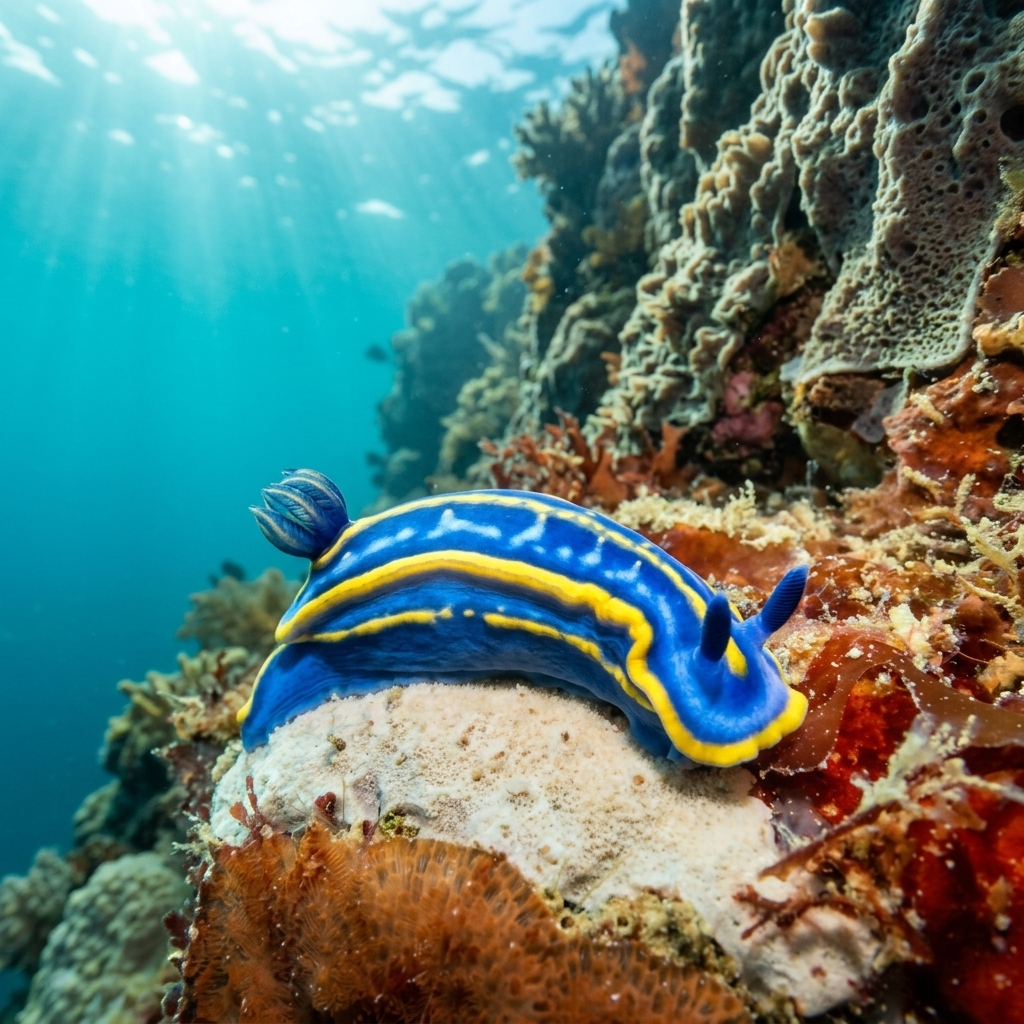
A compact, flattened nudibranch with a vivid blue body edged by a bold white margin and a contrasting orange or yellow inner border running around the mantle. The gills and rhinophores (scent organs on the head) are typically blue with white tips, making them stand out clearly against the rocky substrate. Look for that three-tone rim pattern: blue centre, white band, then orange, which is the feature that gives this species its name. It is a slow-moving animal found creeping across encrusting sponges and algae-covered rock.
You will usually find one crawling slowly over encrusting sponges or algae-covered rock, often in the shallows or on sheltered walls where its prey is abundant. It pays little attention to divers and will continue feeding as you approach, making close observation straightforward if you move slowly. Like other chromodorids, it likely feeds on sponges and stores chemical compounds from them as a defence against predators.
The three-colour mantle border is not just eye-catching; it is a warning signal. By concentrating distasteful compounds from the sponges it eats into its own tissues, the tricolor doris advertises its unpleasantness to would-be predators through those bold contrasting colours.
Sightings are recorded from November through September across northern hemisphere sites, suggesting a long active season that avoids only the height of summer in some areas. The observed water temperature range of roughly 13 to 22 degrees Celsius points to a preference for cooler temperate conditions, which fits the seasonal pattern well.
The tricolor doris is most consistently logged across the western Mediterranean and eastern Atlantic coast of Europe. France leads the way, particularly along the French Riviera and Provence coastline, with the Costa Brava in Spain and the Algarve in Portugal also ranking among the strongest regions for sightings. Italy, especially Sardinia and the Tuscan coast, rounds out the Mediterranean hotspots, while smaller but reliable records come from the Canary Islands, Gibraltar, and the Azores.
Mapping where Tricolor Doris is logged…
The tricolor doris is most reliably found along the French Riviera and Provence, the Costa Brava in Spain, and the Algarve in Portugal. Strong records also exist for Sardinia, the Tuscan coast, and the Spanish Costa Blanca. Smaller populations have been logged around the Canary Islands, Gibraltar, and the Azores.
Sightings are concentrated from November through September across the Mediterranean and eastern Atlantic, so the season is long. Peak activity aligns with cooler water temperatures, roughly 13 to 22 degrees Celsius, which characterises late autumn, winter, and spring in these regions.
Focus on the mantle border: a blue body edged with a white band and then an orange or yellow inner stripe running all the way around the rim. The gills and rhinophores are blue with white tips. That three-colour margin is the key feature and visible even in low visibility on rocky reef walls.
Exact size data for this species is limited, but like most chromodorids it is a small nudibranch, typically a few centimetres in length. At that scale, a slow approach and a macro lens will give you the best view of its markings.
The bold blue, white, and orange patterning is a form of aposematism, a warning to predators. The tricolor doris feeds on sponges and accumulates their chemical defences in its own tissues, making itself unpalatable. The vivid colours signal that to anything considering a bite.
Site and sighting data is aggregated from diver logs, iNaturalist and GBIF. For taxonomy and conservation status:
Light-spotted Aegires
3,168 sites