
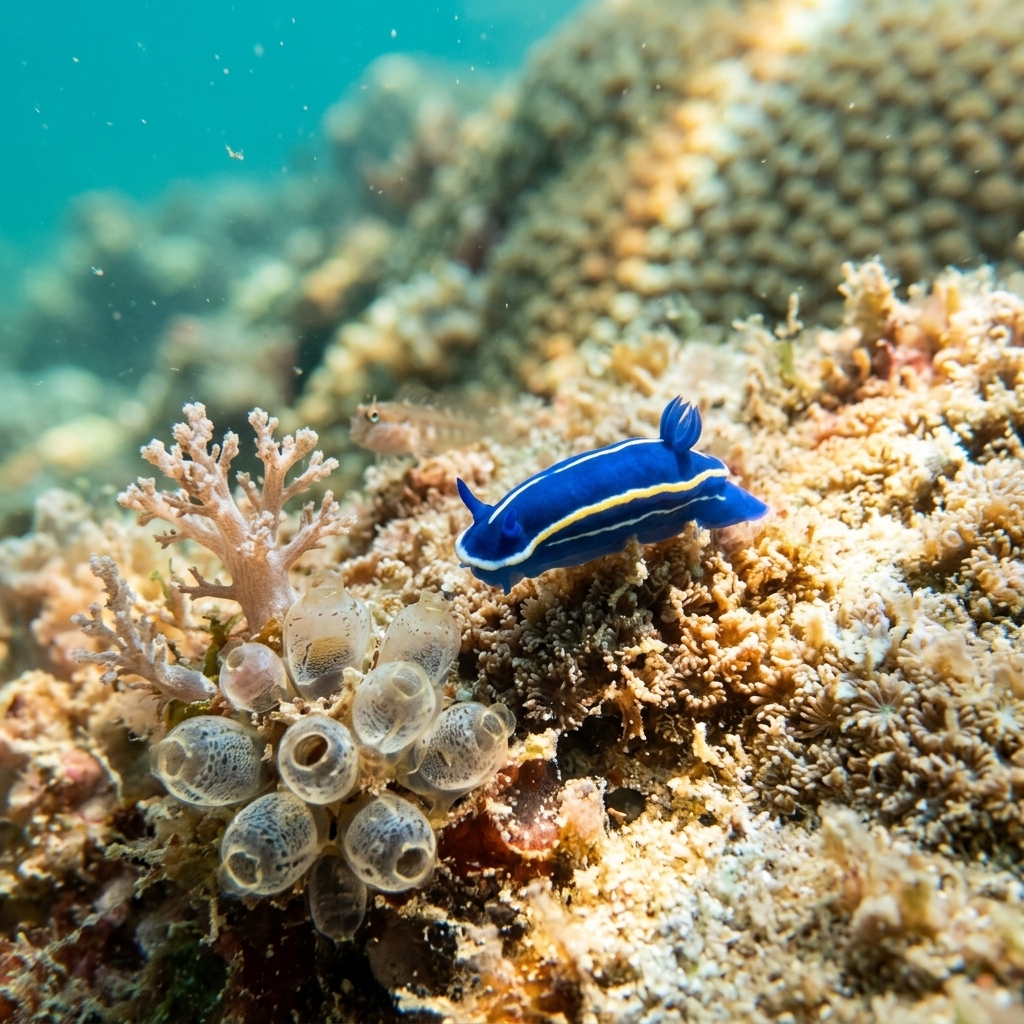
Felimare orsinii
Spot Orsini's Felimare in the French Riviera and Costa Brava between March and August. A chromodorid nudibranch logged across the western Mediterranean.
A chromodorid nudibranch (a shell-less mollusc with exposed gill plumes on its back) with a vivid blue body marked by yellow or orange marginal lines running along the mantle edge. The gill rosette and rhinophores (sensory horns at the head) share the same contrasting colours, which is the key detail to lock onto underwater. Relatively small and low-slung, it moves slowly across encrusted rock, making its bright edging the first thing your eye catches in dim conditions.
Encountered crawling slowly across hard substrate such as rocky reefs and encrusted walls, usually at close range because it rarely moves far or fast. It tends to ignore divers completely, which makes for relaxed observation and photography. Look carefully in areas of coralline algae and sponge growth where its food sources are concentrated.
Like other chromodorids, Felimare orsinii sequesters toxic or distasteful chemicals from the sponges it feeds on, and its striking colour pattern is thought to advertise that unpalatability to would-be predators.
Sightings in the northern hemisphere concentrate from March through August, suggesting a spring and early-summer peak. Water temperatures at logged sites run from around 13 °C to 22 °C, so it tolerates cool conditions well.
Most sightings come from the western Mediterranean, with the French Riviera and Provence accounting for the majority of logged observations by a wide margin. The Costa Brava in Spain is the next most reliable area, followed by Sardinia, Tuscany, and Croatia's Dalmatian coast. Greece, particularly Crete, rounds out the known range.
Mapping where Orsini's Felimare is logged…
The French Riviera and Provence are far and away the most productive areas, with the Costa Brava in Spain a strong second. Sardinia, Tuscany, Croatia's Dalmatian coast, and Crete all have confirmed sightings, so the western and central Mediterranean is the place to look.
Sightings peak between March and August across its range. Spring appears to be particularly productive, coinciding with cooler water temperatures that this species seems well suited to.
Look for a small, slow-moving nudibranch with a blue body and contrasting yellow or orange lines tracing the mantle edge. The gill plume and rhinophores carry the same bold colouring. It crawls on rocky, encrusted surfaces, usually in less than 40 metres of water.
It is most often described as uncommon at the sites where it turns up, though a handful of locations in the French Riviera and Costa Brava do see it regularly. Patience and a slow, thorough search of rocky walls pays off more than luck.
Site and sighting data is aggregated from diver logs, iNaturalist and GBIF. For taxonomy and conservation status:
Light-spotted Aegires
3,168 sites





