Doto pinnatifida
A small, branched-looking nudibranch turning up in Brittany's kelp beds and along England and Wales, mostly in cool 10-18C water year-round.
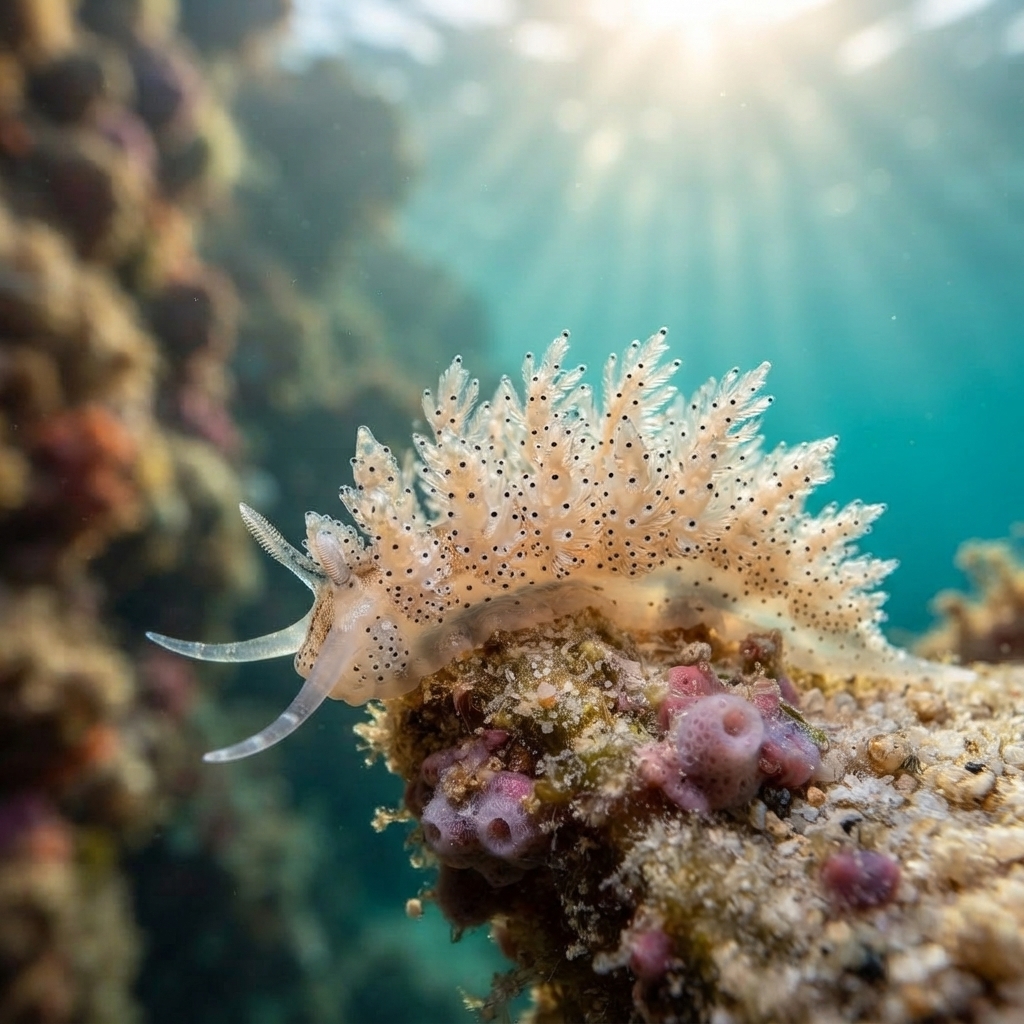
A small, pale, translucent-bodied nudibranch covered in club-shaped projections (cerata) that give it a feathery, tufted outline rather than a smooth slug-like body. It sits low on hydroid stems, often the same colour as its host, which makes it easy to miss until you look closely at the tips of the branches. There's no bright warning colouration here; look for the clustered, bumpy cerata silhouette rather than a bold pattern.
Divers find it parked motionless on hydroid colonies, where it spends most of its time grazing slowly rather than moving across open rock. It shows no reaction to divers and won't swim off if disturbed, so a slow, close look with a torch or magnifier is the only way most people spot one at all. Because it's uncommon to rare at most sites logging it, this is very much a species for divers who stop and search the small stuff rather than cruise past.
Its cerata are often stocked with stinging cells lifted straight from the hydroids it feeds on, a defence borrowed from its prey rather than made from scratch.
Sightings don't show a clear seasonal peak, and with a temperature niche of roughly 10 to 18C it seems to tolerate the cool water typical of UK and Brittany diving across most of the year, so go whenever you're diving these regions and search hydroid patches carefully.
Most reliably found in Brittany, France, which carries the bulk of logged sightings, alongside a solid spread across England and Wales in the United Kingdom. A smaller number of sightings come from the Lisbon Coast in Portugal, so it's worth checking hydroid-covered rock and kelp holdfasts at temperate Atlantic sites generally.
Mapping where Feathered Doto is logged…
Brittany in France has the strongest run of sightings, with further records across England and Wales in the UK and a handful from Portugal's Lisbon Coast. Look on hydroid growth on rock and kelp holdfasts at temperate Atlantic sites.
There's no strong seasonal pattern in the sightings, and it turns up across a wide 10 to 18C temperature range, so it's treated as a year-round find in UK and Brittany waters rather than a seasonal species.
Look for a small, pale, translucent body covered in clustered, club-shaped cerata that give it a tufted, feathery outline. It sits still on hydroid strands, often blending in with its host, so the shape of the cerata is the main giveaway rather than any bold colour.
Exact size data isn't confirmed, but like most Doto species it's small, generally in the range of a centimetre or so, and easy to overlook against its hydroid host.
It feeds directly on hydroids and can incorporate their stinging cells into its own cerata as a borrowed defence, a trick shared with several other nudibranch groups.
Site and sighting data is aggregated from diver logs, iNaturalist and GBIF. For taxonomy and conservation status:
Light-spotted Aegires
3,168 sites