Favorinus branchialis
A small pale nudibranch logged at reefs from Northern Ireland to Jutland, most reliably spotted feeding on egg masses in cool Atlantic water.
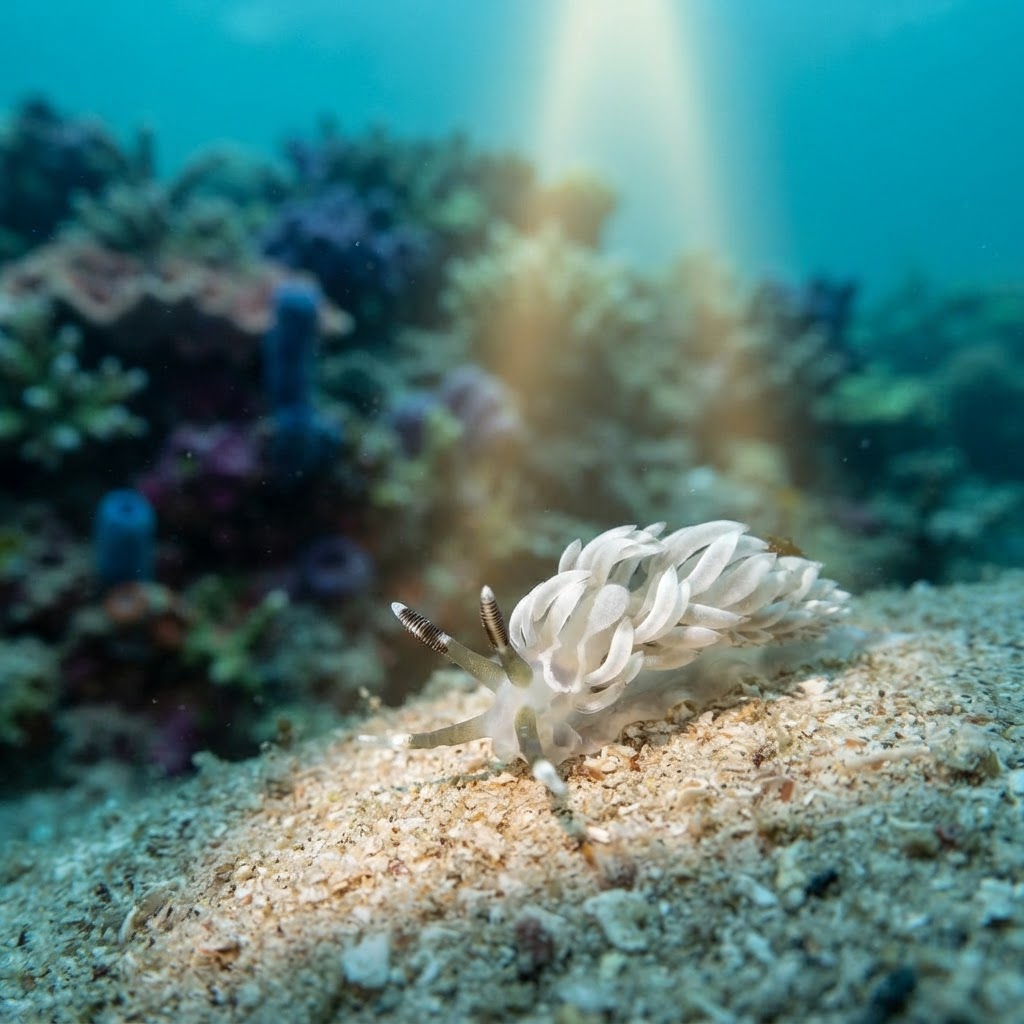
A small, slender nudibranch with a translucent whitish or pale grey body and rows of finger-like projections (cerata) along its back, each often tipped in orange or yellow from the pigments of its last meal. It has two rhinophores (sensory tentacles) on the head that are typically ringed or clubbed, and the whole animal rarely draws attention until you look closely at egg masses on rock or weed. Colouring can shift slightly depending on diet, since it feeds on the eggs of other molluscs.
Look for it slowly grazing over rock, weed, or shell debris rather than swimming, usually tucked close to the substrate where it's easy to miss on a casual pass. It shows no reaction to divers and simply continues foraging, so a slow eye and a torch on close-up detail are what actually turn up a sighting. Most logs come from shallower parts of the 5 to 20 m depth range where its favoured egg-laying molluscs are also found.
It feeds almost exclusively on the egg masses of other sea slugs and sometimes fish, and can take on the colour of whatever eggs it has recently eaten, which is why individuals vary so much in tone.
Sightings show no detectable seasonal pattern, and it's been recorded across a wide temperature range from 8.9 to 18.1 C, so it's treated as a year-round find at these cool-water sites rather than tied to a particular month.
Most commonly logged in the United Kingdom, with strong numbers in Northern Ireland, England, Wales, and a scattering of sightings in Scotland. It's also a reliable find in Jutland in Denmark, Brittany and Occitanie in France, and along the Lisbon Coast in Portugal, with further records in Ireland, Guadeloupe, and Spain.
Mapping where White Aeolis is logged…
It's most often logged in the United Kingdom, particularly Northern Ireland, England, and Wales, with further reliable records in Jutland (Denmark), Brittany (France), and Portugal's Lisbon Coast.
There's no clear seasonal pattern in the sightings, and it's been recorded in water from around 9 to 18 C, so divers log it year-round at its known sites rather than in one particular season.
Look for a small, pale, translucent nudibranch with rows of cerata often tipped orange or yellow, and ringed rhinophores on the head. It's usually found motionless or slowly grazing on rock or weed rather than swimming in open water.
Exact size data isn't confirmed for this species, but like most facelinid nudibranchs it stays small, typically only a couple of centimetres long, making close-up viewing essential to spot the detail.
It specialises in eating the egg masses of other sea slugs and occasionally fish eggs, and its body colour can shift depending on what pigments it has recently ingested.
Site and sighting data is aggregated from diver logs, iNaturalist and GBIF. For taxonomy and conservation status:
Light-spotted Aegires
3,168 sites