Eubranchopsis virginalis
A rarely-logged nudibranch found on Bali's reefs in warm 25.5-31.5C water, present year-round but always an uncommon find.
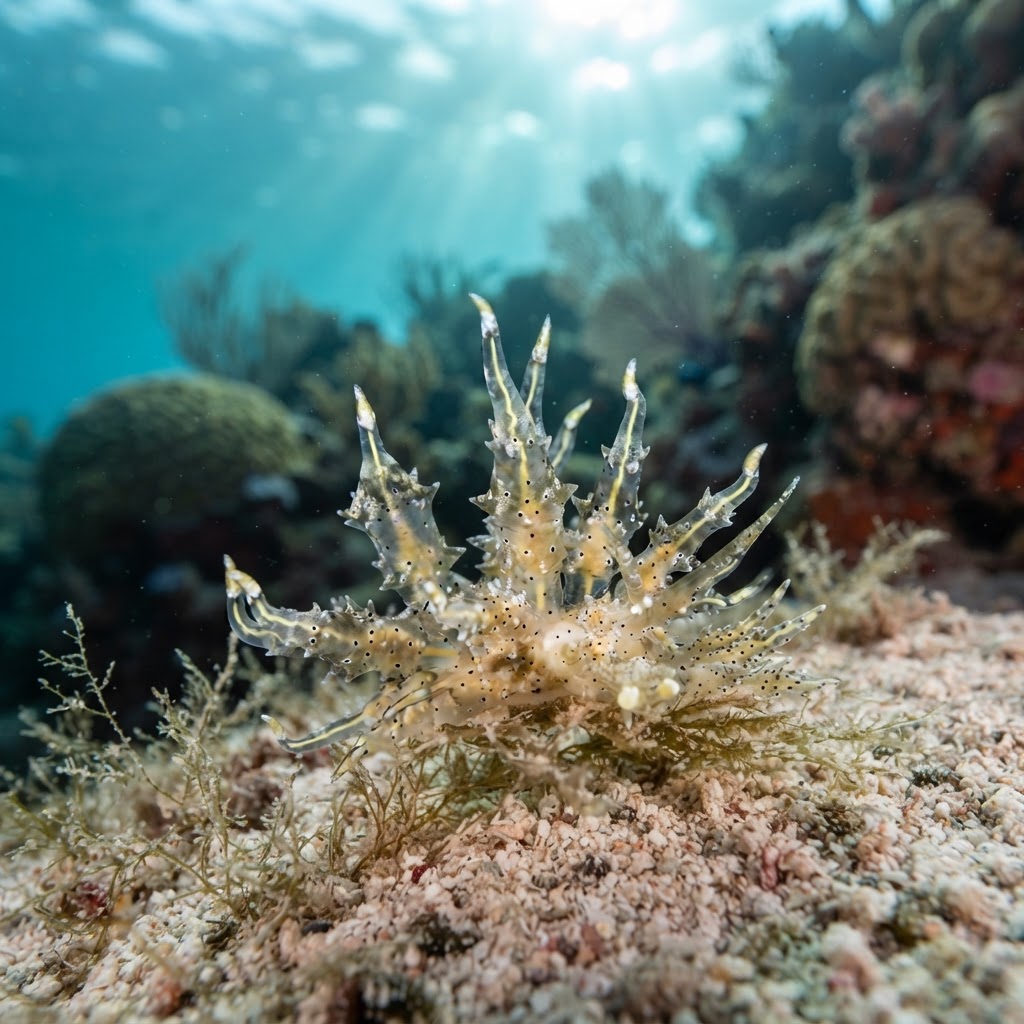
A small nudibranch (sea slug) best picked out by its pale, translucent body and the cluster of feathery gill projections (cerata) along its back that catch the light against darker reef substrate. Like most members of the eubranch family, it stays low and slow on the reef, so divers usually spot it while scanning slowly with a torch or macro lens rather than mid-water. No distinct juvenile or sex-based colour difference is documented for this species.
Divers encounter it tucked low on the reef or muck substrate, moving slowly as nudibranchs do while grazing on its food source. It shows no reaction to divers beyond continuing its unhurried crawl, and like other small nudibranchs it's usually found during slow, close-focus searches rather than spotted from a distance.
As with other eubranch nudibranchs, its cerata likely double as both gills and a defence mechanism, often storing stinging cells borrowed from the hydroids it feeds on.
Sightings don't show a clear seasonal pattern, so treat it as a year-round possibility on Bali's reefs. The water where it has been logged sits in a warm 25.5 to 31.5C range, consistent with typical Bali conditions through most of the year.
Every logged sighting of this nudibranch comes from Bali, Indonesia, making it the one place divers have reliably found it so far. There is no confirmed record from any other country in the current data, so a Bali muck or reef dive is your best bet if you want to look for it.
Mapping where Eubranchopsis Virginalis is logged…
All recorded sightings come from Bali, Indonesia, making it the only confirmed location for divers hoping to find this nudibranch.
There's no detected seasonal pattern, so it's considered a year-round find on Bali's reefs, which stay warm enough for it throughout the year.
Look for a small, pale, translucent-bodied nudibranch with feathery gill projections (cerata) along its back, usually found moving slowly across reef or muck substrate.
Exact size data isn't confirmed for this species, but like most eubranch nudibranchs it's small enough to be easy to miss without a close, slow search of the substrate.
No, it's logged as uncommon even at the handful of Bali sites where divers have found it, so spotting one is a real highlight rather than a given.
Site and sighting data is aggregated from diver logs, iNaturalist and GBIF. For taxonomy and conservation status:
Blue Dragon
3,163 sites