
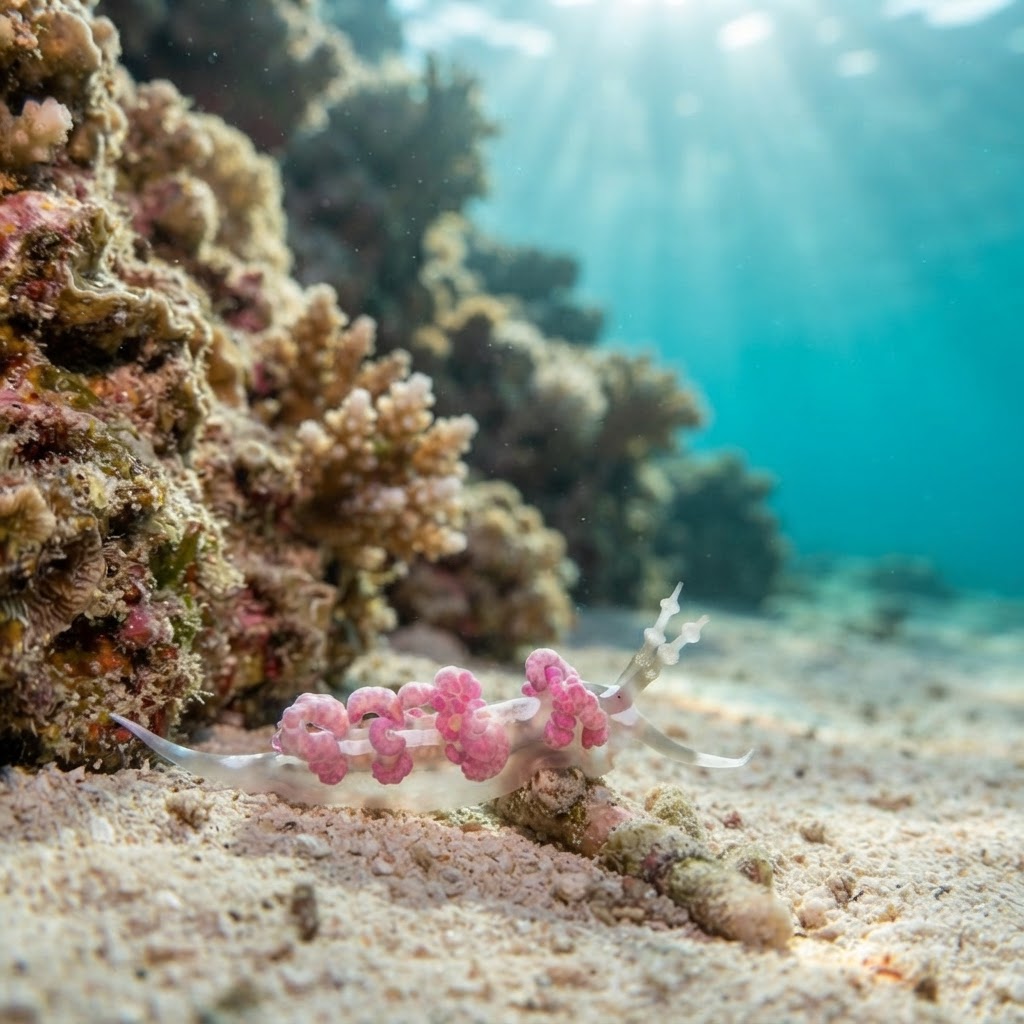
Favorinus japonicus
Rare find in Xiaoliuqiu, Taiwan and Kwajalein Atoll: this translucent nudibranch feeds on other slugs' eggs in warm tropical water.
Small, slender-bodied nudibranch with a translucent to pale white body that lets internal organs show through faintly. Look for the finger-like projections (cerata) along its back, often tipped in orange or yellow depending on its most recent diet, since pigment from eaten eggs can show through the tissue. Its slim, elongated shape and lack of bold reef-fish colouring mean it is easy to swim past unless you are already scanning egg masses on the reef.
Divers who spot this one are usually looking closely at another nudibranch's egg ribbon, since that is exactly what this species is doing too. It moves slowly across the substrate or over egg masses, showing little reaction to divers and no defensive display worth noting. Best found by scanning known nudibranch or sea hare egg coils rather than searching open reef.
It specialises in eating the eggs of other sea slugs and nudibranchs, and can even take on the colour of the eggs it has recently consumed, which is why individuals vary so much in tint.
No clear seasonal pattern shows up in the sightings, so treat it as a year-round possibility on warm reefs. It has been observed in water between 23.1 and 29.5 C, well within typical tropical reef temperatures for most of the year in Taiwan and the Marshall Islands.
Logged from a small handful of sites, split between Xiaoliuqiu in Taiwan and Kwajalein Atoll in the Marshall Islands. Both regions report it as a rare find, so it is not a species divers plan a dive around, more a bonus spot for macro-focused divers checking egg masses on the reef.
Mapping where Egg-eating Nudibranch is logged…
It has been logged in Xiaoliuqiu, Taiwan and Kwajalein Atoll in the Marshall Islands, though sightings at both are rare. It is a species for divers already searching macro life closely rather than a guaranteed find.
There is no detected season in the sighting data, so it appears to be a year-round possibility. It has been recorded in water from 23.1 to 29.5 C, which covers most of the year on the reefs where it is found.
Look for a small, slender, translucent to pale-bodied nudibranch with cerata along its back that are often tinted orange or yellow. The colour can shift depending on what eggs it has recently fed on, so pattern rather than colour is the more reliable cue.
Exact size data is not confirmed, but like most Favorinus nudibranchs it is a small, slender macro subject best spotted by looking closely at egg masses rather than scanning open reef.
Unlike most nudibranchs that graze sponges or hydroids, this species feeds specifically on the egg masses of other sea slugs and nudibranchs. It can even absorb pigment from the eggs it eats, which shows through its translucent body and changes its colour over time.
Site and sighting data is aggregated from diver logs, iNaturalist and GBIF. For taxonomy and conservation status:
Light-spotted Aegires
3,168 sites





