Doto urak
A small, uncommon find along California's cool-water reefs, usually turning up in 12-19C water on hydroid-covered rock and rubble.
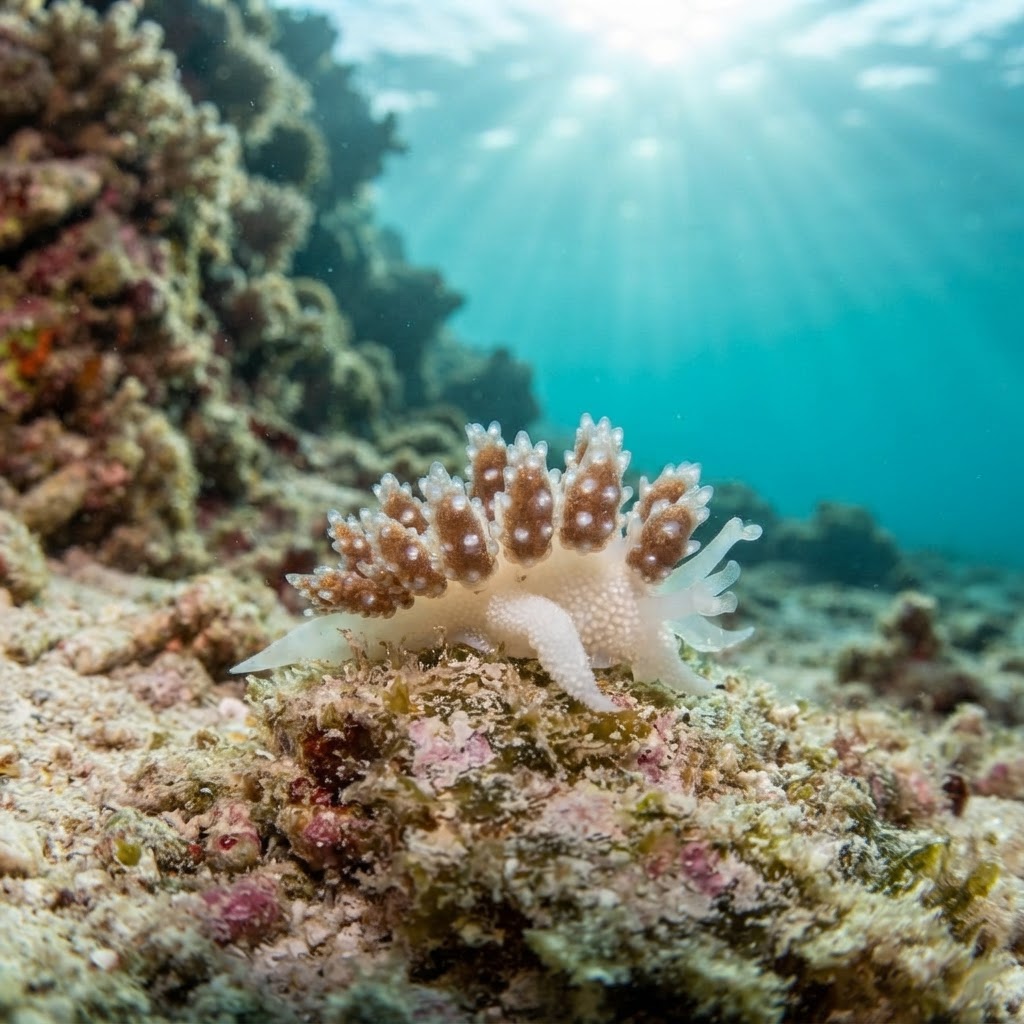
A small, slug-bodied nudibranch with a translucent to pale body covered in clusters of raised, warty tubercles (cerata) running down its back, giving it a bumpy, almost cauliflower-like silhouette. Look closely at hydroid strands on rock and rubble rather than open sand, since this species is easy to miss against similar-textured backgrounds. Size in the water is small enough that most divers need a torch or magnifier to confirm the tubercle pattern.
Divers typically find this one sitting still on hydroid growth, grazing slowly rather than moving with any urgency, which fits its likely diet within the Dotidae family. It shows no reaction to divers and there is no swimming escape response to watch for, so a slow, methodical scan of hydroid-covered surfaces is the only way to pick it out. Most logs describe it as an uncommon find rather than something you stumble across on every dive.
Like other Dotidae, this species almost certainly feeds on hydroids, and its clustered back tubercles likely help it blend into the branching hydroid colonies it lives among.
Sightings show no clear seasonal peak, so treat it as a year-round possibility on Californian dives in the 12.3 to 18.9C range this species has been observed in. Cooler months may still suit it fine given that temperature niche, so don't wait for a specific season to look for it.
Every logged sighting comes from the United States, concentrated along California, where it turns up on cold-water reef and rubble sites rather than tropical coral. If you are diving Californian sites regularly, this is the region to keep checking rather than somewhere it is reported elsewhere.
Mapping where Doto Urak is logged…
All confirmed sightings are from California, United States, where it has been logged across a spread of dive sites on cold-water reef and rubble. It has not been reported outside this region in current diver data.
There is no detected seasonal pattern, so it is best treated as a year-round possibility in California's cooler water, roughly 12 to 19C. Keep checking hydroid growth on any dive rather than targeting a specific month.
Look for a small, pale, translucent-bodied nudibranch with clusters of bumpy tubercles running along its back, usually resting on hydroid strands. A dive light helps pick out the texture against similarly coloured rock and rubble.
Exact size data isn't available, but like most Doto species it is small, generally in the centimetre range, meaning divers usually need a close look or magnifier to spot the tubercle detail.
No. It poses no risk to divers and has no means of harming anyone; the main challenge is simply spotting something this small and camouflaged.
It most likely feeds on hydroids, in keeping with the diet of other members of the Dotidae family, grazing slowly across colonies rather than actively hunting.
Site and sighting data is aggregated from diver logs, iNaturalist and GBIF. For taxonomy and conservation status:
Blue Dragon
3,163 sites