Doto fragilis
Cold-water find: this tiny nudibranch turns up on hydroid stems in Østlandet, Norway and Northern Ireland, best searched for close to the substrate in 8-14°C water.
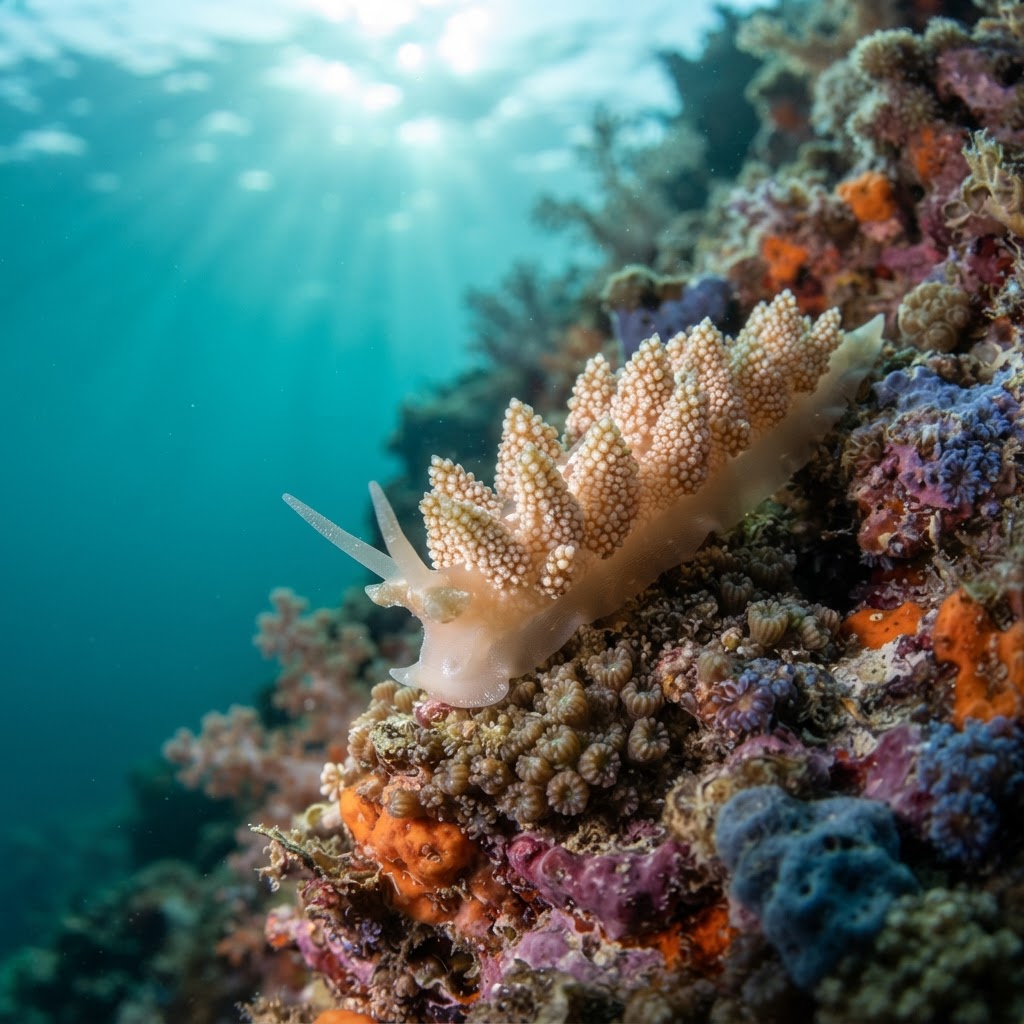
Look for a small, translucent white to pale grey body covered in raised, knobbly tubercles (called cerata) along its back, which is the main feature that catches a diver's torch light. The body is soft, almost jelly-like, and the animal rarely stretches more than a couple of centimetres, so you'll be scanning close-up rather than spotting it from a distance. It's usually found clinging to the fine branches of hydroids, which it matches in scale and often colour, making it easy to swim straight past.
Divers typically find it motionless or slowly grazing along hydroid stems, using its small size and matching colour to stay inconspicuous rather than fleeing when approached. It shows no reaction to divers beyond staying put, so a slow, close look with a torch or macro lens is the way to actually notice one among the hydroid fronds. Most sightings happen on structure close to the seabed rather than out in open water, where hydroid colonies are established.
Species in the genus Doto feed almost exclusively on hydroids, and their cerata often take on the colour of whatever prey they've been eating, which is part of why they blend in so well against their food source.
There isn't enough logged data to pin down a clear season, so treat sightings as possible year-round. Given the narrow cold-water niche of 8.3 to 14.3°C, it's a species tied to temperate seas rather than a particular month, so timing your dive to local water temperature matters more than chasing a calendar season.
Reef neighbours a diver could mistake it for. Use the identification notes above to tell them apart.
This one is most reliably logged in the United Kingdom and Norway, with the United Kingdom carrying the highest site count overall spread across Northern Ireland, England and Wales. In Norway, Østlandet is the strongest region by far, and it also turns up in smaller numbers in Bohuslän, Sweden, Nordland, Norway and Brittany, France.
Mapping where Doto fragilis is logged…
It's most commonly logged in the United Kingdom, particularly Northern Ireland, England and Wales, and in Norway, especially the Østlandet region. Smaller numbers have been recorded in Bohuslän, Sweden and Brittany, France.
There isn't a clear seasonal pattern in the data, so sightings are possible across the year. Focus on locating hydroid colonies in cold water within its 8.3 to 14.3°C niche rather than a specific month.
Look for a small, pale, translucent nudibranch covered in bumpy tubercles, usually found clinging to hydroid branches. Its size and colour often match its hydroid prey, so a close, slow search is needed to spot one.
Exact size data isn't available, but like other Doto species it's small, generally only a centimetre or two long, meaning it's easy to overlook without a close look at hydroid stems.
It feeds on hydroids, grazing along their branches, and its cerata often pick up the colour of the hydroid tissue it has consumed, helping it blend into its surroundings.
No, it poses no danger to divers. It's a tiny, slow-moving grazer with no means of harming anyone nearby.
Site and sighting data is aggregated from diver logs, iNaturalist and GBIF. For taxonomy and conservation status:
Blue Dragon
3,163 sites