Doto floridicola
An uncommon little nudibranch logged across Wales and the French Riviera, found in cool water between 11.8 and 18.1 C year-round.
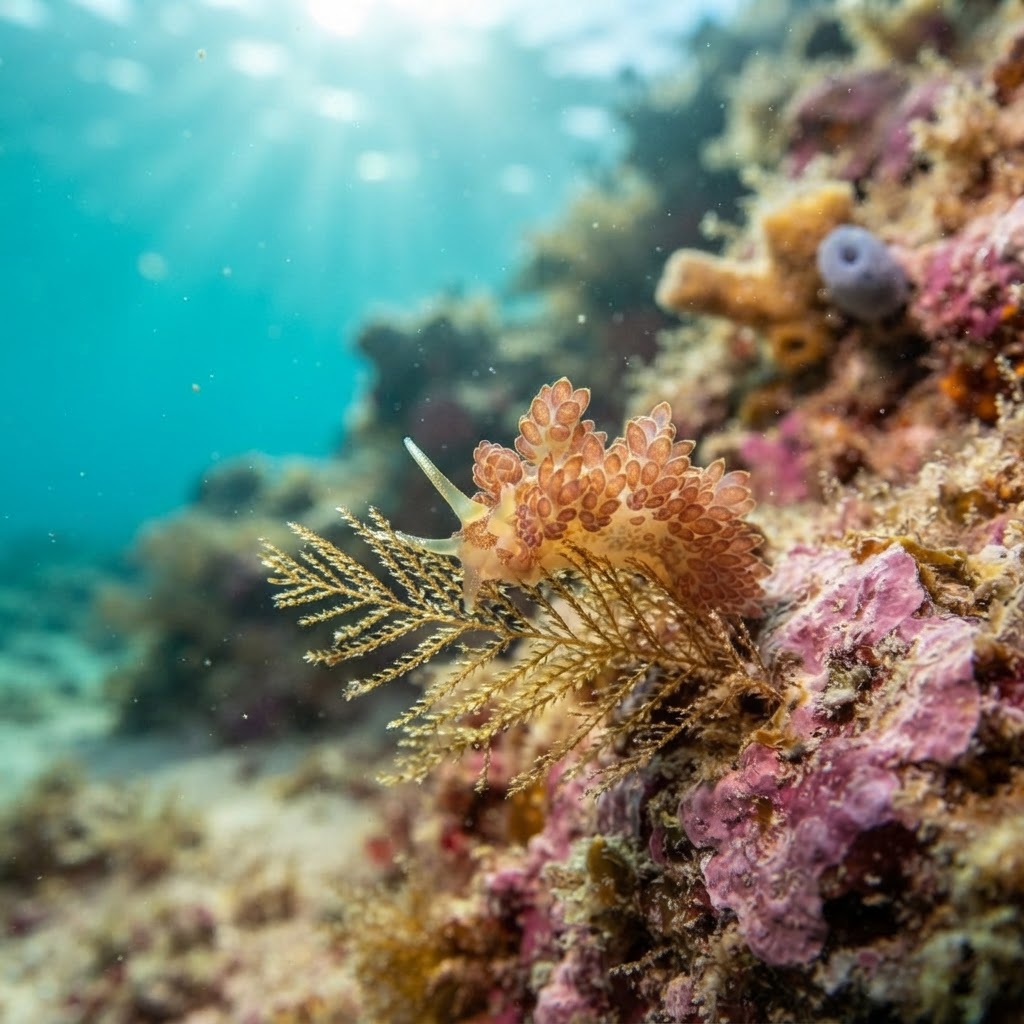
Look for a tiny, semi-translucent slug rarely more than a centimetre long, its back covered in rounded, tubercle-like projections called cerata that give it a bumpy, knobbly outline. The body is usually pale cream to whitish, sometimes with faint tinges of colour picked up from its diet, and it clings tight to branching hydroids rather than open rock. Its small size and hydroid habitat are the giveaway combination, since most divers only spot it once they know to check hydroid stands closely.
Divers find it sitting motionless or slowly grazing on the hydroid colonies it lives among, often needing a torch and a slow, close look to pick out against the similarly textured branches. It shows no reaction to divers beyond retracting slightly if disturbed, since it has no real means of fleeing and relies on staying hidden in the hydroid structure. Most sightings come from divers deliberately combing through hydroid patches on wrecks, pilings, or rocky ledges rather than spotting it in open water.
Like other Doto species, it feeds exclusively on hydroids and its cerata often echo the colour of whatever prey colony it has been eating, making individual animals look subtly different from one hydroid patch to the next.
Sightings show no clear seasonal peak, so treat it as a year-round possibility in its cool-water range rather than a summer-only species. Its observed temperature niche of 11.8 to 18.1 C spans much of the diving calendar in Wales and the French Riviera, which likely explains the lack of a sharp season.
This is a cool-water species, most reliably logged in the United Kingdom, especially around Wales and down through England, and across the French Riviera and Provence and Occitanie in southern France. Divers searching hydroid-covered rock and wreckage in these regions have the best shot at finding it, though even there it stays an uncommon find rather than a given.
Mapping where Florida Doto is logged…
It turns up most often in Wales and elsewhere in the United Kingdom, along with the French Riviera, Provence, and Occitanie in southern France. Look specifically at sites with dense hydroid growth on wrecks or rocky ledges rather than open reef.
There is no strong seasonal pattern in the sightings, so it is considered a year-round find within its cool-water range. Its recorded temperature niche of 11.8 to 18.1 C covers most of the diving season in the UK and southern France.
It is a tiny, pale, bumpy-backed nudibranch covered in rounded cerata, usually found clinging to branching hydroid colonies. Its small size and hydroid habitat, rather than bold colour, are the main clues divers use to pick it out.
It is a very small nudibranch, generally under a centimetre or two in length, which is part of why it goes unnoticed unless divers are searching hydroid patches closely.
It feeds only on hydroids, and its cerata can shift in tone depending on which hydroid colony it has been grazing, so its exact colouring varies slightly from one sighting to the next.
Site and sighting data is aggregated from diver logs, iNaturalist and GBIF. For taxonomy and conservation status:
Light-spotted Aegires
3,168 sites