Dicata odhneri
A rarely-logged nudibranch turning up on Basse-Terre reefs in Guadeloupe, in warm 25-31C water, year-round.
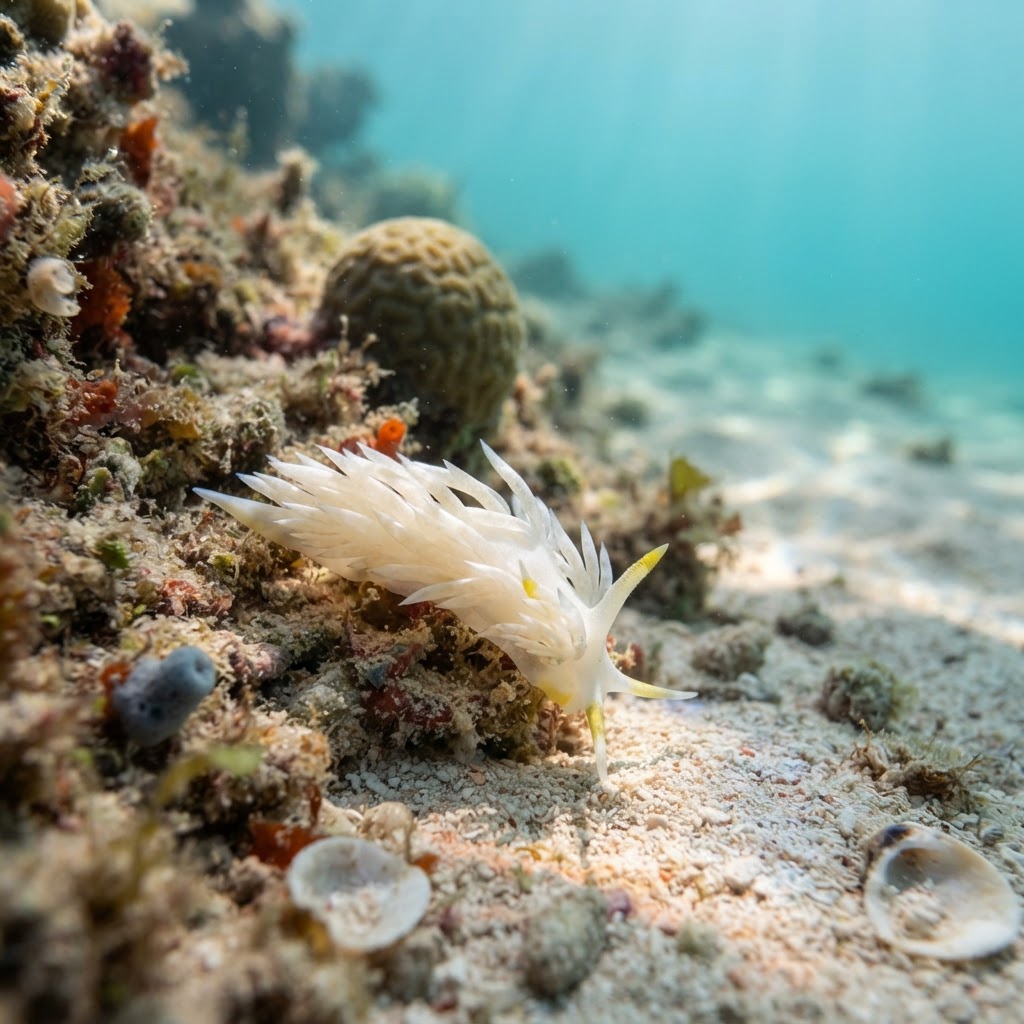
A small facelinid nudibranch (a soft-bodied sea slug with finger-like projections called cerata along its back) rather than a smooth-mantled dorid. Look for a slender, elongated body with rows of cerata that usually carry some colour banding or pigment picked up from its diet, since facelinids often reflect the colour of the prey inside their cerata tips. Size is not well documented for this species, so expect to search close to the substrate rather than scanning open water. Distinguishing it from other small aeolid-type slugs comes down to careful cerata pattern and headshield shape rather than an obvious single mark.
Like most facelinid nudibranchs, expect to find it moving slowly over reef substrate or rubble while grazing on hydroids or small cnidarians, rather than swimming or reacting to divers in any obvious way. It is logged as uncommon at every site where it turns up, so finding one usually means a slow, close look at the bottom rather than a lucky drift-by. Divers doing muck or macro dives around Basse-Terre have the best odds simply because that's where patient search effort has paid off so far.
Facelinid nudibranchs like this one often store stinging cells from the hydroids they eat in the tips of their cerata, reusing their prey's own defences as their own.
Sightings don't show a detectable seasonal pattern, and the water temperature range logged (24.8 to 30.8C) covers essentially the whole year on Basse-Terre's reefs, so it is reasonable to look for it in any month.
Every logged sighting of this nudibranch comes from Guadeloupe, with Basse-Terre standing out as the region where divers consistently find it. There is no verified record yet from outside this part of the Caribbean, so it is effectively a Guadeloupe specialty on the current data.
Mapping where Odhner's Dicata is logged…
All confirmed sightings come from Guadeloupe, concentrated on Basse-Terre. There is no verified record of this species being logged outside that region so far.
There's no clear seasonal pattern in the sighting data, and water temperatures on Basse-Terre's reefs stay in a comfortable range year-round, so any month is a reasonable time to look.
Look for a small, slender nudibranch with rows of cerata along its back, typically found on or near reef substrate. Precise colour and pattern details are not well documented, so close macro observation is the best approach.
Size has not been well documented for this species. Like most facelinid nudibranchs it is likely small, best searched for at close range rather than spotted from a distance.
As a facelinid nudibranch, it likely feeds on hydroids and stores their stinging cells in its own cerata tips, turning prey defences into its own protection.
No. It poses no threat to divers and is harmless to observe or photograph at close range.
Site and sighting data is aggregated from diver logs, iNaturalist and GBIF. For taxonomy and conservation status:
Light-spotted Aegires
3,168 sites