Doto kya
A 1cm nudibranch found in cold Pacific waters off California and British Columbia, year-round in temperatures down to 10C.
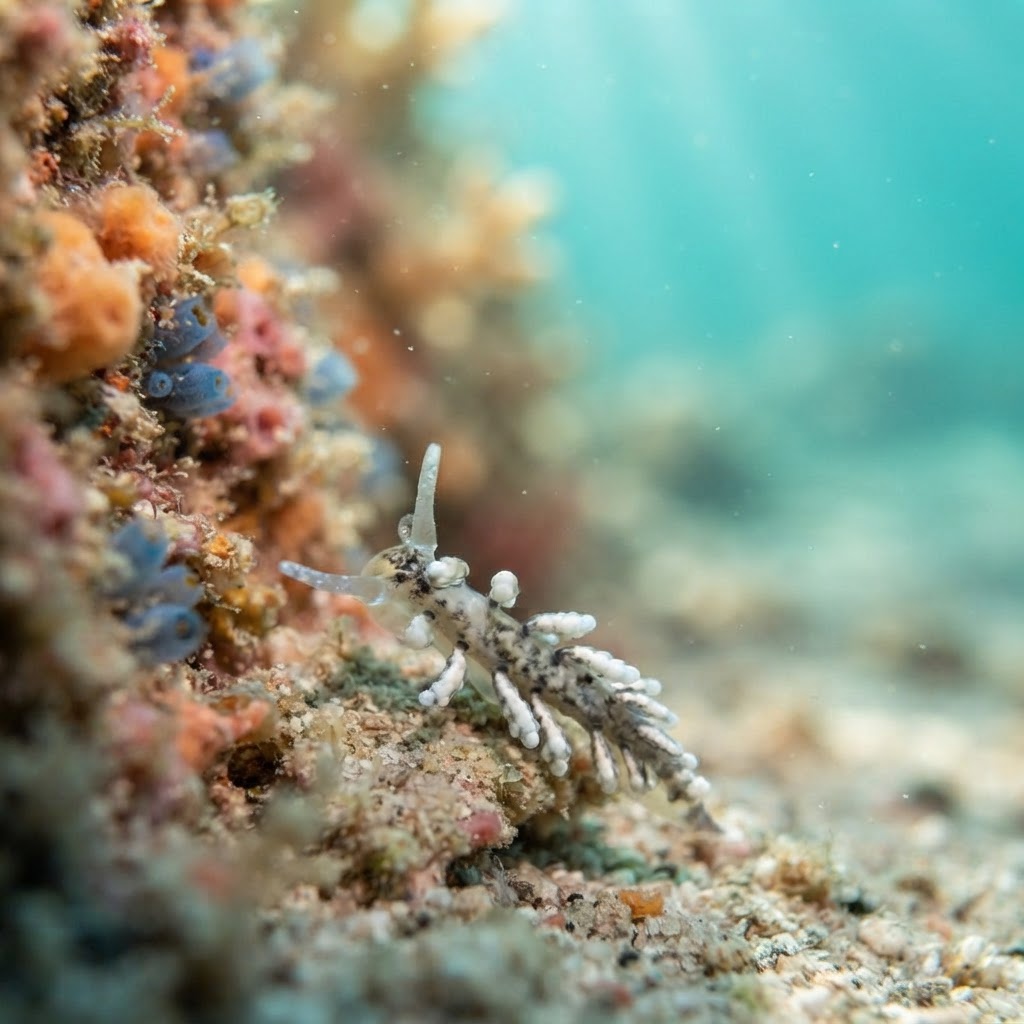
Barely a centimetre long, this is a slug you have to hunt for, not one that jumps out at you. Look for a slender, translucent to dark body carrying rows of raised, club-shaped projections (cerata) along its back, giving it a bristly, almost furry silhouette. Colour tends toward dusky brown or grey rather than the bright patterning of many reef nudibranchs, which is exactly why it gets overlooked on a wall or under a ledge.
Found tucked into cold-water reef structure, moving slowly across hard substrate as it grazes rather than swimming or drifting in the open. Divers who log it tend to be doing dedicated slow macro searches, scanning walls and crevices at close range rather than spotting it on a normal swim-by. It shows no reaction to divers beyond its usual crawl, since at this size and speed there is little else it can do.
Like other Doto species, it almost certainly feeds on hydroids, and its cerata likely help it blend into the branching hydroid colonies it lives among, making a slow, patient search the only reliable way to find one.
Sightings are spread across the year with no clear seasonal peak, consistent with a cold-water species comfortable in the 10 to 19C range logged so far. Plan your search around good visibility and slow, methodical reef scanning rather than a particular month.
Most records come from California, particularly sites along the US Pacific coast, with a second cluster in British Columbia, Canada. Between these two regions divers have logged it at a handful of cold-water sites, making the Pacific Northwest and California the two places worth searching if this is a target species.
Mapping where Dark Doto is logged…
It has been logged mainly in California, along the US Pacific coast, and in British Columbia, Canada. These two regions currently account for all recorded sightings, so they are the places to search if you want to find one.
There is no detected seasonal pattern, so sightings happen year-round. It has been recorded in water from about 10 to 19C, so cooler months are not a barrier to finding it.
It is tiny, around 1cm, with a slender dark or translucent body covered in raised, club-like cerata that give it a bristly outline. There is no bold colour pattern to key on, so size, shape, and habitat are the main clues.
Around 1cm long, making it one of the smaller nudibranchs a diver is likely to try to spot. A dive light and a slow pace help enormously when searching for it.
Logged sightings describe it as uncommon at most sites where it has been recorded, with a few rare records and one site where it turns up more reliably. It is not a species you stumble on casually, it takes deliberate searching.
Site and sighting data is aggregated from diver logs, iNaturalist and GBIF. For taxonomy and conservation status:
Light-spotted Aegires
3,168 sites