
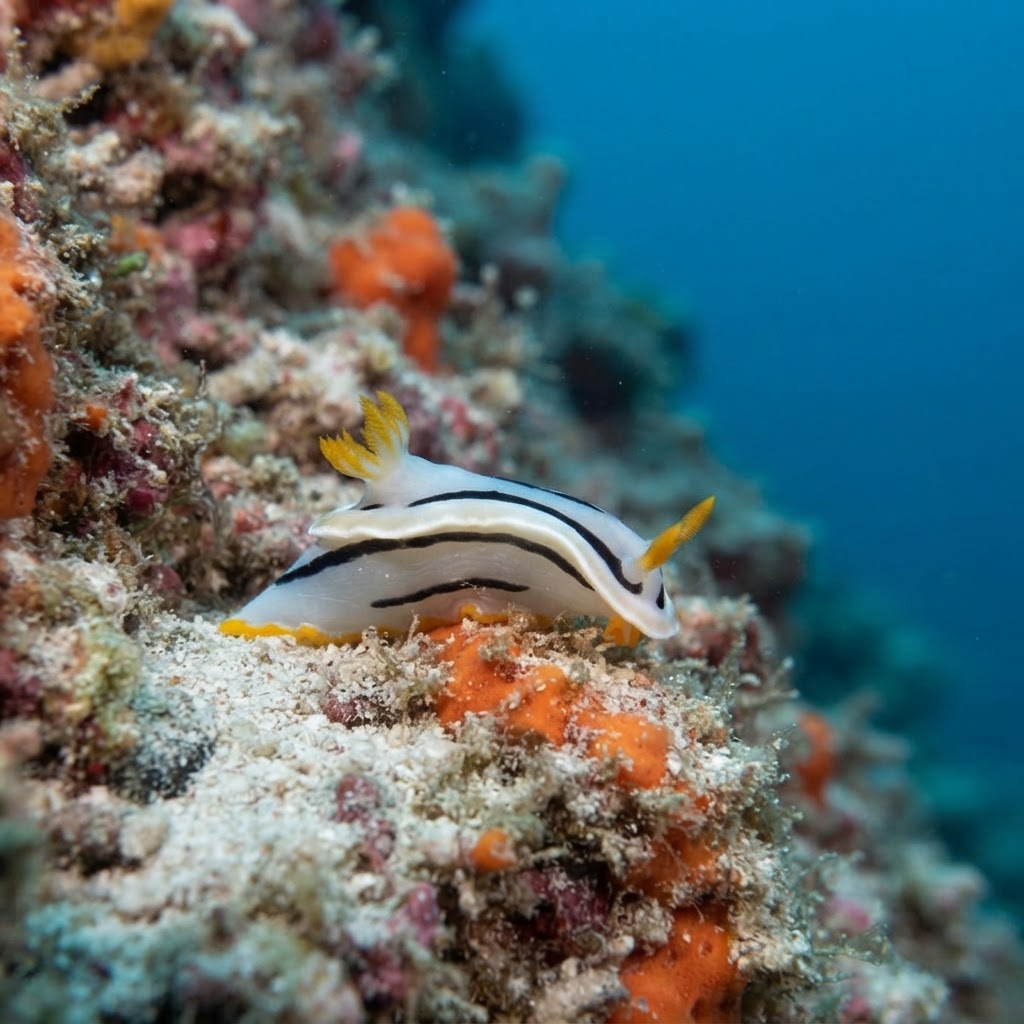
Polycera capensis
Small, frilly, and common in the Western Cape: find the crowned nudibranch on cold-water reefs from 14.8 to 21.6 C.
A slender, almost see-through white body about 4 cm long, with a scatter of orange-yellow spots along its back and a fringe of feathery gills near the tail. Two pairs of curled, yellow-tipped tentacles (rhinophores and oral tentacles) project from the front of the body, giving it a slightly crowned look. It moves slowly across rock and kelp holdfasts, low and close to the substrate, so a careful eye and a torch on grey days help pick it out.
Divers find it grazing slowly over rock faces, kelp stipes, and under ledges, often alongside the bryozoan colonies it feeds on. It pays no attention to divers and won't flee or hide, so a slow approach and a close focus lens are all you need for a good look. Most sightings are on shallower reef and kelp forest terrain rather than deep drop-offs, in keeping with its 0 to 30 m range.
Like other nudibranchs, it lacks a shell as an adult and instead gets chemical defence from the bryozoans and hydroids it eats, storing distasteful compounds in its tissue as a deterrent to predators.
Sightings don't show a clear seasonal pattern, so treat it as a year-round find within its temperature comfort zone of roughly 14.8 to 21.6 C. In the Western Cape that means cool water diving through most of the year rather than a single peak month.
This is a Western Cape speciality: South Africa accounts for the vast majority of logged sightings, with Cape Town's reefs and kelp forests the most reliable ground. It also turns up with a smaller but steady following in Australia, particularly New South Wales and Victoria.
Mapping where Crowned Nudibranch is logged…
The Western Cape in South Africa is by far the most reliable region, with strong numbers also logged in New South Wales and Victoria, Australia.
There's no strong seasonal pattern in the sightings, so it's a year-round find in cool water reefs sitting roughly between 14.8 and 21.6 C.
Look for a small, translucent white slug around 4 cm long with orange-yellow spots and yellow-tipped gills and tentacles, moving slowly over rock or kelp.
They're small, typically reaching around 4 cm in length, so a close look or macro lens is usually needed to appreciate the detail on their gills and tentacles.
No. They're harmless to divers, with no sting or bite risk, and they won't react defensively if you get close for a photo.
They feed on bryozoans and similar encrusting organisms on rock and kelp, and use chemicals absorbed from this diet as a defence against predators.
Site and sighting data is aggregated from diver logs, iNaturalist and GBIF. For taxonomy and conservation status:
Light-spotted Aegires
3,168 sites





