Crimora papillata
A yellow-spotted nudibranch found on rocky reefs from the Algarve to Brittany, most often logged as an uncommon find in cooler Atlantic water.
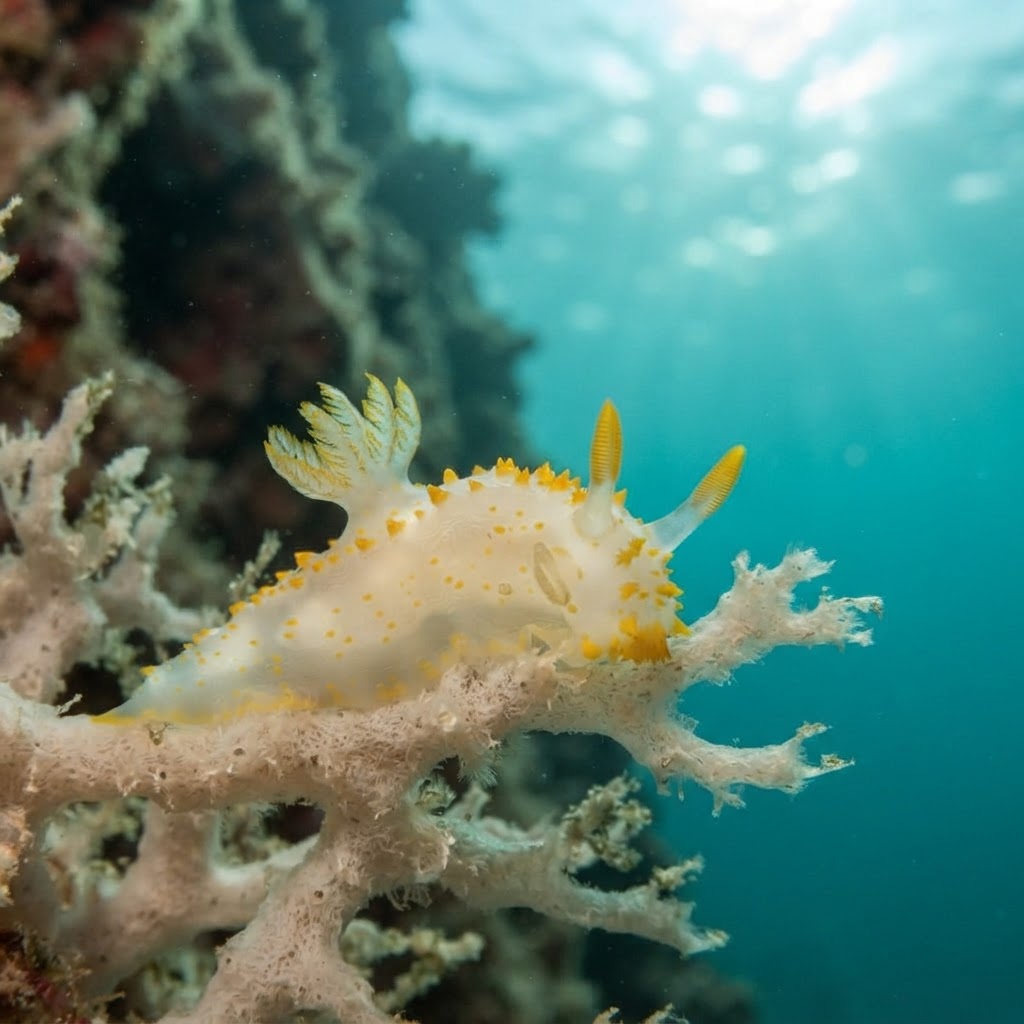
A small, elongated nudibranch with a translucent white to pale grey body covered in raised bumps (tubercles) tipped in bright yellow or orange. The rhinophores (the paired sensory stalks on the head) and the gill cluster on the back often carry the same yellow highlights, which is the easiest thing to spot in torchlight. Look for it tucked against rock and rubble rather than out in the open water column.
Found crawling slowly over rock, rubble and encrusting growth on the seabed, usually while divers are working a torch along cracks and ledges rather than cruising past in open water. It shows no reaction to divers beyond the usual slow retreat into a crevice, and most sightings come from close, deliberate looking rather than chance encounters mid-dive.
Like other members of its family, it almost certainly feeds on hydroids and bryozoans, and the yellow tubercle tips are thought to help it blend into the encrusting growth it grazes on.
There is no clear seasonal peak in the sightings data, so treat this as a year-round find on the sites where it occurs. It has been logged in water from about 11 to 19 C, which covers most of the diving season across its Atlantic and Mediterranean range.
Most reliably logged in Portugal, especially around the Algarve, with strong numbers also coming out of Brittany and the Bay of Biscay in France. Divers also find it along the Cantabrian Coast in Spain, around England and Wales in the UK, and on reefs around Gozo in Malta.
Mapping where Papillose Crimora is logged…
It turns up most often in Portugal's Algarve region, with good numbers also reported from Brittany and the Bay of Biscay in France. Smaller but consistent counts come from the Cantabrian Coast in Spain, England and Wales, and Gozo in Malta.
Sightings do not show a strong seasonal pattern, so it is considered a year-round species on the sites where it lives. It has been recorded in water from about 11 to 19 C, so it is findable across most of the local diving season.
Look for a small, pale, elongated nudibranch with raised yellow-tipped bumps along its back and matching colour on the gill cluster and sensory stalks. It sits low on rock and rubble rather than swimming, so a slow torch search is the best way to find one.
Exact size data is not confirmed for this species, but like most nudibranchs in its family it is a small, easily overlooked animal best spotted by scanning rock and rubble closely with a torch.
No. It has no known sting or venom risk to divers and simply crawls away or retreats into crevices if disturbed.
It is thought to graze on hydroids and bryozoans growing on rock and rubble, in keeping with the feeding habits of related nudibranchs in the Polyceridae family.
Site and sighting data is aggregated from diver logs, iNaturalist and GBIF. For taxonomy and conservation status:
Light-spotted Aegires
3,168 sites