Coryphellina poenicia
A pink-and-white nudibranch most reliably logged around Victoria, Australia, in cool 15-22C water year-round.
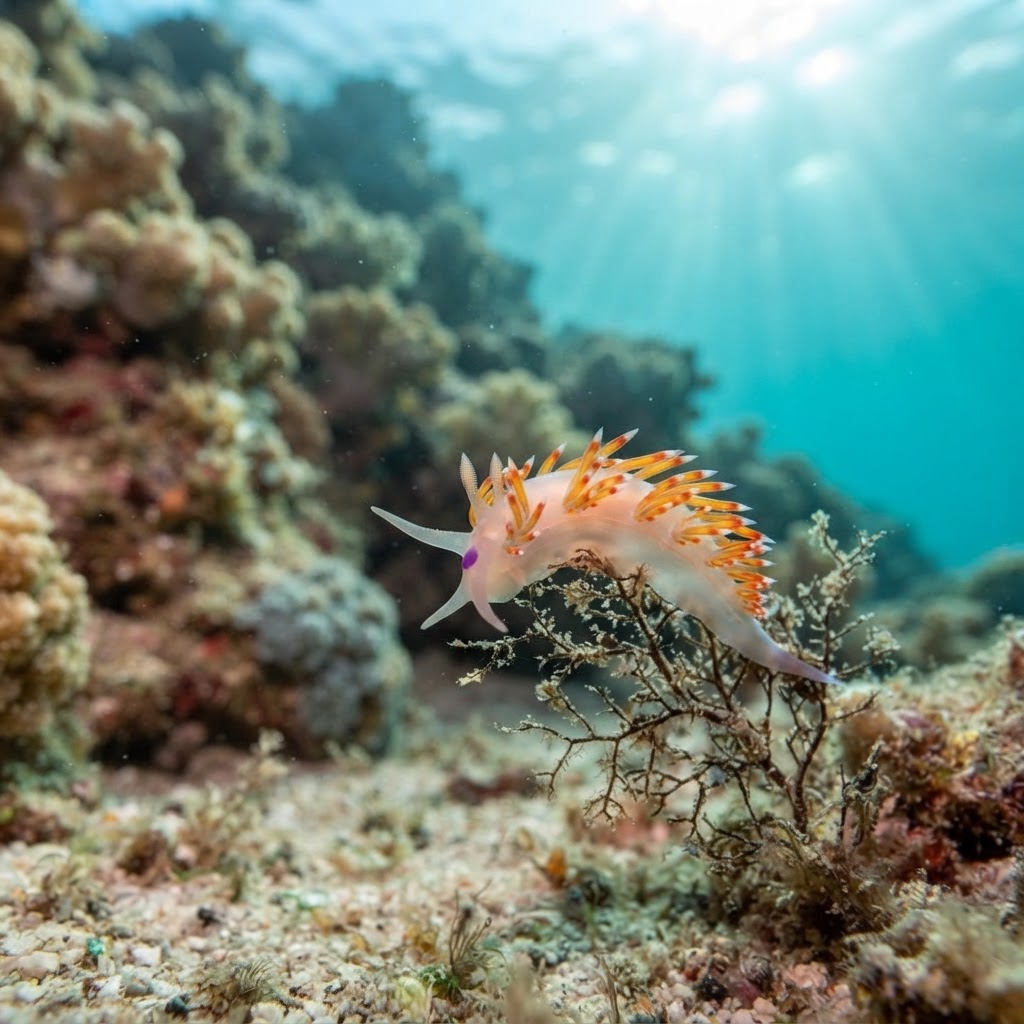
Small, slender sea slug with a translucent to pale pink body and rows of finger-like projections (cerata) running down its back, often tipped in a deeper pink or orange with white bands near the tip. The head carries a pair of long, tapering sensory tentacles (rhinophores) that are usually ringed or tipped white. Look for it tucked into rubble or algae on temperate reefs rather than out on open coral, since it is small enough to miss at a glance.
Divers find it moving slowly over rubble, sponge and algae-covered rock, grazing on the hydroids it feeds on rather than swimming or fleeing. It pays no attention to divers and will simply keep crawling if you get close, so a slow approach and a macro lens are all you need. Most logs come from uncommon, one-off finds rather than clusters, so treat any sighting as a small win.
Like other members of its nudibranch family, it feeds on hydroids and is thought to store stinging cells from its prey in those back-mounted cerata as a form of borrowed defence.
Sightings are spread across the year with no clear seasonal spike, which fits its cool-water niche of roughly 15 to 22C found on Victoria's reefs year-round. Plan around water temperature rather than a specific month.
Almost every logged sighting comes from Australia, and specifically from Victoria, which accounts for the vast majority of records. Smaller numbers turn up in New South Wales and Western Australia, so it is very much a southern Australian temperate-reef find rather than a tropical one.
Mapping where Phoenician Coryphellina is logged…
It is almost entirely an Australian find, with the strongest records from Victoria and scattered sightings in New South Wales and Western Australia.
There is no strong season in the data, it turns up year-round in Victoria's cool 15 to 22C water, so any time you can dive is fair game.
Look for a small, slender, pale pink to translucent nudibranch with rows of cerata down its back, often tipped in deeper pink or white, and white-ringed rhinophores on the head.
Exact size data is not confirmed, but like most flabellinid nudibranchs it is a small, easy-to-overlook animal typically only a couple of centimetres long.
No, it poses no threat to divers and can be safely observed and photographed up close without any risk.
It grazes on hydroids and is believed to recycle their stinging cells into its own cerata, turning its prey's defences into its own protection.
Site and sighting data is aggregated from diver logs, iNaturalist and GBIF. For taxonomy and conservation status:
Light-spotted Aegires
3,168 sites