Coryphella piunca
A small, cold-water nudibranch most reliably logged off California, in water between 10.7 and 18.9C, year-round.
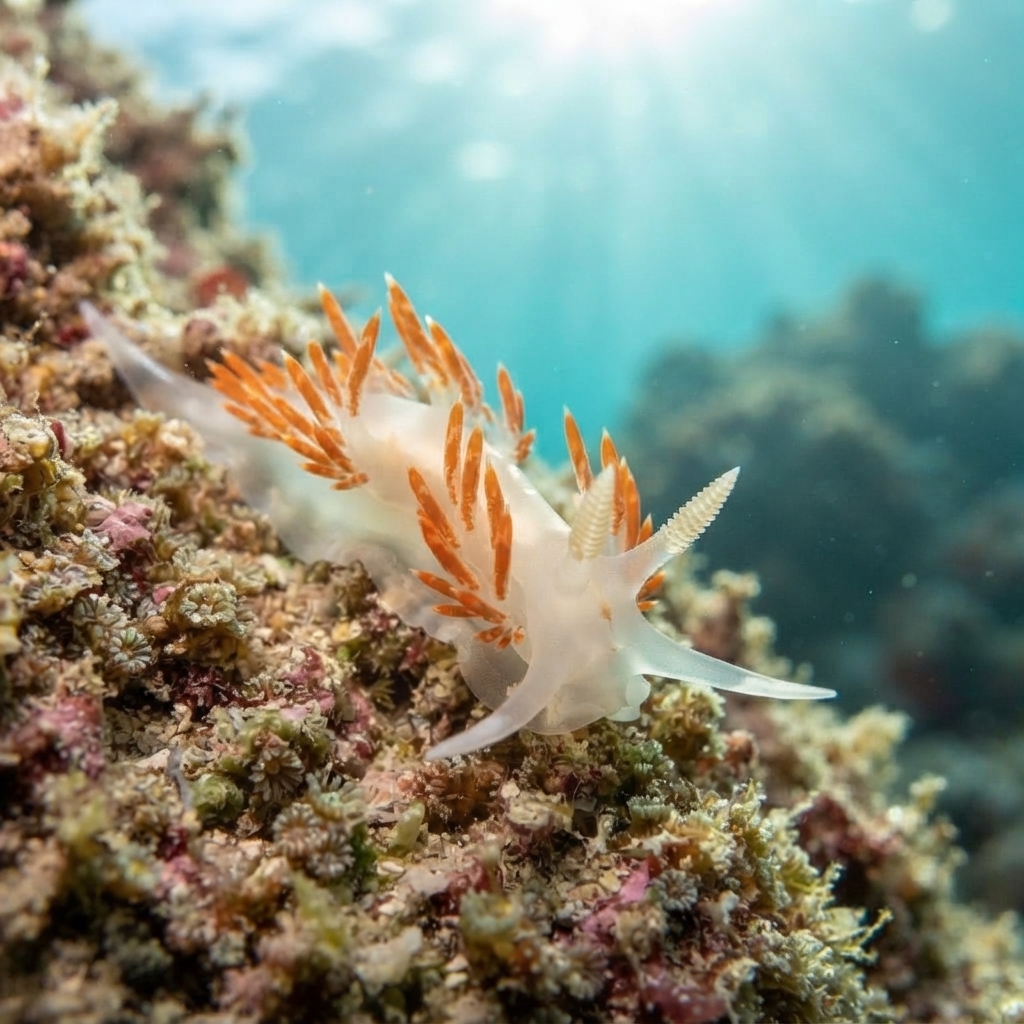
Look for a small, slender-bodied nudibranch with a translucent white to pale body and rows of finger-like projections called cerata running down its back, often tipped in shades of red, orange, or pink depending on diet. There is no dorsal shell or mantle, just the bare, soft body typical of aeolid nudibranchs. Size is modest and it is easy to miss against rock and algae unless you are moving slowly and scanning close to the substrate.
Divers typically find this nudibranch slowly grazing over rock and algae-covered surfaces, often tucked into crevices or moving across encrusting hydroids and other prey it feeds on. It shows no reaction to divers beyond continuing its slow crawl, and most sightings happen on careful, close-focus looks at the substrate rather than mid-water encounters. It is logged most often as an uncommon find, so expect to search rather than stumble across it.
Like other aeolid nudibranchs, it likely feeds on hydroids and can incorporate stinging cells from its prey into its own cerata as a defence, though this has not been specifically documented for this species.
Sightings do not show a strong seasonal pattern, so treat it as a year-round find at sites within its temperature niche of roughly 10.7 to 18.9C. That range covers cold temperate water for most of the year on the US west coast, so timing your dive around season matters less than choosing the right kind of site.
Nearly all logged sightings come from the United States, with California carrying most of the records, particularly around dive sites in the state. The Pacific Northwest of the United States accounts for a smaller but consistent share, making it the secondary spot to look for this species along the west coast.
Mapping where Fisher's Aeolid is logged…
It is most reliably found off California, with additional sightings in the Pacific Northwest of the United States. Nearly all logged records come from these two US regions.
There is no clear seasonal pattern in the sightings, so it can turn up year-round at sites within its cold-water temperature range of about 10.7 to 18.9C.
Look for a small, slender nudibranch with a translucent body and rows of cerata (finger-like projections) along its back, often showing reddish or orange tips. It lacks a shell and moves slowly over rock and algae.
No. It poses no risk to divers and is safe to observe closely without any special precautions.
Site and sighting data is aggregated from diver logs, iNaturalist and GBIF. For taxonomy and conservation status:
Light-spotted Aegires
3,168 sites