Coryphella lineata
A slender white and orange nudibranch found on cold-water dives in Bohuslän, Sweden and Northern Ireland, year-round in 8.6-14.6°C water.
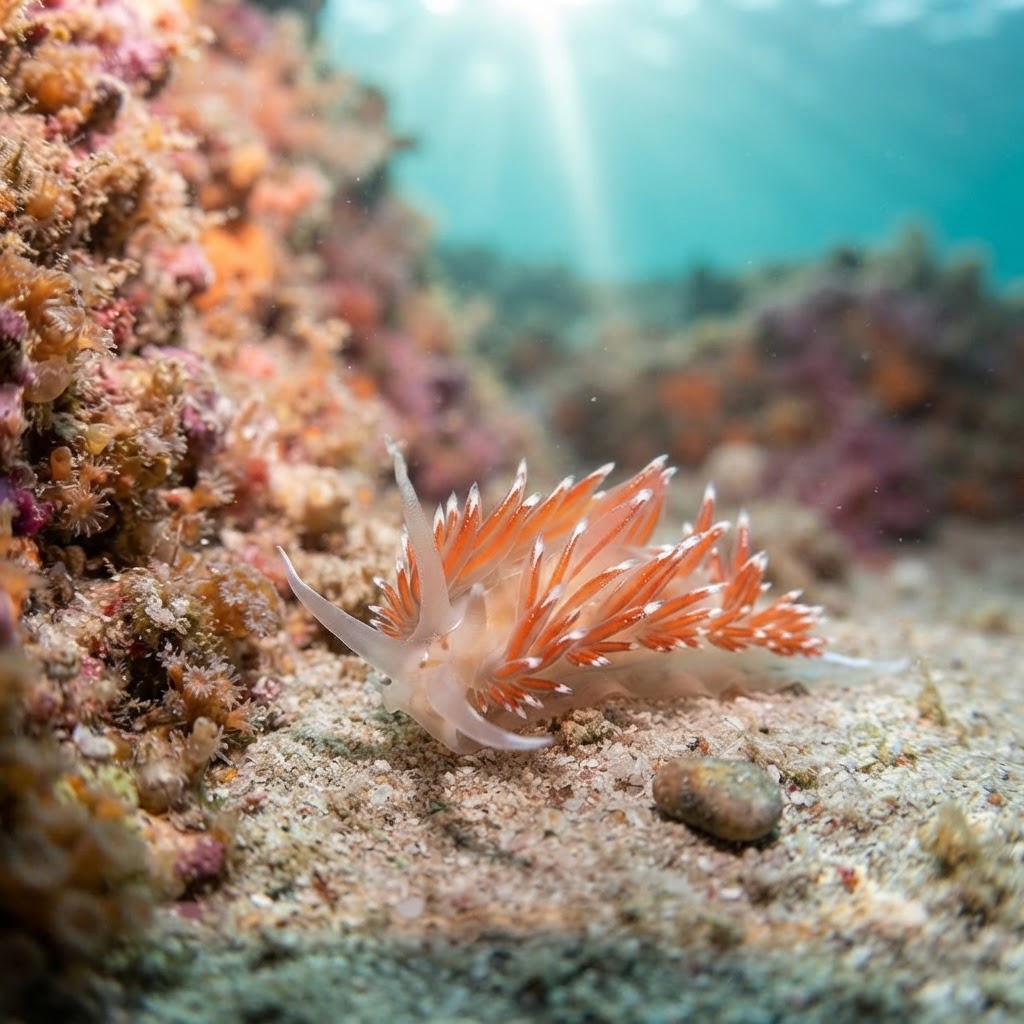
Slender, translucent-white body covered in slim, finger-like projections (cerata) that carry an orange to reddish tint toward their tips, giving it a bristly, almost furry look underwater. It stays small, usually just a couple of centimetres, and moves slowly across rock and kelp-holdfast habitat where the cerata catch the light. Two long, smooth tentacles (rhinophores) on the head stand upright and lack the fine branching seen on some lookalike nudibranchs.
Divers most often spot it grazing slowly over rock walls, kelp holdfasts, and hydroid-covered surfaces, which are its likely food source. It shows no reaction to divers and simply carries on feeding, making it an easy subject for close-up photos once you spot the pale, bristled body against darker rock. Most logs describe it as uncommon rather than common, so it rewards divers who take time to scan cold-water reef surfaces closely.
Like other members of its family, it likely feeds on hydroids and can store stinging cells from its prey in the tips of its cerata as a defence against predators.
Sightings show no clear seasonal pattern, so treat it as a year-round find wherever the water stays cold, roughly 8.6 to 14.6°C, which fits the North Sea and North Atlantic sites where it is most often logged.
This is a cold-water species with its strongest logged populations in the United Kingdom, particularly Northern Ireland and Scotland, alongside Norway's Østlandet region and Sweden's Bohuslän coast. It also turns up reliably in Ireland's Galway & Connemara area, with a smaller presence in Wales, Clare, and Brittany in France.
Mapping where Striped Fjordia is logged…
It is most reliably found in cold-water sites in the United Kingdom, especially Northern Ireland and Scotland, plus Norway's Østlandet region and Sweden's Bohuslän coast. Smaller numbers are logged in Ireland's Galway & Connemara and in Wales and Brittany.
There is no strong seasonal pattern in sightings, so it is logged year-round. It favours cold water between about 8.6 and 14.6°C, conditions found through much of the year at its North Atlantic and North Sea sites.
Look for a small, slender, translucent-white nudibranch with orange-tipped cerata covering its back and two smooth upright rhinophores on its head. It moves slowly over rock and kelp holdfasts rather than swimming.
It stays small, typically only a couple of centimetres long, which means divers usually need to look closely at rock and kelp surfaces to spot it.
No, it poses no threat to divers. It is a small, slow-moving nudibranch that simply grazes on hydroids and ignores anyone diving nearby.
It likely feeds on stinging hydroids and, like related species, may store the prey's stinging cells in the tips of its own cerata as a defence against predators.
Site and sighting data is aggregated from diver logs, iNaturalist and GBIF. For taxonomy and conservation status:
Light-spotted Aegires
3,168 sites