Coryphella gracilis
Cold-water nudibranch most often logged in Zeeland, Netherlands, in waters around 7 to 13C. Uncommon but findable year-round.
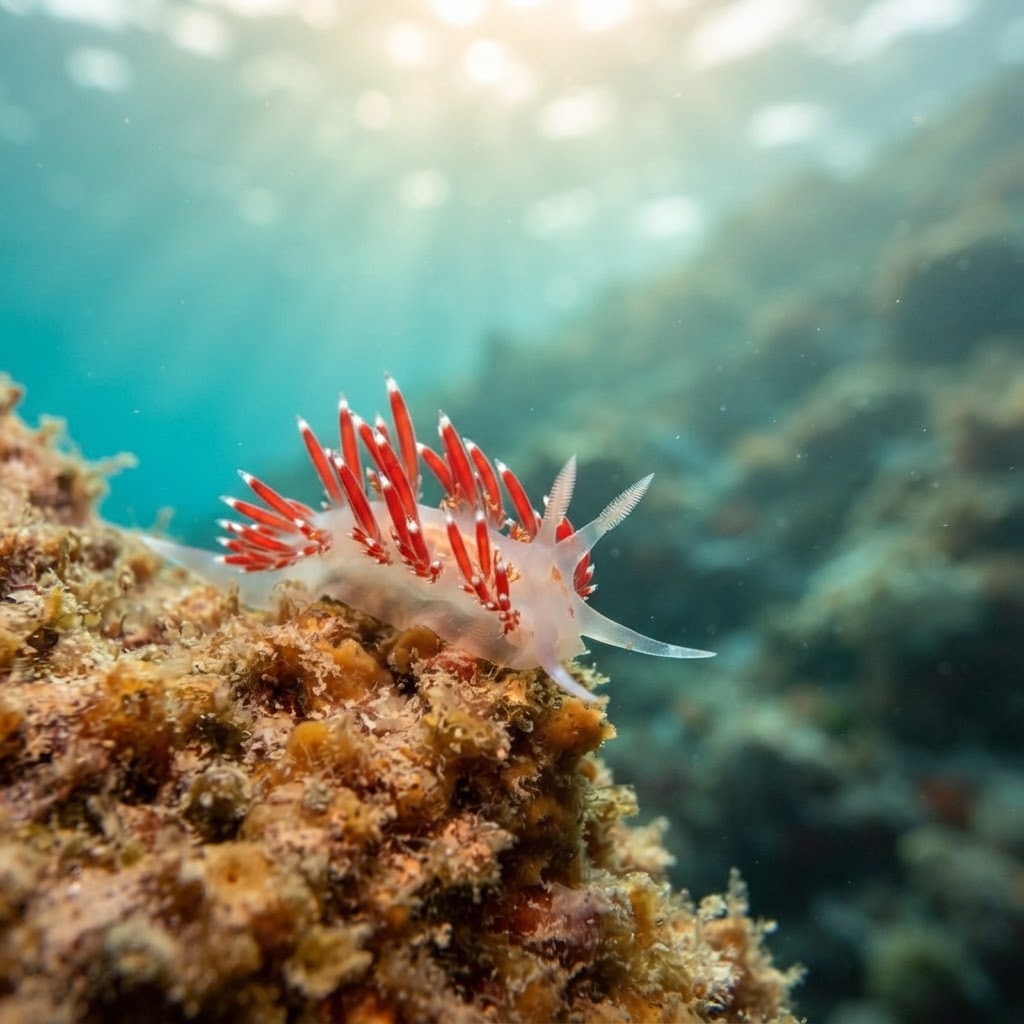
A slender-bodied nudibranch usually seen in shades of pink to orange, with tall clusters of finger-like projections called cerata (the fleshy respiratory and digestive extensions running down its back) tipped in a darker or contrasting colour. The body stays narrow and elongated compared to the bulkier dorid-type nudibranchs, and it moves slowly across hard substrate, kelp holdfasts, and rubble. Size is not well documented for this species, so scale it against surrounding hydroids or bryozoans, its likely food source, rather than assuming a fixed length.
Divers usually spot it moving slowly over rock, rubble, or kelp holdfasts while grazing on hydroids, the small colonial animals that make up much of its likely diet. It shows no reaction to divers beyond withdrawing its cerata slightly if bumped, and it is most often picked out by torch light on night dives or by patient macro hunters scanning encrusted surfaces in daylight. Most logs describe it as uncommon rather than common, so it takes a slow, close look at the right substrate rather than a lucky glance.
Like other members of its family, it likely feeds on hydroids and can incorporate stinging cells from its prey into its own cerata as a borrowed defence, a trick shared across many aeolid nudibranchs.
Sightings show no detectable seasonal pattern, so treat this as a year-round find at sites within its 7.4 to 13.4C comfort range. Cold Atlantic and North Sea waters stay within that band for much of the year, which likely explains the lack of a sharp season in the logs.
This is a cold-water species, most reliably logged in Zeeland in the Netherlands, with further strongholds in Østlandet in Norway and Northern Ireland in the UK. Smaller but consistent numbers turn up in Jutland, Denmark, and Bohuslän, Sweden, with occasional sightings further north in Nordland and in Wales and Scotland.
Mapping where Slender Eolis is logged…
It is most often logged in Zeeland in the Netherlands, with further sightings in Østlandet in Norway, Northern Ireland, Jutland in Denmark, and Bohuslän in Sweden. It is a cold-water North Atlantic and North Sea species rather than a tropical one.
Logs show no clear seasonal pattern, so it is best treated as a year-round sighting at sites within its usual 7.4 to 13.4C temperature range.
Look for a slender pink to orange nudibranch with tall clusters of cerata along its back, moving slowly over rock, rubble, or kelp holdfasts. Its narrow body shape sets it apart from bulkier dorid nudibranchs on the same reef.
Exact size data is not well documented for this species. Divers should judge scale against nearby hydroids or bryozoans rather than expecting a specific length.
No. It poses no threat to divers and can be observed safely at close range without disturbing it.
It most likely grazes on hydroids, small colonial animals encrusting rock and kelp holdfasts, and may store their stinging cells in its own cerata for defence, a common trait among related aeolid nudibranchs.
Site and sighting data is aggregated from diver logs, iNaturalist and GBIF. For taxonomy and conservation status:
Light-spotted Aegires
3,168 sites