Coryphella chriskaugei
A rare cold-water find best hunted in Østlandet, Norway, in waters around 8-14C. Here's where divers actually log it.
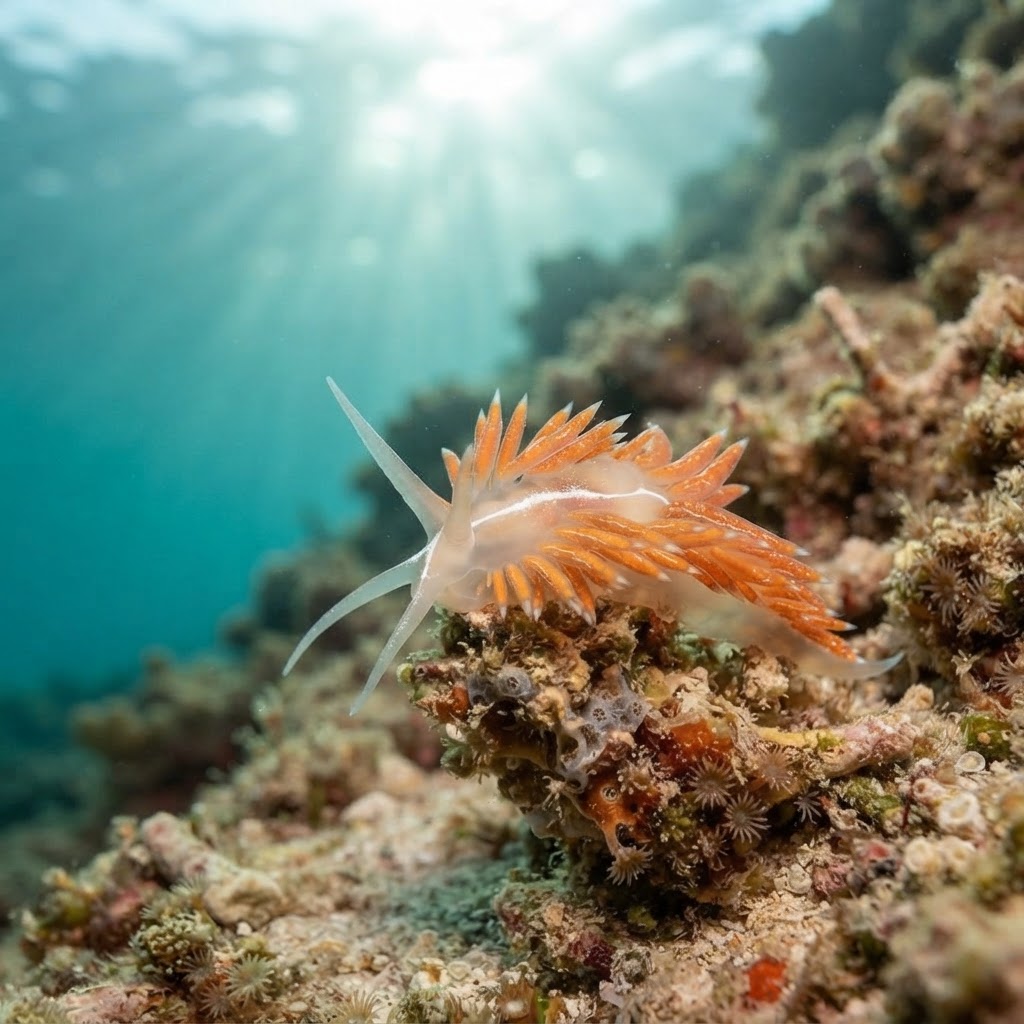
Small, slender-bodied sea slug with rows of finger-like projections (cerata) covering its back, typically showing translucent white to pale flesh tones tipped in orange or red. The cerata carry the digestive gland colour visible through the skin, giving a soft banded look rather than a solid colour block. Look closely at rock and boulder surfaces in cold water rather than expecting it to stand out from a distance, since it stays small and easy to miss.
Divers find it slow-moving and stationary on rock and boulder surfaces, grazing rather than swimming off when approached. It shows no reaction to divers beyond continuing to feed, so a slow scan of cold-water reef walls with a torch is the best way to spot one. Most logs describe it as rare to uncommon at any given site, so finding it usually takes a patient, close-focus search rather than a lucky swim-by.
Like other Coryphella species, it likely feeds on hydroids and stores stinging cells from its prey in those orange-tipped cerata as a defence, though this hasn't been specifically confirmed for this species.
Sightings don't show a clear seasonal pattern, so treat it as a year-round possibility on any dive within its 7.8 to 13.8C comfort range. Norwegian fjord diving stays cold enough for this species across most of the year, which likely explains the lack of a sharp season in the logs.
Most reliably logged in Norway, especially around Østlandet and in smaller numbers in Nordland, making it the strongest bet for a sighting. Outside Norway it turns up occasionally in Clare (Ireland), Brittany (France), and Northern Ireland (UK), so it's worth a careful look on any cold Atlantic rock reef in those areas too.
Mapping where Chris Kauge's Coryphella is logged…
Norway is the strongest area, particularly Østlandet and Nordland, with additional sightings logged in Clare (Ireland), Brittany (France), and Northern Ireland. It's a species for cold-water Atlantic reef diving rather than tropical sites.
There's no detected seasonal pattern, so it's logged year-round. Its comfort range of roughly 7.8 to 13.8C matches Norwegian fjord conditions for much of the year, which may be why sightings don't cluster in one season.
Look for a small, slender nudibranch covered in slim cerata along its back, pale bodied with orange or reddish tips on those projections. It sits still on rock surfaces in cold water, so a slow close-up search works better than scanning for movement.
Exact size data isn't available for this species, but like other members of its genus it stays small, likely under a couple of centimetres, and is easy to overlook on a reef wall.
No. It poses no threat to divers and can be observed and photographed safely without any special precautions.
Like related Coryphella species, it most likely grazes on hydroids and may recycle their stinging cells into its own cerata as a defence against predators, a trick common across this nudibranch group.
Site and sighting data is aggregated from diver logs, iNaturalist and GBIF. For taxonomy and conservation status:
Light-spotted Aegires
3,168 sites